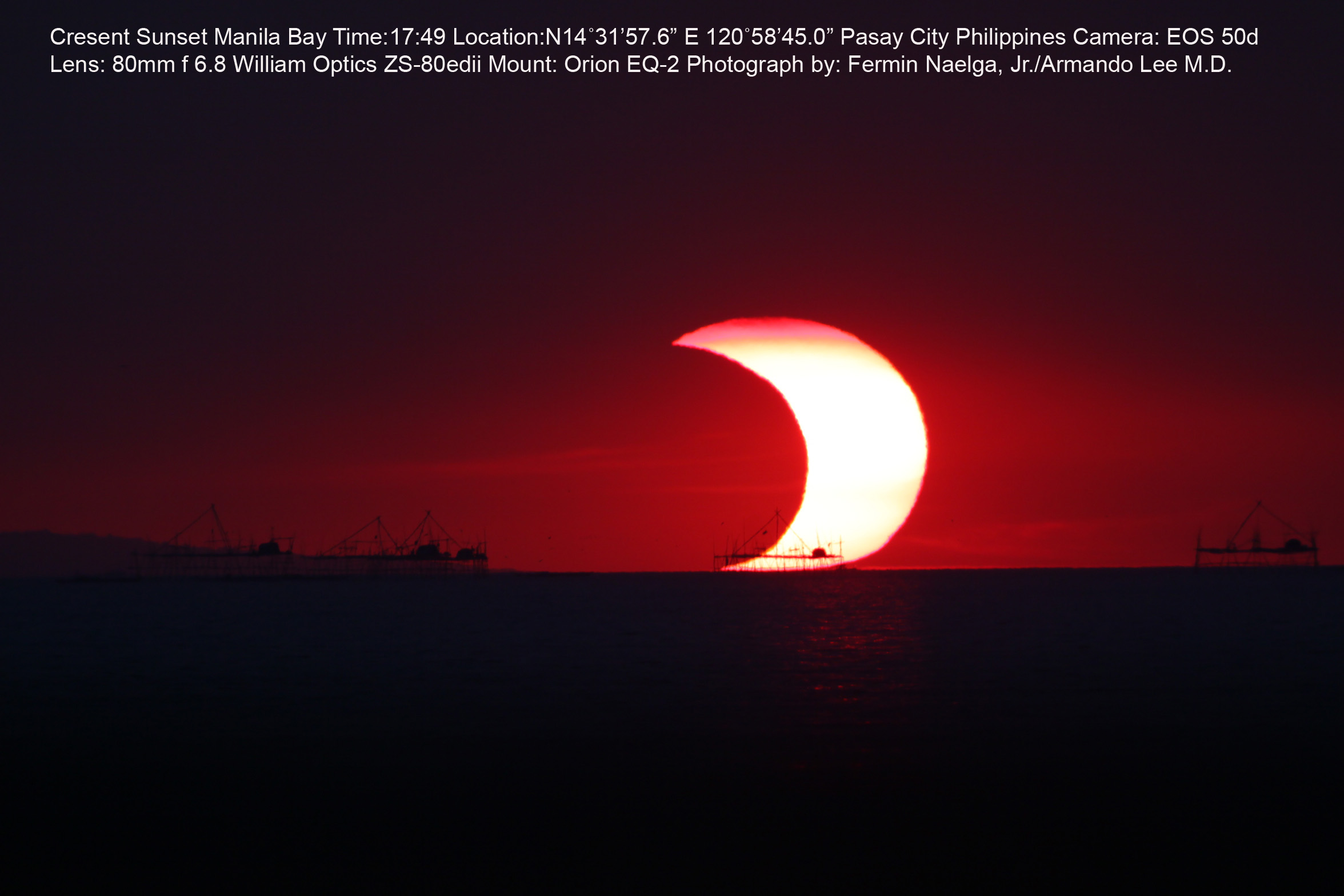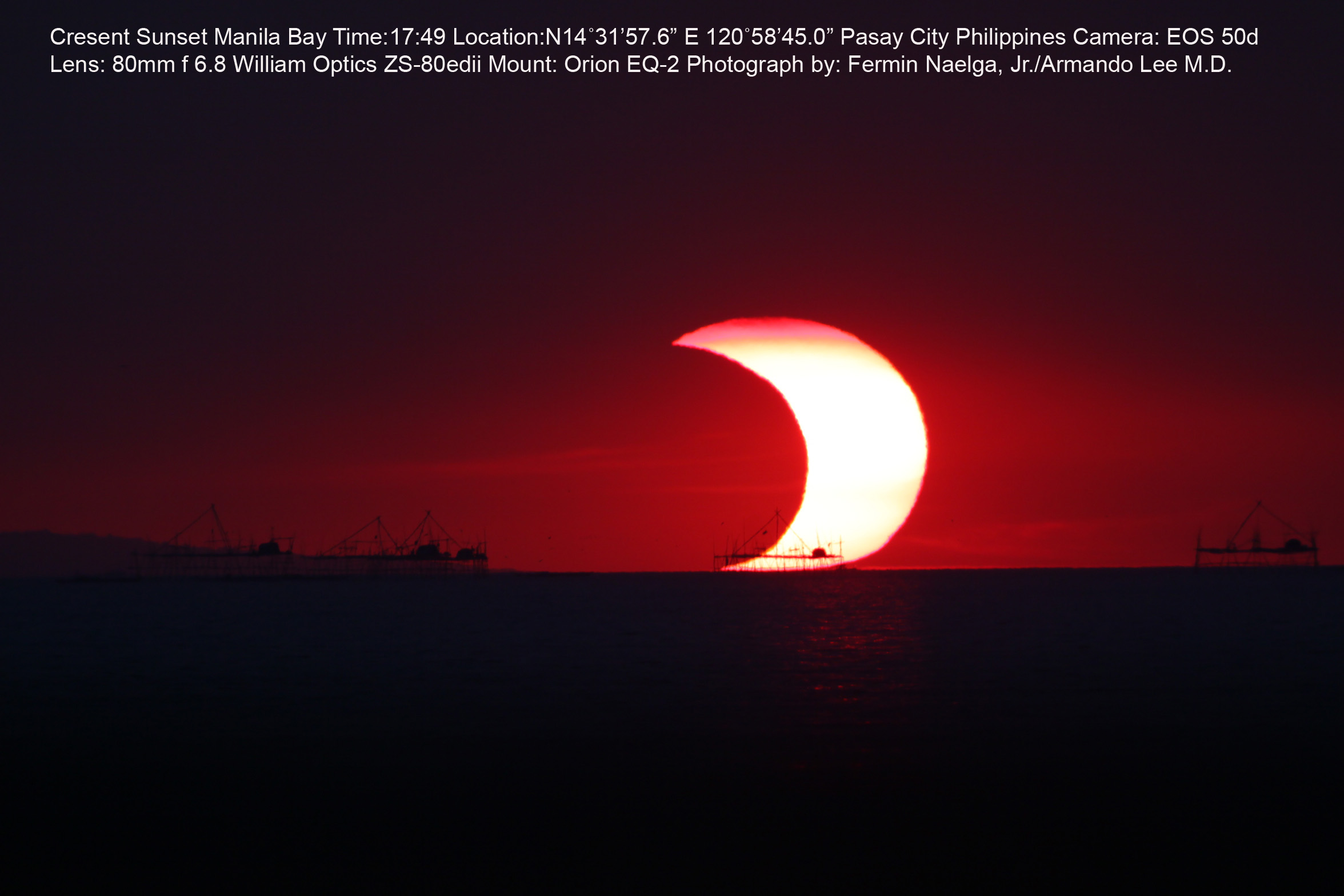
What's happened to the setting Sun? An eclipse! In early 2009, the Moon eclipsed part of the Sun as visible from parts of Africa, Australia, and Asia. In particular the above image, taken from the Mall of Asia seawall, caught a partially eclipsed Sun setting over Manila Bay in the Philippines. Piers are visible in silhouette in the foreground. Eclipse chasers and well placed sky enthusiasts captured many other interesting and artistic images of the year's only annular solar eclipse, including movies, eclipse shadow arrays, and rings of fire. Today parts of the Sun again will become briefly blocked by the Moon, again visible to some as a partial eclipse of a setting Sun. A small swath of Earth, however, will be exposed to the unusual ring of fire effect when the Moon is completely surrounded by the glowing light of the slightly larger Sun. APOD Collection: Images of Past Partial Solar Eclipses Gallery: Images of Today's Eclipse
¿Qué le ha sucedido al Sol que se pone? ¡Un eclipse! En principios de 2009, la Luna eclipsó parte del Sol, visible desde partes de África, Australia y Asia. En particular, la imagen mostrada fue tomada desde el muro costero del Mall of Asia y muestra un Sol parcialmente eclipsado poniéndose sobre la Bahía de Manila en Filipinas. En primer plano se ven puentes en silueta. Los entusiastas de los eclipses y los observadores del cielo bien ubicados capturaron muchas otras imágenes interesantes y artísticas del único eclipse solar anular del año, incluyendo películas, patrones de sombra de eclipse y anillos de fuego. Hoy nuevamente parte del Sol será brevemente bloqueada por la Luna, visible nuevamente para algunos como un eclipse parcial de un Sol que se pone. Sin embargo, una pequeña franja de la Tierra será expuesta al inusual efecto del anillo de fuego cuando la Luna esté completamente rodeada por la luz brillante del Sol ligeramente más grande.