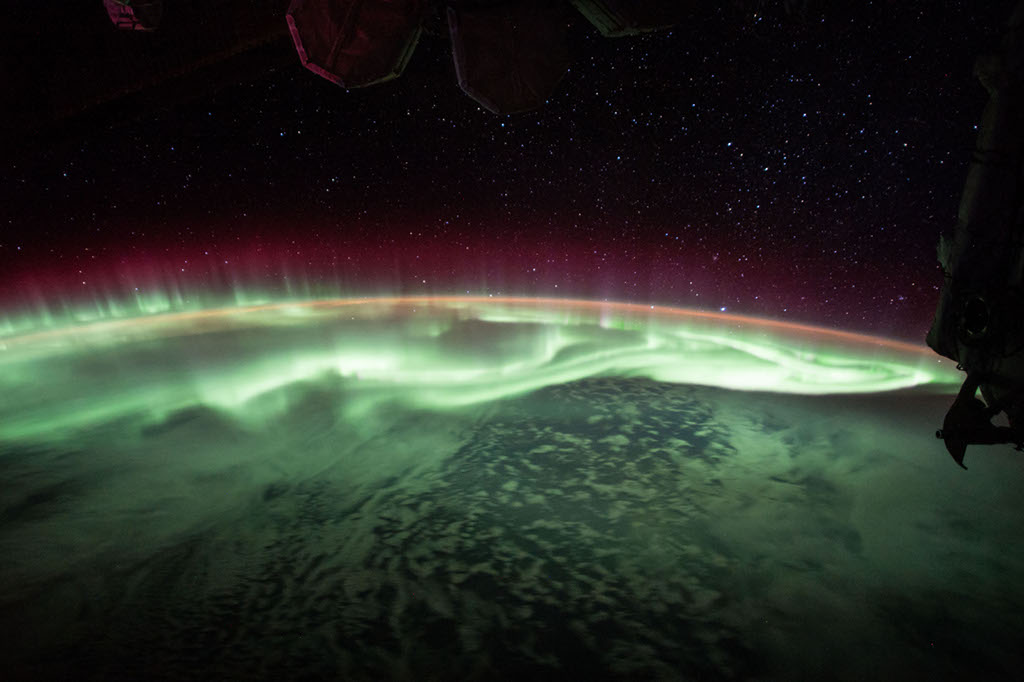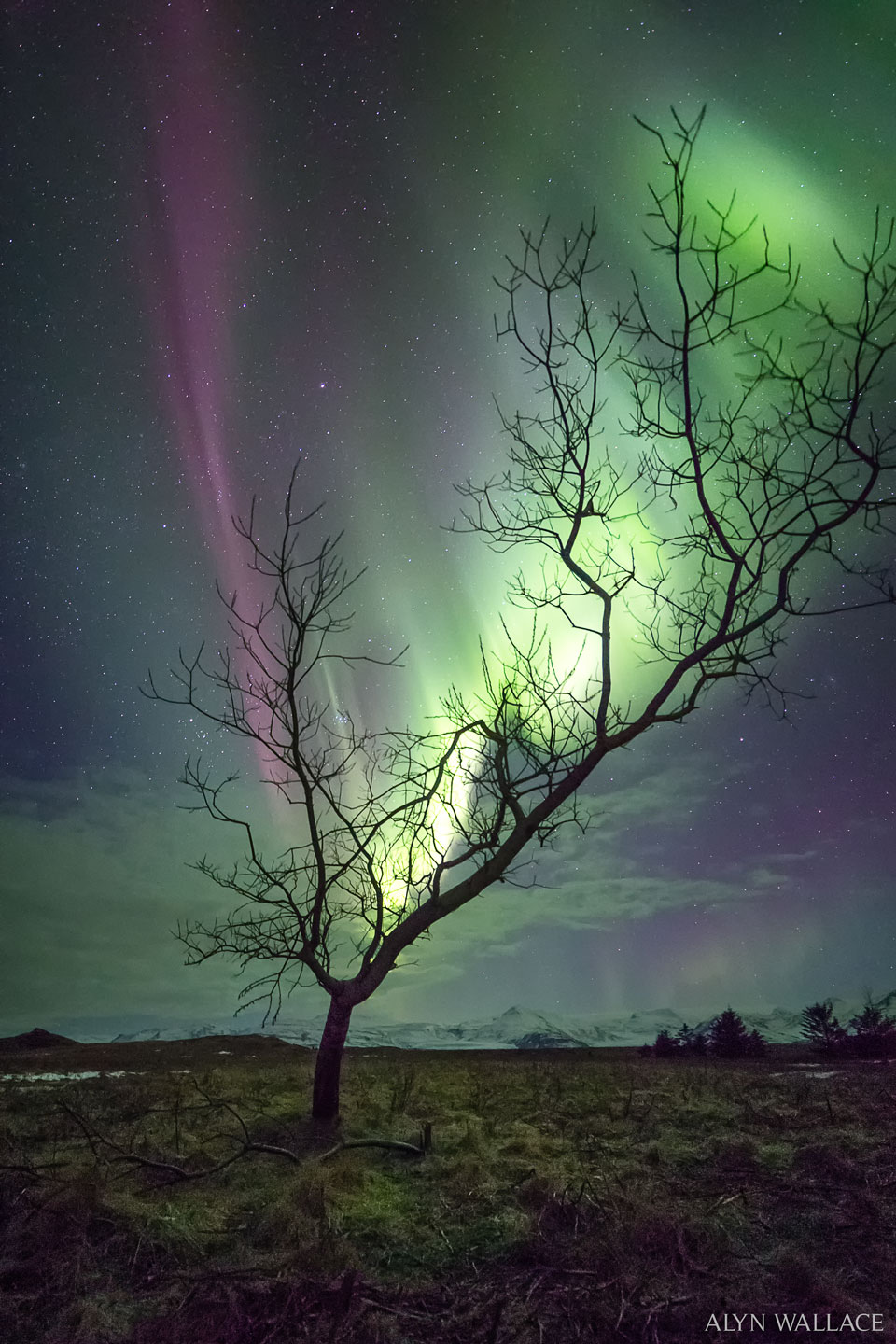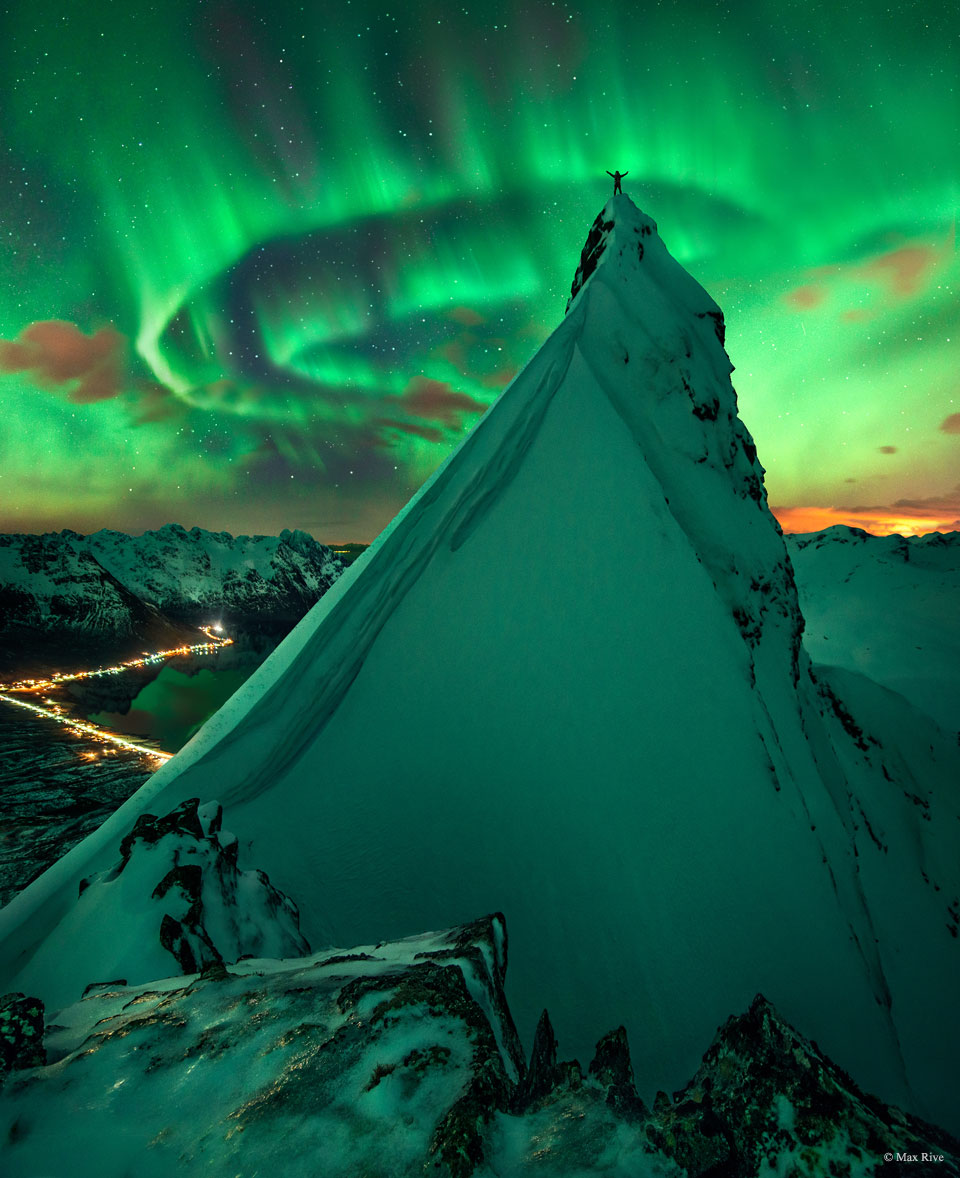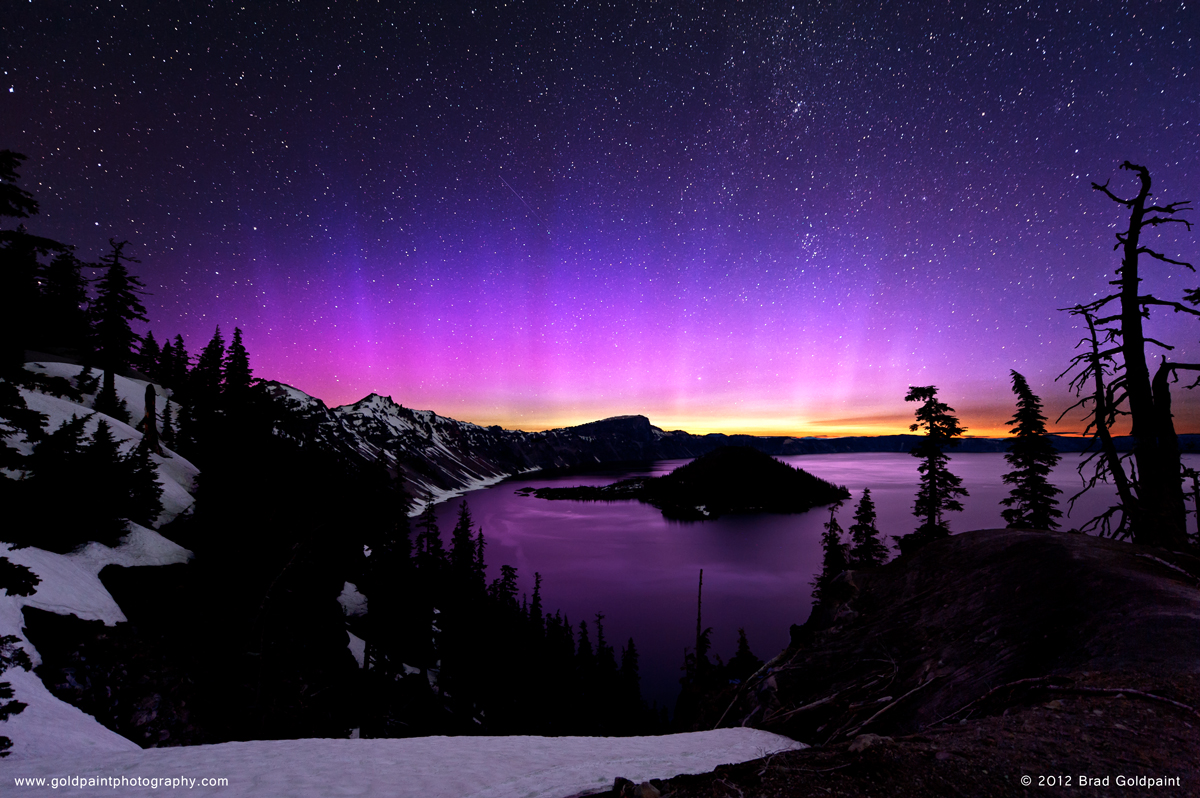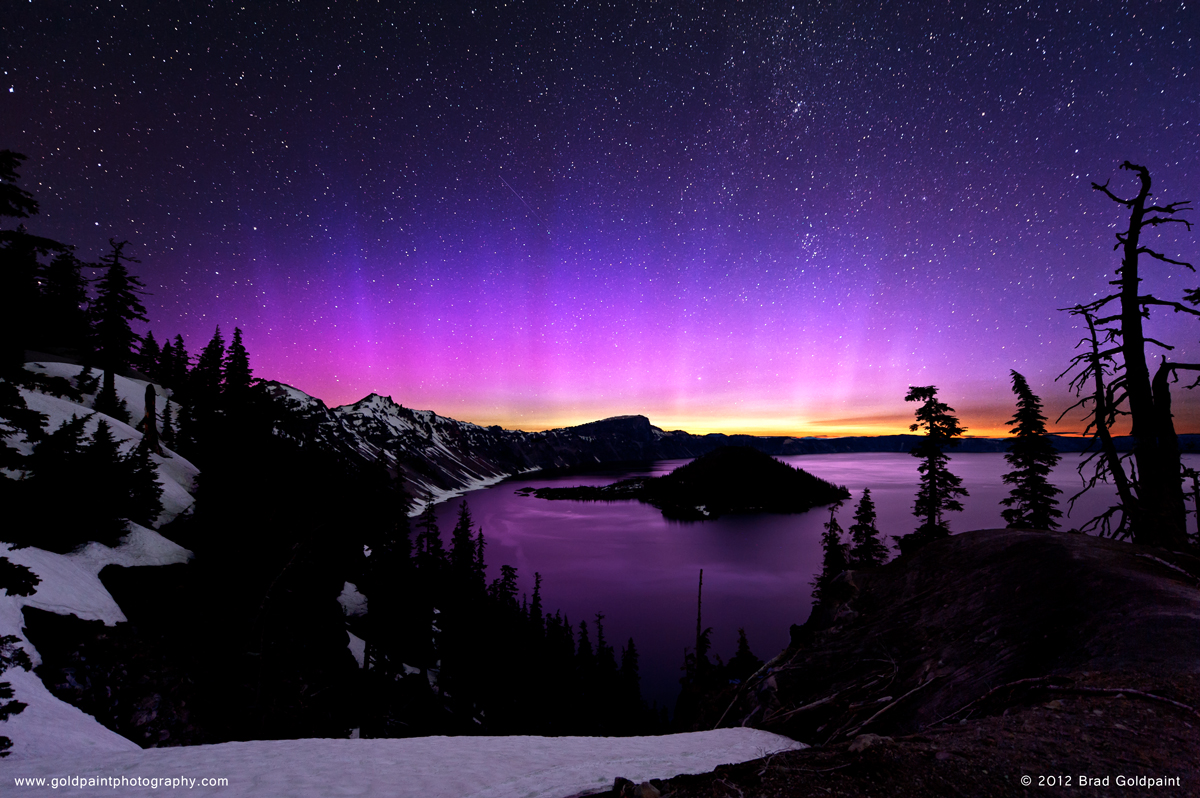
Why is this aurora strikingly pink? When photographing picturesque Crater Lake in Oregon, USA last month, the background sky lit up with auroras of unusual colors. Although much is known about the physical mechanisms that create auroras, accurately predicting the occurrence and colors of auroras remains a topic of investigation. Typically, it is known, the lowest auroras appear green. These occur at about 100 kilometers high and involve atmospheric oxygen atoms excited by fast moving plasma from space. The next highest auroras -- at about 200 kilometers up -- appear red, and are also emitted by resettling atmospheric oxygen. Some of the highest auroras visible -- as high as 500 kilometers up -- appear blue, and are caused by sunlight-scattering nitrogen ions. When looking from the ground through different layers of distant auroras, their colors can combine to produce unique and spectacular hues, in this case rare pink hues seen above. As Solar Maximum nears over the next two years, particle explosions from the Sun are sure to continue and likely to create even more memorable nighttime displays. Students: Browse a free online astronomy course.
¿Por qué esta aurora tiene un color rosa tan llamativo? Al fotografiar el pintoresco Lago Crater en Oregon, EE. UU., el mes pasado, el cielo de fondo se iluminó con auroras de colores inusuales. Aunque se conoce mucho sobre los mecanismos físicos que crean las auroras, predecir con precisión su ocurrencia y colores sigue siendo un tema de investigación. En general, se sabe que las auroras más bajas aparecen verdes. Estas ocurren a unos 100 kilómetros de altura y involucran átomos de oxígeno atmosférico excitados por plasma en movimiento rápido proveniente del espacio. Las auroras siguientes, a unos 200 kilómetros de altura, aparecen rojas y también son emitidas por oxígeno atmosférico que se estabiliza. Algunas de las auroras más altas visibles, hasta 500 kilómetros de altura, aparecen azules y son causadas por iones de nitrógeno que dispersan la luz solar. Al observar desde el suelo a través de diferentes capas de auroras distantes, sus colores pueden combinarse para producir tonos únicos y espectaculares, en este caso tonos rosas raros vistos arriba. A medida que se acerca el Máximo Solar en los próximos dos años, las explosiones de partículas del Sol seguramente continuarán y probablemente crearán incluso más despliegues memorables durante la noche.