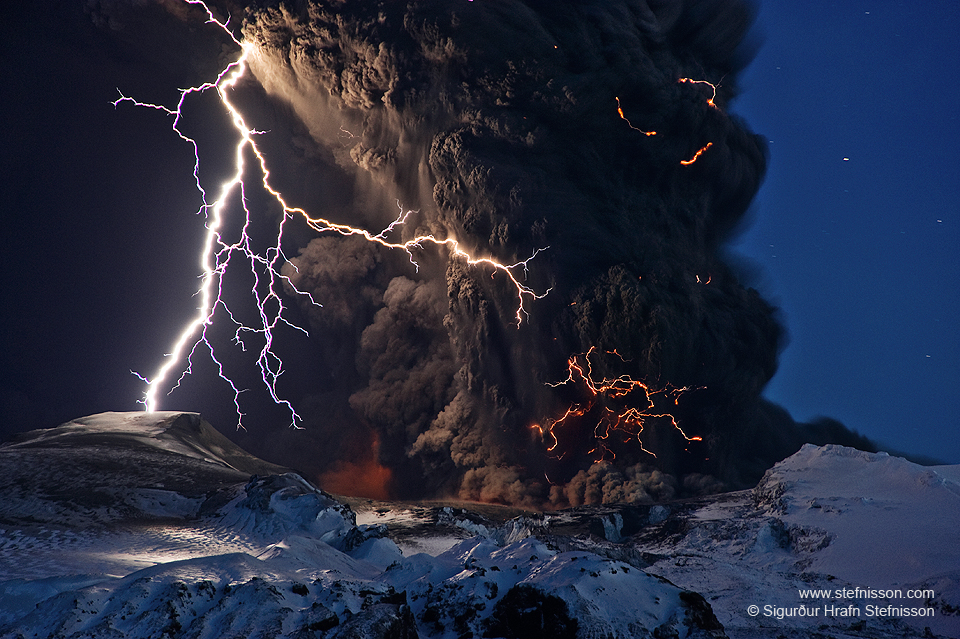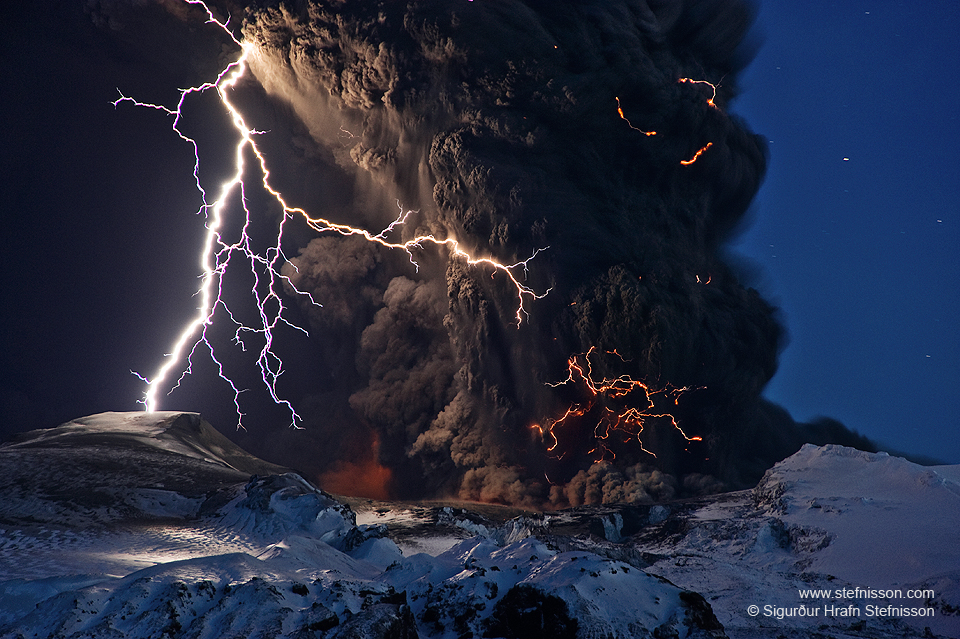
Why did the picturesque 2010 volcanic eruption in Iceland create so much ash? Although the large ash plume was not unparalleled in its abundance, its location was particularly noticeable because it drifted across such well-populated areas. The Eyjafjallaj�kull volcano in southern Iceland began erupting on 2010 March 20, with a second eruption starting under the center of a small glacier on 2010 April 14. Neither eruption was unusually powerful. The second eruption, however, melted a large amount of glacial ice which then cooled and fragmented lava into gritty glass particles that were carried up with the rising volcanic plume. Pictured above during the second eruption, lightning bolts illuminate ash pouring out of the Eyjafjallaj�kull volcano.
¿Por qué la erupción volcánica pintoresca de 2010 en Islandia generó tanta ceniza? Aunque la gran nube de ceniza no fue sin precedentes en cuanto a su abundancia, su ubicación fue particularmente llamativa porque se extendió sobre áreas muy pobladas. El volcán Eyjafjallajökull en el sur de Islandia comenzó a erupcionar el 20 de marzo de 2010, con una segunda erupción que comenzó bajo el centro de un pequeño glaciar el 14 de abril de 2010. Ninguna de las erupciones fue inusualmente poderosa. Sin embargo, la segunda erupción fundió una gran cantidad de hielo glaciar, el cual luego enfrió y fragmentó la lava en partículas de vidrio áspero que fueron transportadas hacia arriba con la columna volcánica ascendente. En la imagen, durante la segunda erupción, los relámpagos iluminan la ceniza que sale del volcán Eyjafjallajökull.