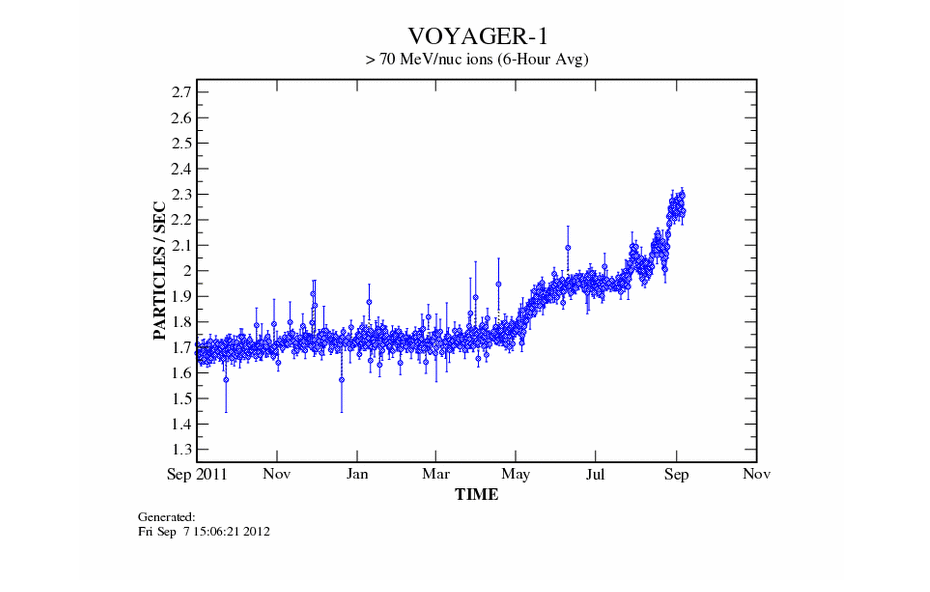
Launched on a grand tour of the outer planets in 1977, by good fortune the twin Voyager spacecraft were also headed in the general direction of the Sun's motion relative to nearby stars. Thirty five years later, Voyager 1 appears to be nearing the boundary of the Sun's heliosphere and interstellar space. Of course the heliosphere is the realm of the Sun defined by the influence of the solar wind and the Sun's magnetic field. But how can you tell when your spacecraft crosses the boundary into interstellar space? One clue would be a sudden increase in the detection of energetic cosmic rays. The high energy particles stream through interstellar space accelerated by distant supernovae in our galaxy, but are normally deflected or slowed by the heliosphere. Covering a 12 month period (September 2011 to 2012), this plot does show a dramatic increase in the rate of cosmic ray particle detection in past months by the Voyager 1 spacecraft. Voyager 1 is now 18 billion kilometers (17 light hours, 122 Astronomical Units) from the Sun and may soon be the first spacecraft from Earth to enter the realm of the stars.
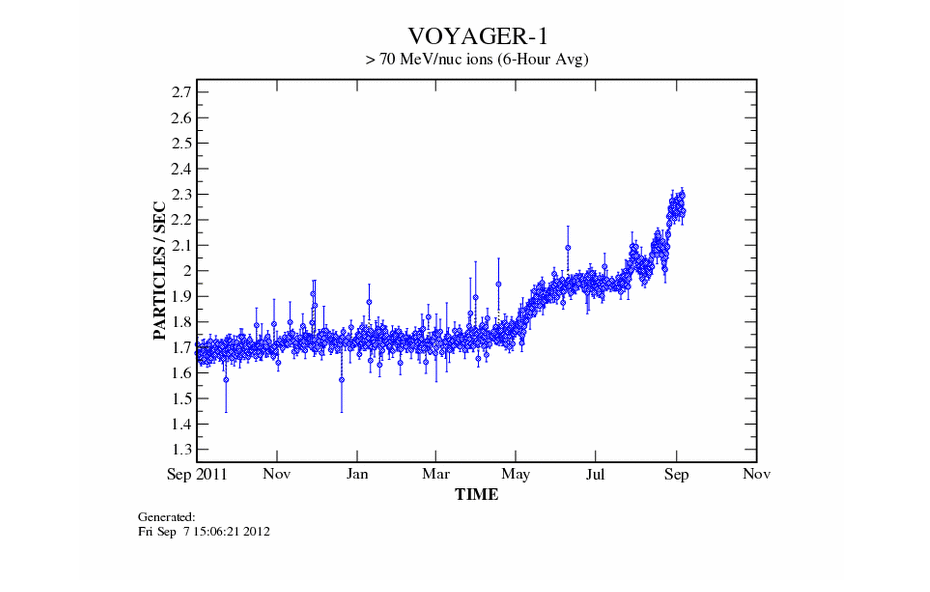
Lanzado en un viaje por los planetas exteriores en 1977, por buena fortuna, las dos naves gemelas Voyager también estaban orientadas en la dirección general del movimiento del Sol respecto a las estrellas cercanas. Treinta y cinco años después, Voyager 1 parece estar acercándose al límite del heliosfera del Sol y al espacio interestelar. Por supuesto, el heliosfera es la región definida por la influencia del viento solar y el campo magnético del Sol. Pero, ¿cómo puedes saber cuándo tu nave espacial cruza la frontera hacia el espacio interestelar? Una pista sería un aumento repentino en la detección de rayos cósmicos energéticos. Estas partículas de alta energía fluyen a través del espacio interestelar, aceleradas por supernovas distantes en nuestra galaxia, pero normalmente son desviadas o ralentizadas por el heliosfera. Este gráfico, que abarca un período de 12 meses (de septiembre de 2011 a 2012), muestra efectivamente un aumento dramático en la tasa de detección de partículas de rayos cósmicos en los últimos meses por parte de la nave Voyager 1. Voyager 1 se encuentra ahora a 18 mil millones de kilómetros (17 horas-luz, 122 Unidades Astronómicas) del Sol y podría convertirse pronto en la primera nave espacial de la Tierra en entrar en el reino de las estrellas.