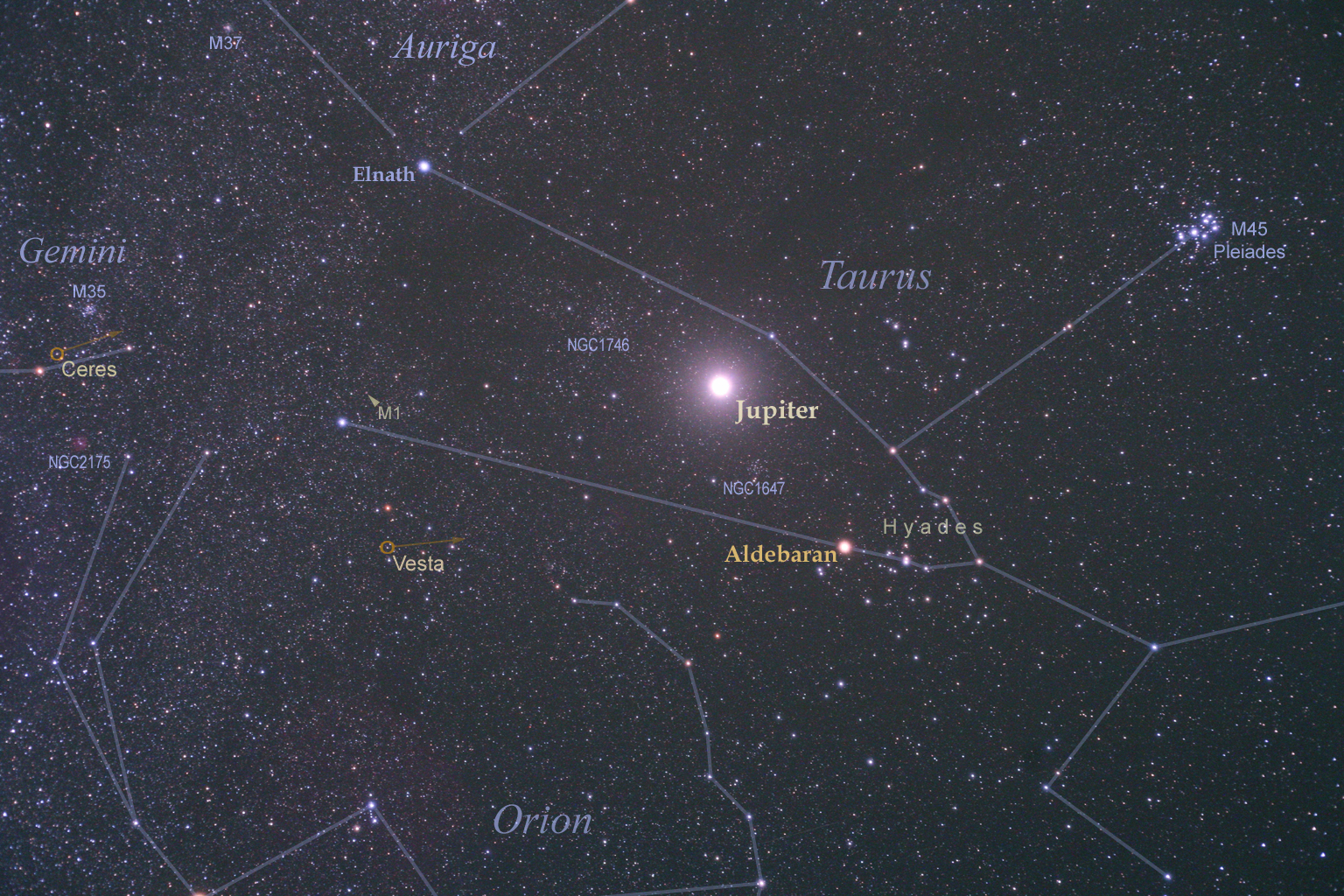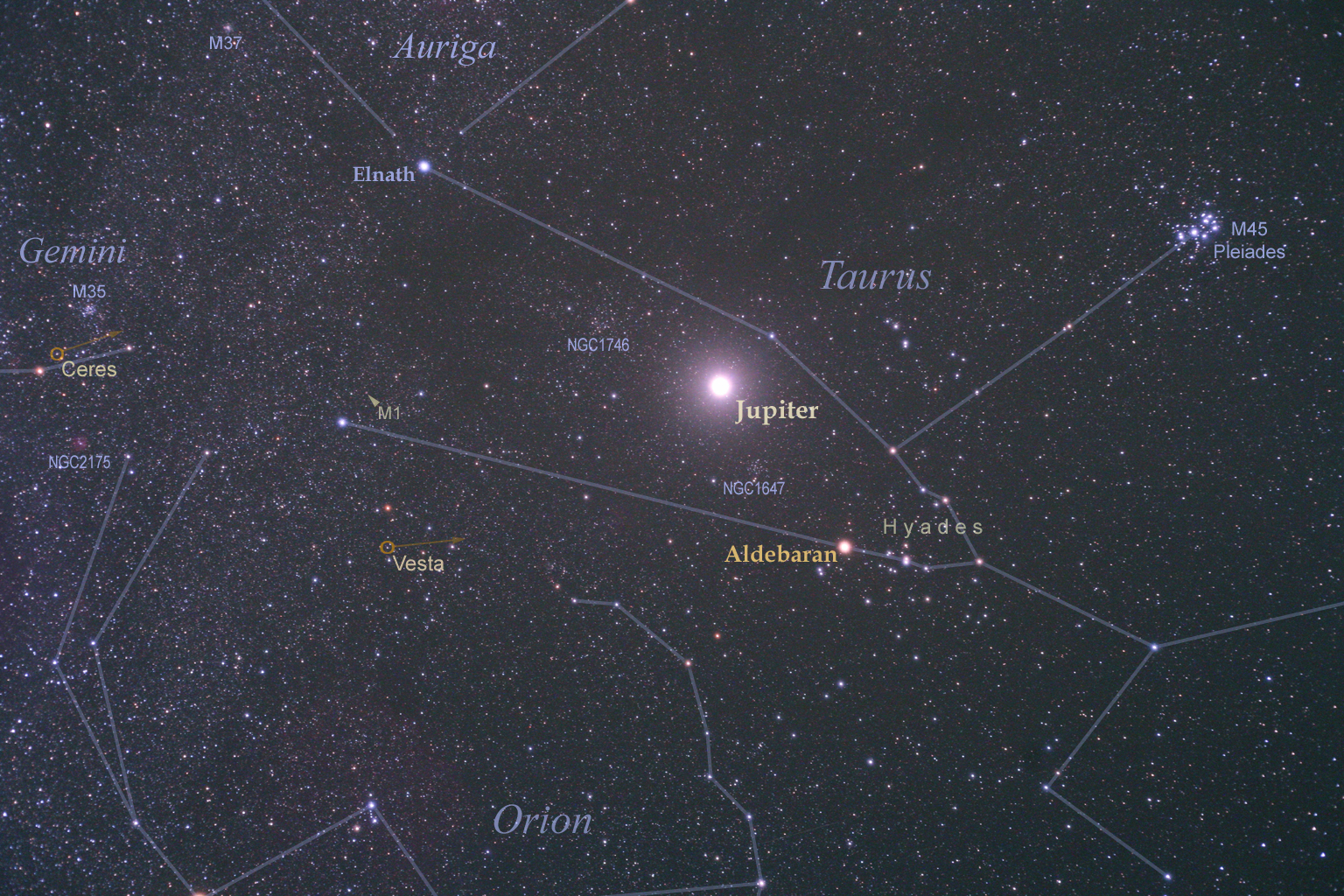
That bright star you've recently noticed rising just after sunset isn't a star at all. It's Jupiter, the solar system's ruling gas giant. Bright Jupiter is nearing its December 3rd opposition when it will stand in Taurus, opposite the Sun in planet Earth's sky. Clearly outshining yellowish Aldebaran, alpha star of Taurus, Jupiter is centered in this skyview from November 14th, also featuring the Pleiades and Hyades star clusters, familiar celestial sights as the northern hemisphere winter approaches. Sliding your cursor over the image will label the scene and identify two other solar system worlds approaching their opposition in December. Small and faint, asteroid Vesta and dwarf planet Ceres are about 10 degrees from Jupiter, near the left edge of the frame. Of course, you can imagine NASA's Dawn spacecraft in this field of view. Having left Vesta in September, Dawn's ion engine is now steadily driving it to match orbits with Ceres, scheduled to arrive there in February 2015.
Esa estrella brillante que has notado recientemente apareciendo poco después de la puesta de sol no es una estrella en absoluto. Es Júpiter, el gigante gaseoso que domina el sistema solar. Júpiter brillante se acerca a su oposición del 3 de diciembre, cuando se encontrará en Tauro, opuesto al Sol en el cielo terrestre. Claramente superando en brillo a Aldebarán, la estrella alfa de Tauro, Júpiter está centrado en esta vista del cielo del 14 de noviembre, que también incluye los cúmulos estelares de las Pléyades y las Híades, vistas celestes familiares a medida que se acerca el invierno en el hemisferio norte. Al deslizar el cursor sobre la imagen se etiquetará la escena e identificará otros dos mundos del sistema solar que se acercan a su oposición en diciembre. Pequeños y tenues, el asteroide Vesta y el planeta enano Ceres se encuentran a unos 10 grados de Júpiter, cerca del borde izquierdo del marco. Por supuesto, puedes imaginar la nave espacial Dawn de la NASA en este campo de visión. Tras dejar Vesta en septiembre, el motor iónico de Dawn ahora impulsa con firmeza su acercamiento a la órbita de Ceres, con llegada prevista allí en febrero de 2015.