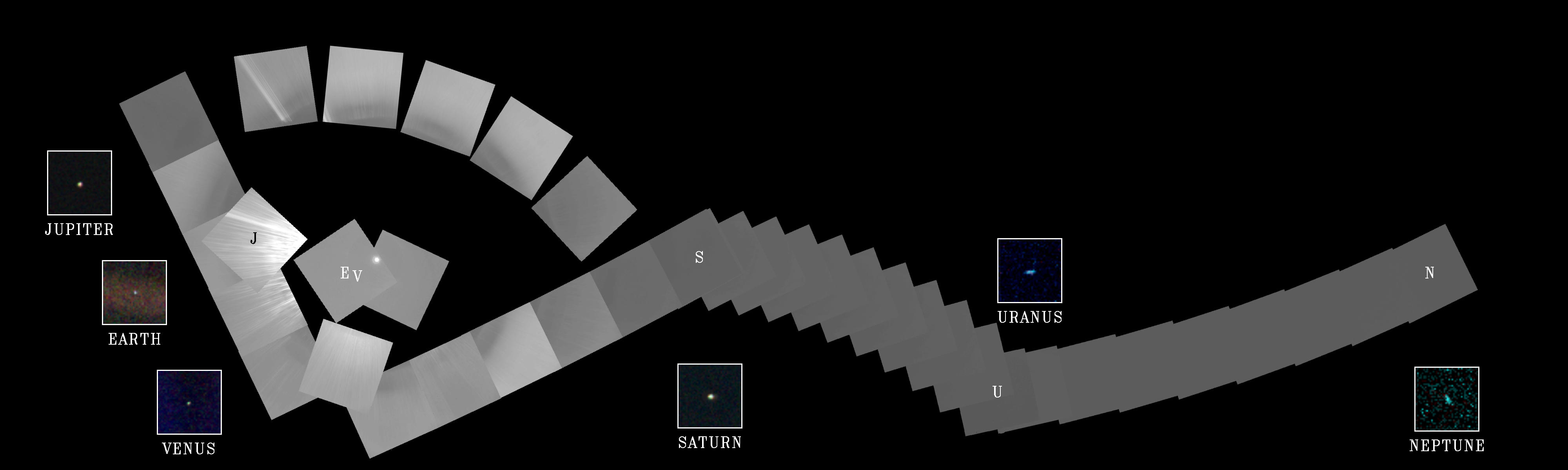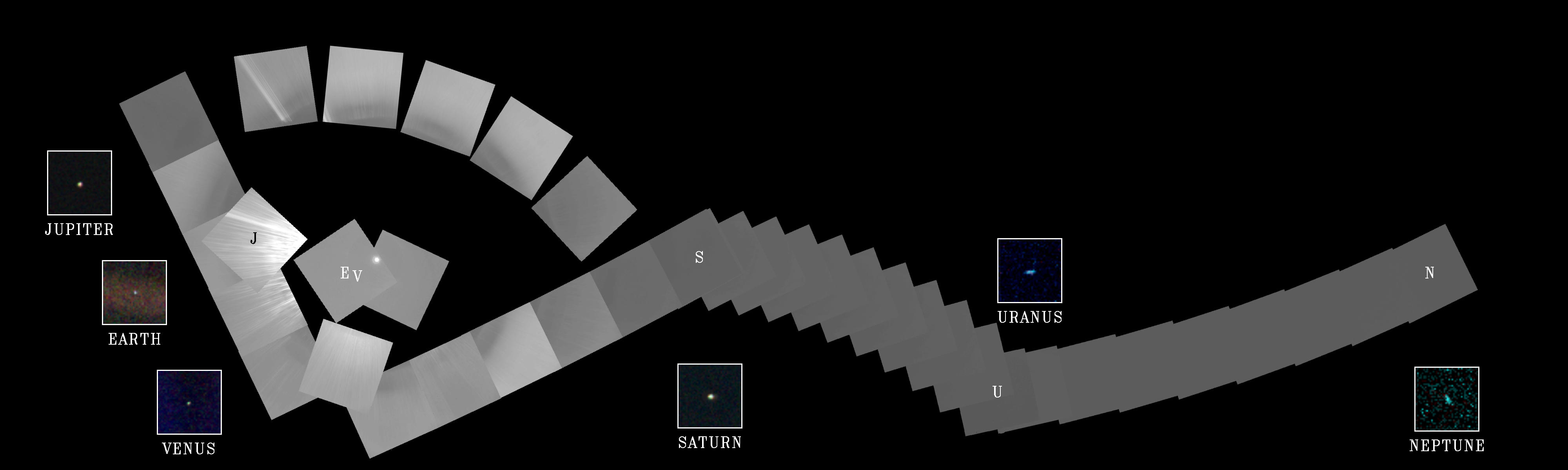
On another Valentine's Day (February 14, 1990), cruising four billion miles from the Sun, the Voyager 1 spacecraft looked back to make this first ever family portrait of our Solar System. The complete portrait is a 60 frame mosaic made from a vantage point 32 degrees above the ecliptic plane. In it, Voyager's wide angle camera frames sweep through the inner Solar System at the left, linking up with gas giant Neptune, at the time the Solar System's outermost planet, at the far right. Positions for Venus, Earth, Jupiter, Saturn, Uranus, and Neptune are indicated by letters, while the Sun is the bright spot near the center of the circle of frames. The inset frames for each of the planets are from Voyager's narrow field camera. Unseen in the portrait are Mercury, too close to the Sun to be detected, and Mars, unfortunately hidden by sunlight scattered in the camera's optical system. Small, faint Pluto's position was not covered. APOD Public Talk: Feb. 21, Howard Astronomical League, Columbia, MD
Crédito: NASA, Voyager Project El 14 de febrero de 1990, en otro Día de San Valentín, la nave espacial Voyager 1, a cuatro mil millones de millas del Sol, miró hacia atrás para crear este primer retrato familiar jamás realizado del Sistema Solar. El retrato completo es un mosaico de 60 imágenes tomadas desde una posición situada 32 grados por encima del plano ecuatorial. En él, la cámara de ángulo amplio de Voyager recorre el Sistema Solar interno en el lado izquierdo, conectándose con el planeta gigante gaseoso Neptuno, en ese momento el planeta más externo del Sistema Solar, en el extremo derecho. Las posiciones de Venus, Tierra, Júpiter, Saturno, Urano y Neptuno están indicadas con letras, mientras que el Sol es el punto brillante cerca del centro del círculo de imágenes. Las imágenes insertadas de cada planeta provienen de la cámara de campo estrecho de Voyager. En este retrato no se ven Mercurio, demasiado cercano al Sol para ser detectado, y Marte, desafortunadamente oculto por la luz solar dispersada en el sistema óptico de la cámara. La posición de Plutón, pequeño y tenue, no fue incluida.