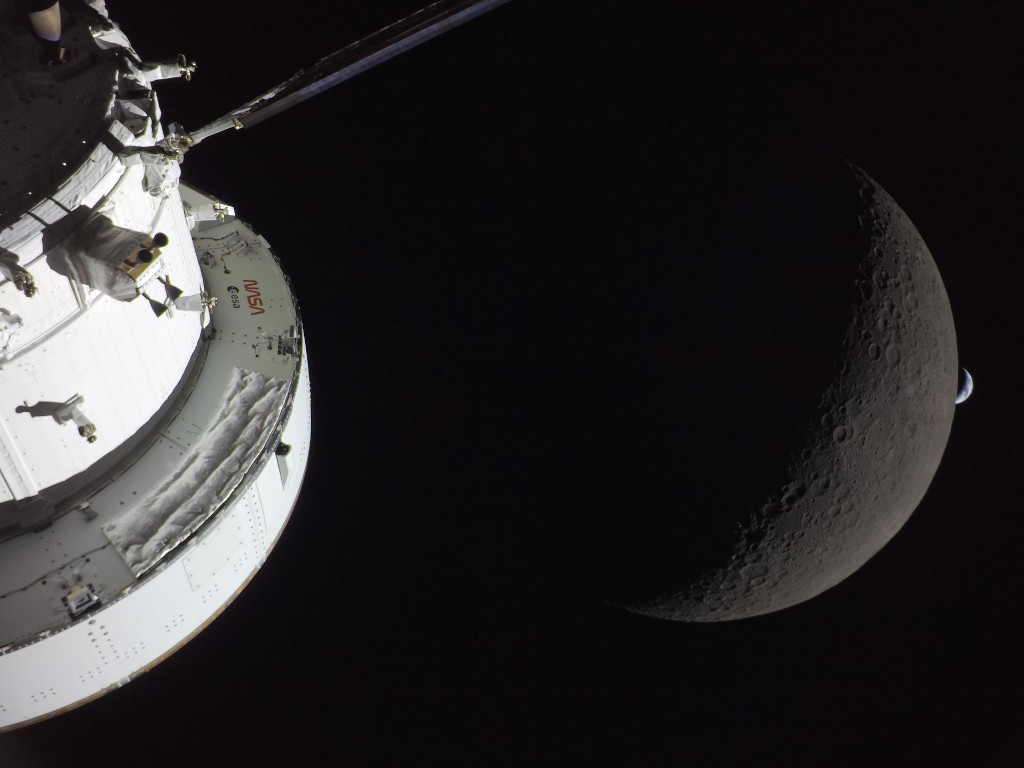
Why doesn't Artemis II land on the Moon? The main reason is that Artemis II is primarily a test mission designed to make a future Artemis missions -- which will land humans on the Moon -- better prepared. Similarly, NASA's Apollo 8 and Apollo 10 went right near the Moon as tests before Apollo 11 -- which landed. As the trajectory in the featured animated video shows, Artemis II will loop around both the Earth and the Moon before returning to the Earth about 10 days after launch. The Artemis II mission will take humans outside the Earth's magnetosphere for the first time since the Apollo missions 50 years ago. In the video, particles from the solar wind are shown as streaks, while the Earth's reacting magnetosphere is shown in flickering green. The Earth's magnetosphere is important in deflecting powerful particles arriving from the Sun as well as creating picturesque auroras visible from the Earth's surface. Explore the Universe: Random APOD Generator
¿Por qué Artemis II no aterriza en la Luna? La razón principal es que Artemis II es fundamentalmente una misión de prueba diseñada para que futuras misiones Artemis —que sí llevarán humanos a la Luna— estén mejor preparadas. De manera similar, las misiones Apolo 8 y Apolo 10 de la NASA sobrevolaron las proximidades de la Luna como ensayos previos al Apolo 11, que sí aterrizó. Como muestra la trayectoria en el vídeo animado presentado, Artemis II orbitará tanto la Tierra como la Luna antes de regresar a la Tierra aproximadamente 10 días después del lanzamiento. La misión Artemis II llevará a seres humanos más allá de la magnetosfera terrestre por primera vez desde las misiones Apolo, hace 50 años. En el vídeo, las partículas del viento solar se representan como trazos, mientras que la magnetosfera terrestre en reacción se muestra en verde parpadeante. La magnetosfera de la Tierra desempeña un papel fundamental al desviar las poderosas partículas provenientes del Sol, además de generar las pintorescas auroras visibles desde la superficie terrestre.