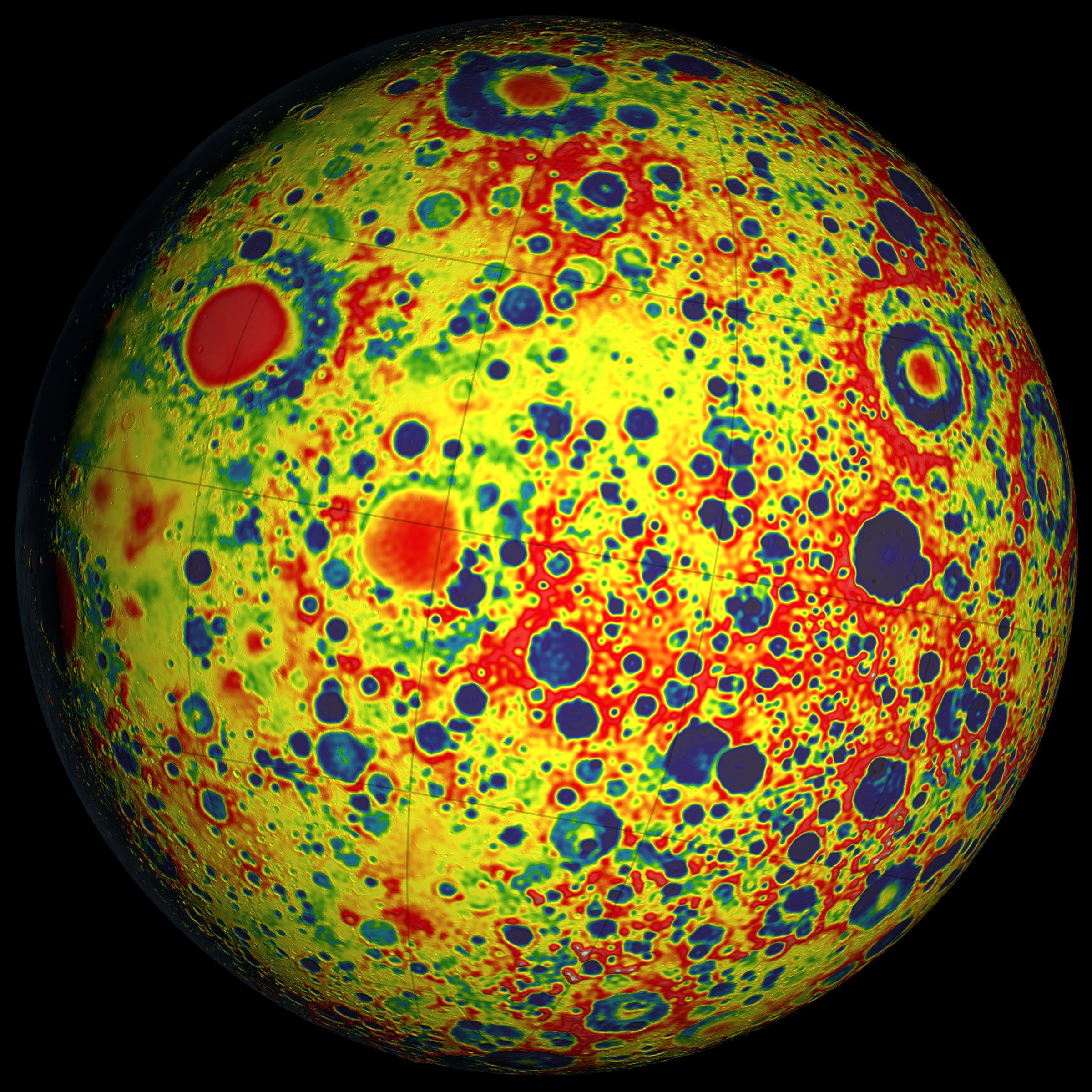
How did the Moon form? To help find out, NASA launched the twin Gravity Recovery and Interior Laboratory (GRAIL) satellites in 2011 to orbit and map the Moon's surface gravity in unprecedented detail. Pictured above is a resulting GRAIL gravity map, with regions of slightly lighter gravity shown in blue and regions of slightly stronger gravity shown in red. Analysis of GRAIL data indicates that the moon has an unexpectedly shallow crust than runs about 40 kilometers deep, and an overall composition similar to the Earth. Although other surprising structures have been discovered that will continue to be investigated, the results generally bolster the hypothesis that the Moon formed mostly from Earth material following a tremendous collision in the early years of our Solar System, about 4.5 billion years ago. After completing their mission and running low on fuel, the two GRAIL satellites, Ebb and Flow, were crashed into a lunar mountain at about 6,000 kilometer per hour. Growing Gallery: Comet PanSTARRS at Sunset
¿Cómo se formó la Luna? Para ayudar a descubrirlo, NASA lanzó en 2011 los satélites gemelos Gravity Recovery and Interior Laboratory (GRAIL) con el objetivo de orbitar y mapear la gravedad de la superficie lunar con un detalle sin precedentes. En la imagen de arriba se muestra un mapa de gravedad obtenido por GRAIL, donde las regiones con una gravedad ligeramente más débil se muestran en azul y las regiones con una gravedad ligeramente más fuerte se muestran en rojo. El análisis de los datos de GRAIL indica que la Luna tiene una corteza inesperadamente poco profunda, que se extiende aproximadamente a 40 kilómetros de profundidad, y una composición general similar a la de la Tierra. Aunque se han descubierto otras estructuras sorprendentes que continuarán siendo investigadas, los resultados en general respaldan la hipótesis de que la Luna se formó principalmente a partir de material terrestre tras una colisión tremenda en los primeros años de nuestro Sistema Solar, hace aproximadamente 4.500 millones de años. Tras completar su misión y agotar su combustible, los dos satélites GRAIL, Ebb y Flow, fueron impactados contra una montaña lunar a una velocidad de aproximadamente 6.000 kilómetros por hora.