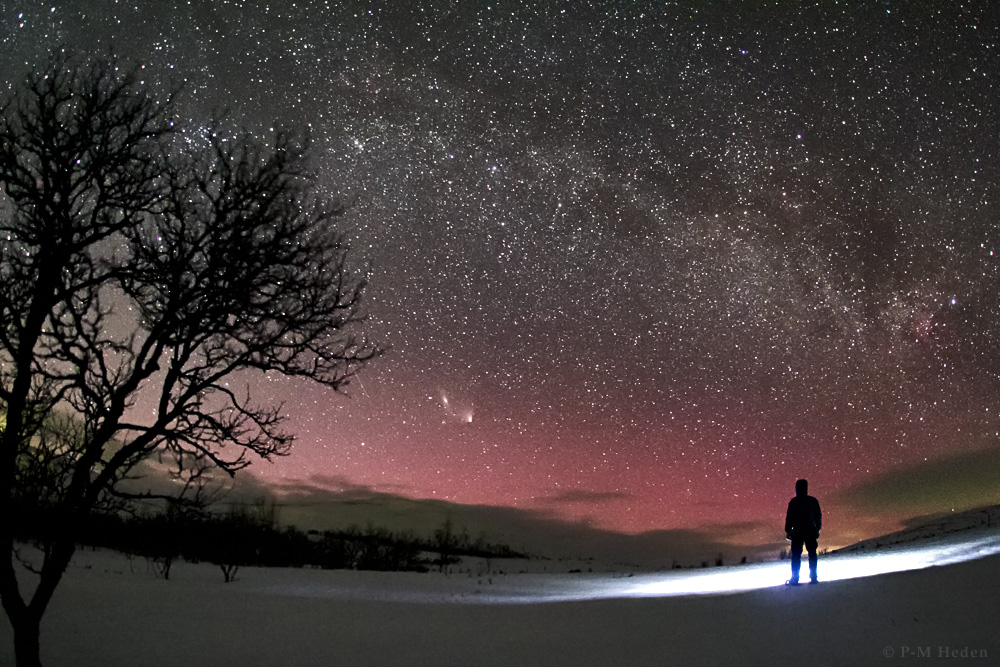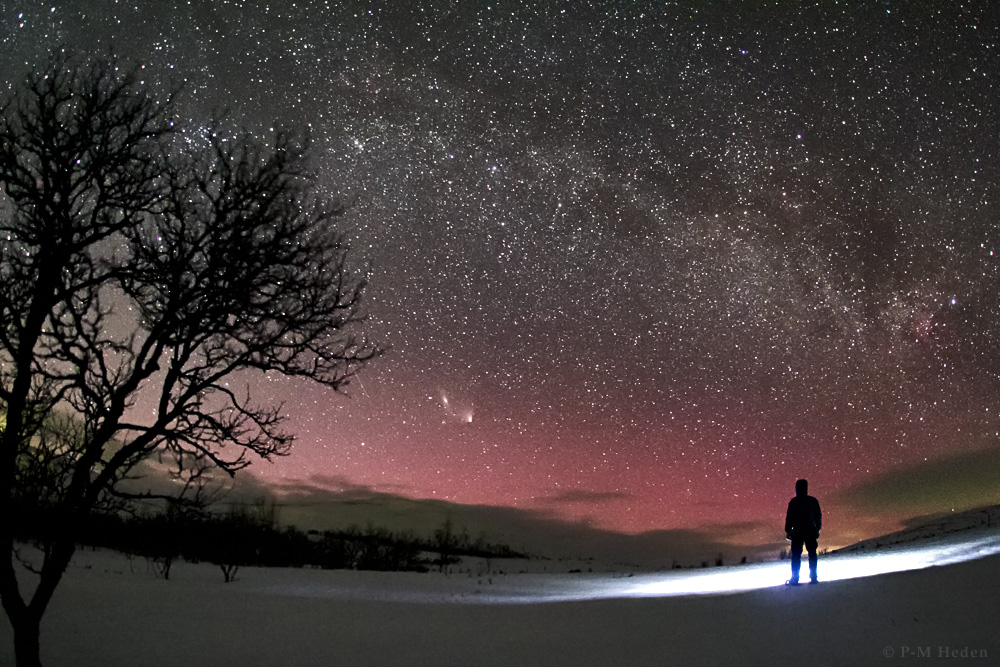
It looks like a double comet, but Comet PanSTARRS (C/2011 L4) is just offering skygazers a Messier moment. Outward bound and fading in this starry scene, the well-photographed comet is remarkably similar in brightness to M31, the Andromeda Galaxy. Tracking through northern skies just below the galaxy, the comet was captured as local midnight approached on April 3. Both comet and galaxy were visible to the eye and are immersed in the faint glow of northern lights. Our own Milky Way galaxy arcs over the snowy field near Tänndalen, Sweden. Double star cluster h and chi Persei can be spotted along the Milky Way's arc high above the comet/galaxy pair. Follow the arc to bright Deneb, alpha star of the constellation Cygnus, at the right edge of the frame.
A simple vista parece un cometa doble, pero el cometa PanSTARRS (C/2011 L4) está ofreciendo a los observadores del cielo un momento Messier. En este escenario estrellado, alejándose y desvaneciéndose, el bien fotografiado cometa es notablemente similar en brillo a M31, la galaxia de Andrómeda. Al desplazarse por los cielos del norte, justo por debajo de la galaxia, el cometa fue capturado cuando se acercaba la medianoche local el 3 de abril. Tanto el cometa como la galaxia eran visibles a simple vista y están inmersos en la tenue luminosidad de las auroras boreales. Nuestra propia galaxia Vía Láctea arquea sobre el campo nevado cerca de Tänndalen, Suecia. El doble cúmulo estelar h y chi Persei puede observarse a lo largo del arco de la Vía Láctea, muy por encima del par cometa/galaxia. Sigue el arco hasta Deneb, la estrella alfa de la constelación del Cisne, en el borde derecho de la imagen.