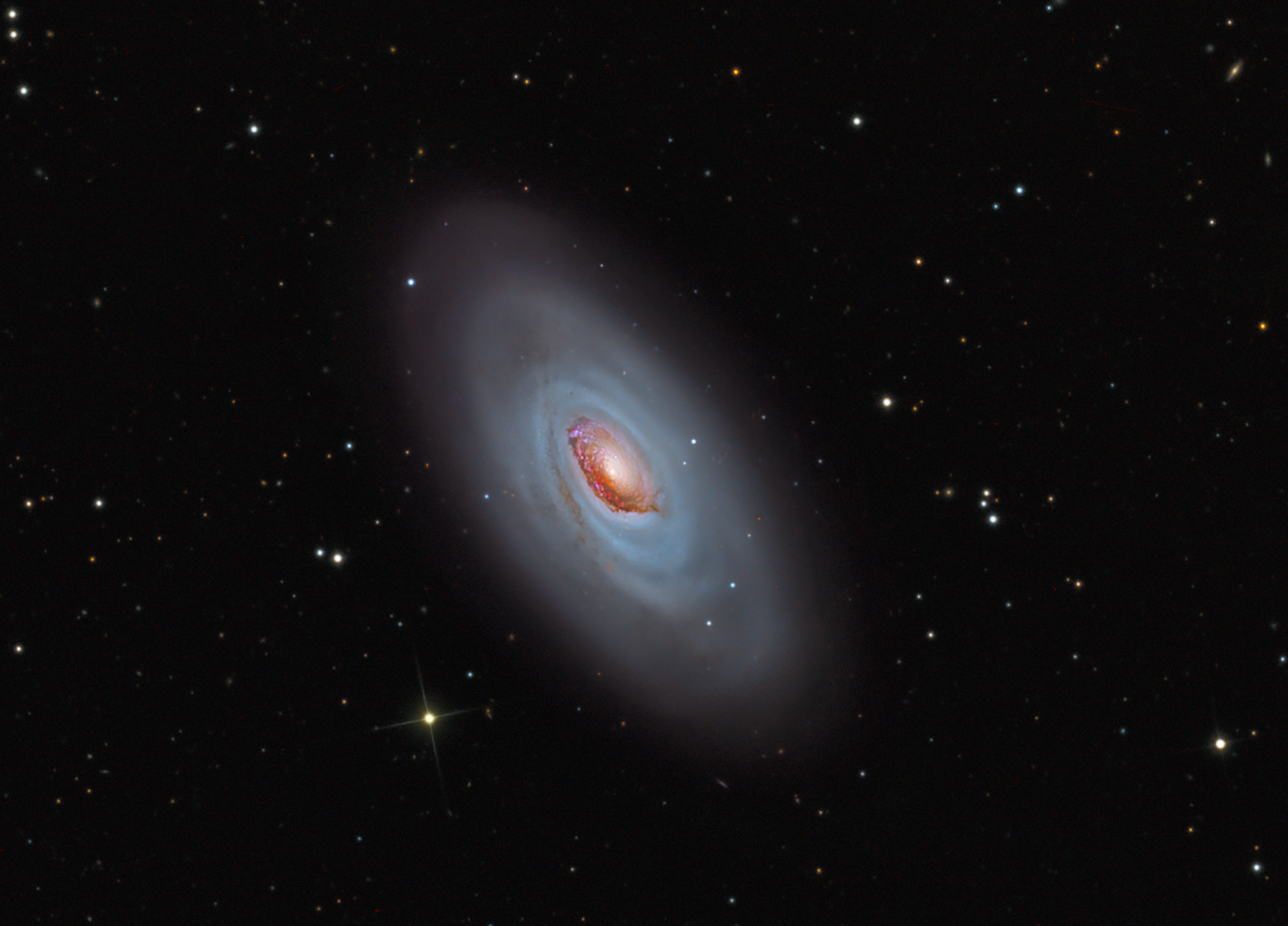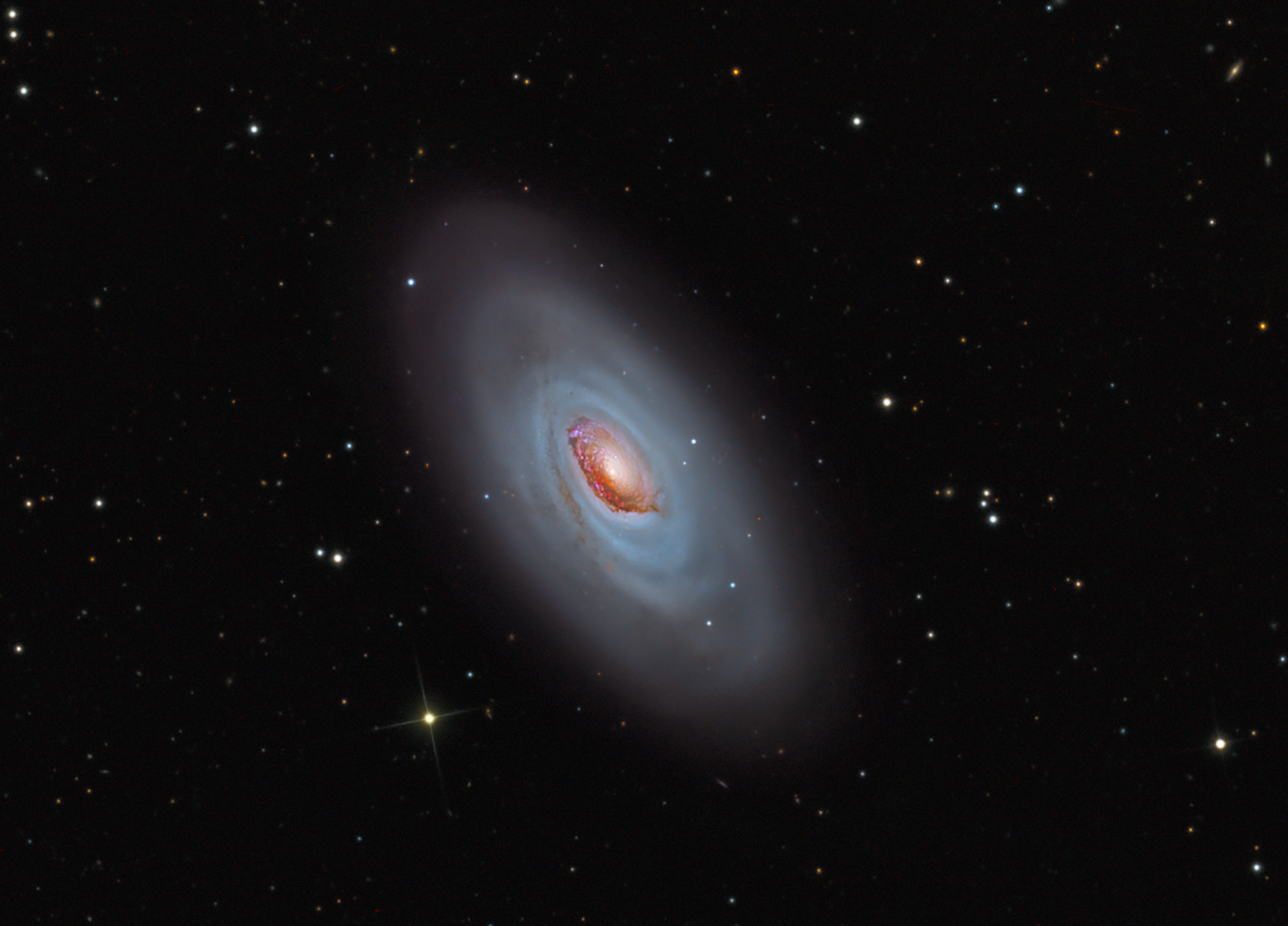
This beautiful, bright, spiral galaxy is Messier 64, often called the Black Eye Galaxy or the Sleeping Beauty Galaxy for its heavy-lidded appearance in telescopic views. M64 is about 17 million light-years distant in the otherwise well-groomed northern constellation Coma Berenices. In fact, the Red Eye Galaxy might also be an appropriate moniker in this colorful composition of narrow and wideband images. The enormous dust clouds obscuring the near-side of M64's central region are laced with the telltale reddish glow of hydrogen associated with star forming regions. But they are not this galaxy's only peculiar feature. Observations show that M64 is actually composed of two concentric, counter-rotating systems. While all the stars in M64 rotate in the same direction as the interstellar gas in the galaxy's central region, gas in the outer regions, extending to about 40,000 light-years, rotates in the opposite direction. The dusty eye and bizarre rotation is likely the result of a billion year old merger of two different galaxies.
Esta hermosa y brillante galaxia esla Messier 64, a menudo llamada la Galaxia Ojo Negro o la Galaxia Bella Durmiente por su apariencia de párpados pesados en vistas telescópicas. M64 se encuentra a unos 17 millones de años luz de distancia en la constelación norteña bien ordenada de Coma Berenices. De hecho, la Galaxia Ojo Rojo también podría ser un apelativo adecuado en esta composición colorida de imágenes de banda estrecha y ancha. Las enormes nubes de polvo que ocultan la cara cercana de la región central de M64 están entrelazadas con el característico brillo rojizo del hidrógeno asociado a regiones de formación estelar. Pero no son la única característica peculiar de esta galaxia. Las observaciones muestran que M64 está compuesta en realidad por dos sistemas concéntricos que rotan en direcciones opuestas. Mientras que todas las estrellas en M64 rotan en la misma dirección que el gas interestelar en la región central de la galaxia, el gas en las regiones externas, que se extiende hasta unos 40 000 años luz, rota en dirección opuesta. El ojo polvoriento y la rotación extraña probablemente son el resultado de una fusión de dos galaxias diferentes que ocurrió hace mil millones de años.