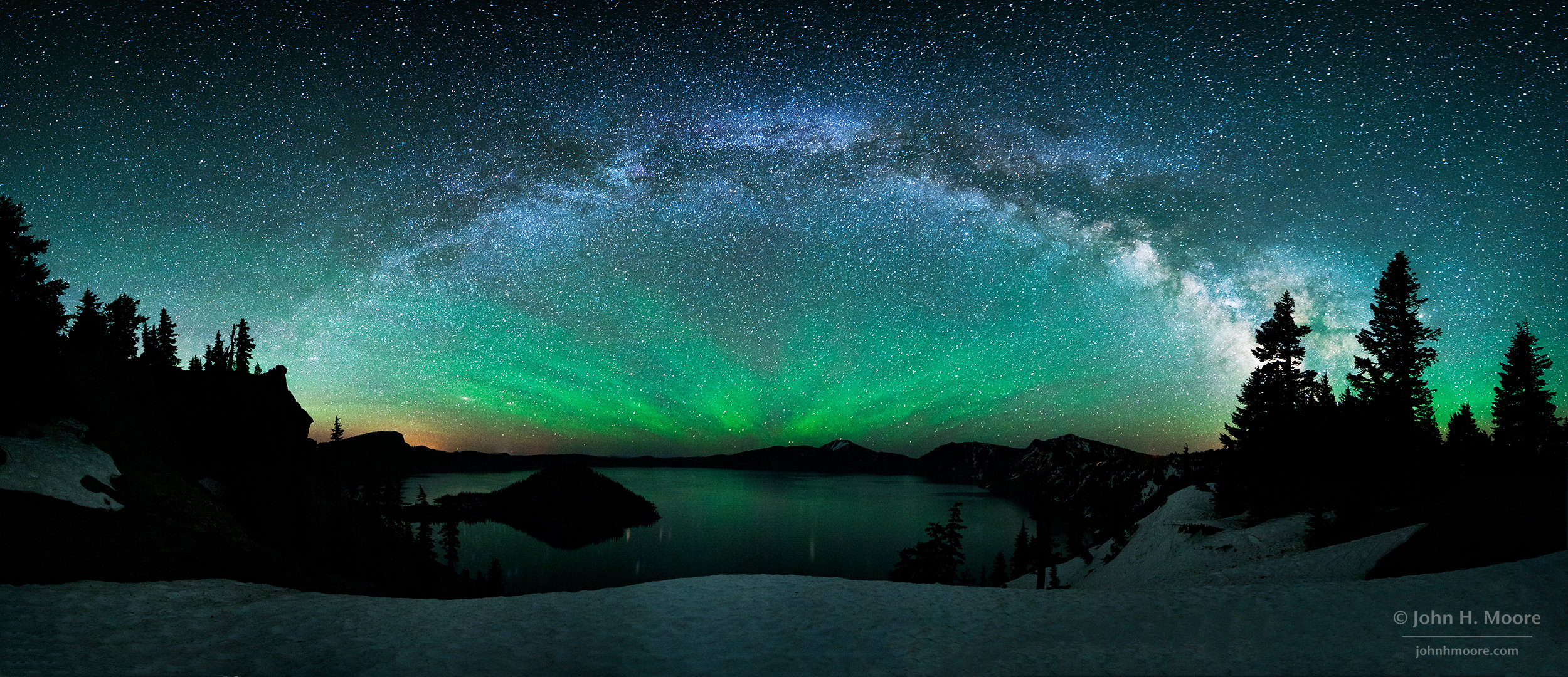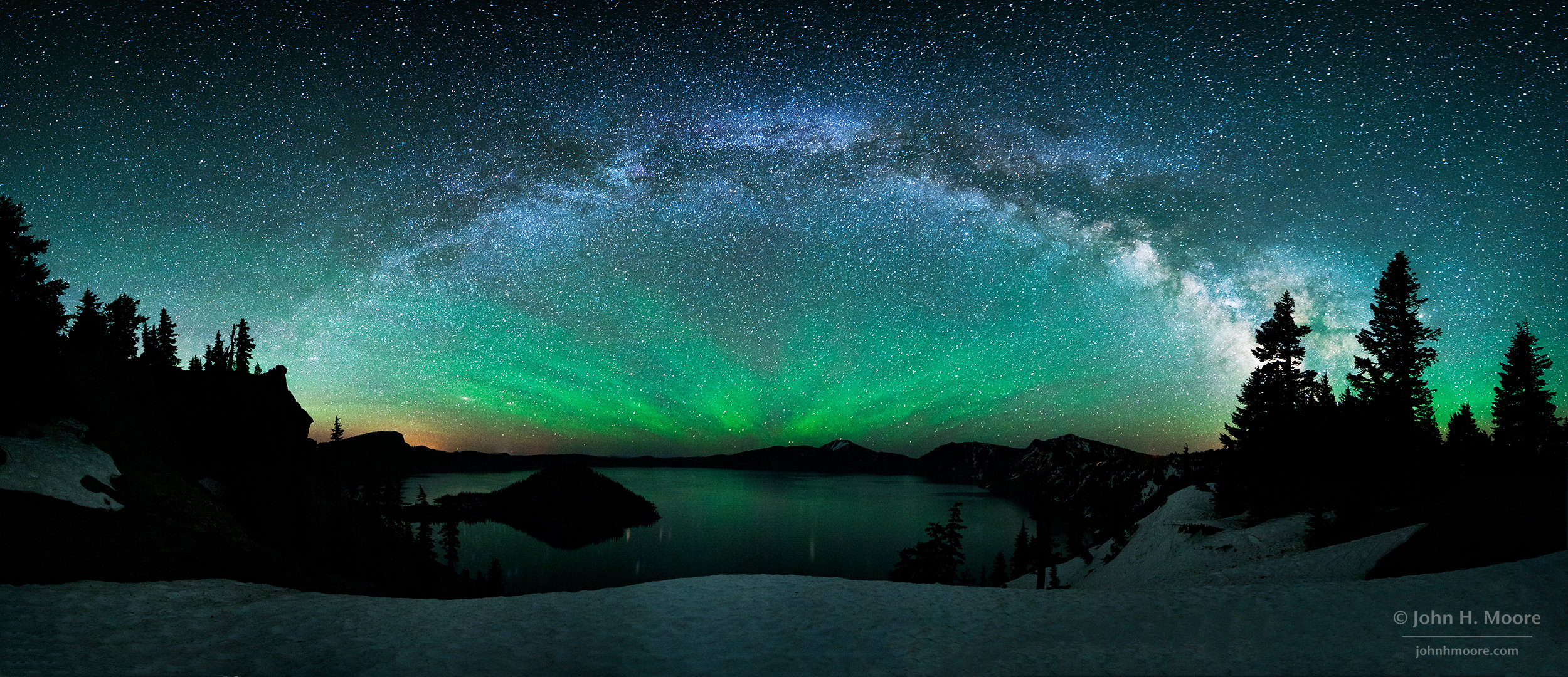
How many different astronomical phenomena have come together to create the above vista? Several. First, in the foreground, is Crater Lake -- a caldera created by volcanism on planet Earth about 7,700 years ago. Next, inside the lake, is water. Although the origin of the water in the crater is melted snowfall, the origin of water on Earth more generally is unclear, but possibly related to ancient Earthly-impacts of icy bodies. Next, the green glow in the sky is airglow, light emitted by atoms high in the Earth's atmosphere as they recombine at night after being separated during the day by energetic sunlight. The many points of light in the sky are stars, glowing by nuclear fusion. They are far above the atmosphere but nearby to our Sun in the Milky Way Galaxy. Finally, the bright arch across the image is the central band of the Milky Way, much further away, on the average, than the nearby stars, and shaped mostly by gravity. Contrary to appearances, the Milky Way band glows by itself and is not illuminated by the airglow. The above image is a six-frame panorama taken during about two weeks ago in Oregon, USA.
¿Cuántos fenómenos astronómicos diferentes se han unido para crear la vista anterior? Varios. En primer lugar, en primer plano, se encuentra el Lago Cráter, un cráter formado por la actividad volcánica en el planeta Tierra hace aproximadamente 7,700 años. A continuación, dentro del lago, está el agua. Aunque el origen del agua en el cráter es el deshielo de la nieve, el origen del agua en la Tierra en general es incierto, pero podría estar relacionado con impactos antiguos de cuerpos helados en la Tierra. Luego, el brillo verde en el cielo es el brillo atmosférico, luz emitida por átomos altos en la atmósfera terrestre mientras se recombinan durante la noche después de haber sido separados durante el día por la luz solar energética. Los muchos puntos de luz en el cielo son estrellas, que brillan por fusión nuclear. Están muy por encima de la atmósfera, pero cercanas a nuestro Sol en la Galaxia Vía Láctea. Finalmente, el arco brillante que atraviesa la imagen es la banda central de la Vía Láctea, que está, en promedio, mucho más lejos que las estrellas cercanas, y su forma está moldeada principalmente por la gravedad. A pesar de lo que parece, la banda de la Vía Láctea brilla por sí misma y no está iluminada por el brillo atmosférico. La imagen anterior es un panorama de seis cuadros tomado hace aproximadamente dos semanas en Oregon, Estados Unidos.