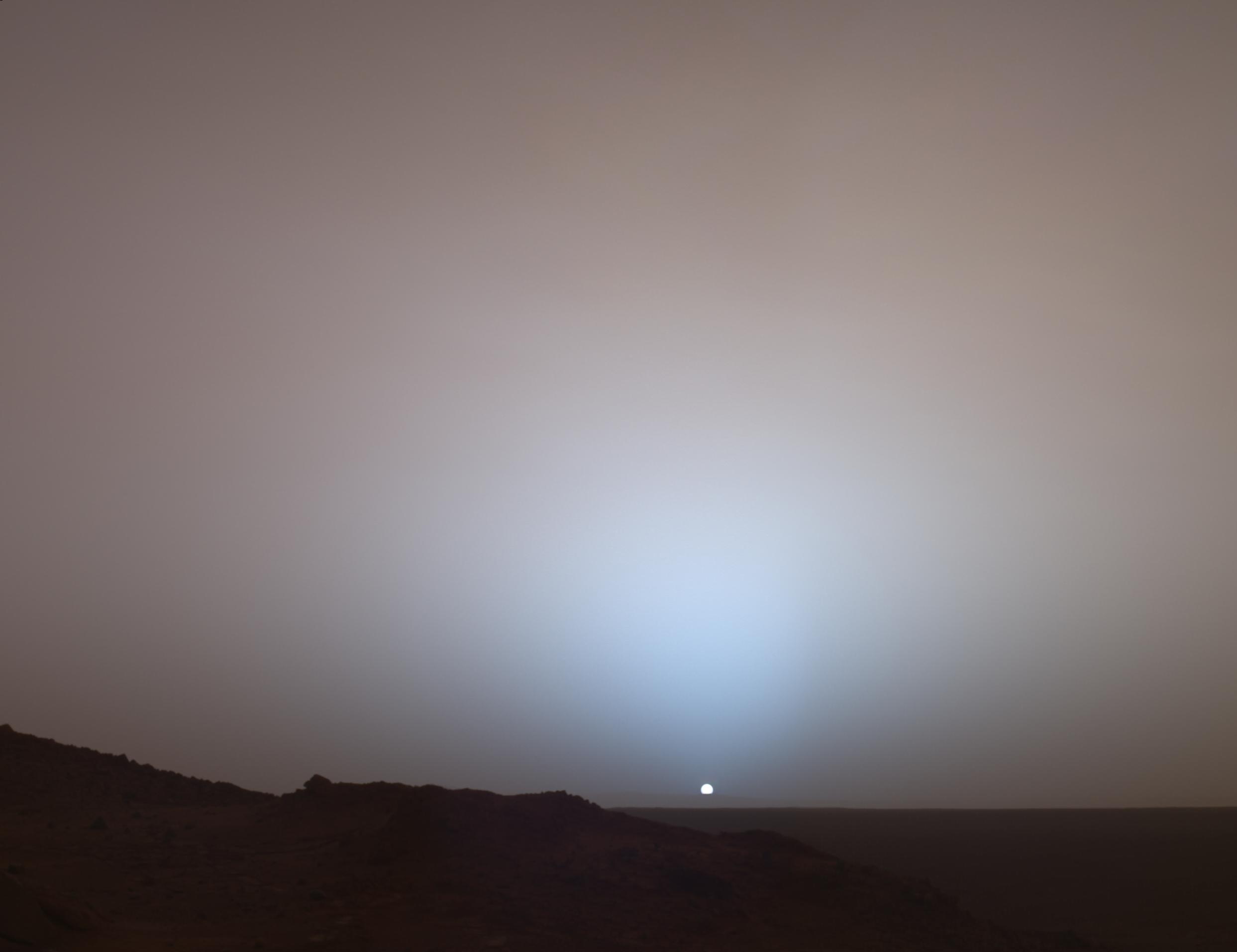
What would it be like to see a sunset on Mars? To help find out, the robotic rover Spirit was deployed in 2005 to park and watch the Sun dip serenely below the distant lip of Gusev crater. Colors in the above image have been slightly exaggerated but would likely be apparent to a human explorer's eye. Fine martian dust particles suspended in the thin atmosphere lend the sky a reddish color, but the dust also scatters blue light in the forward direction, creating a bluish sky glow near the setting Sun. Because Mars is farther away, the Sun is less bright and only about two thirds the diameter it appears from Earth. Images like this help atmospheric scientists understand not only the atmosphere of Mars, but atmospheres across the Solar System, including our home Earth.
¿Qué sería sentir ver un atardecer en Marte? Para ayudar a descubrirlo, se desplegó en 2005 el rover robótico Spirit para detenerse y observar cómo el Sol se hundía suavemente más allá del borde distante del cráter Gusev. Los colores en la imagen anterior han sido ligeramente exagerados, pero probablemente serían visibles para el ojo de un explorador humano. Las finas partículas de polvo marciano suspendidas en la delgada atmósfera le dan al cielo un color rojizo, pero el polvo también dispersa la luz azul en la dirección delante, creando un brillo azulado en el cielo cerca del Sol poniente. Debido a que Marte está más lejos, el Sol es menos brillante y tiene aproximadamente dos tercios del diámetro que parece desde la Tierra. Imágenes como esta ayudan a los científicos atmosféricos a comprender no solo la atmósfera de Marte, sino también las atmósferas a través del Sistema Solar, incluida nuestra Tierra.