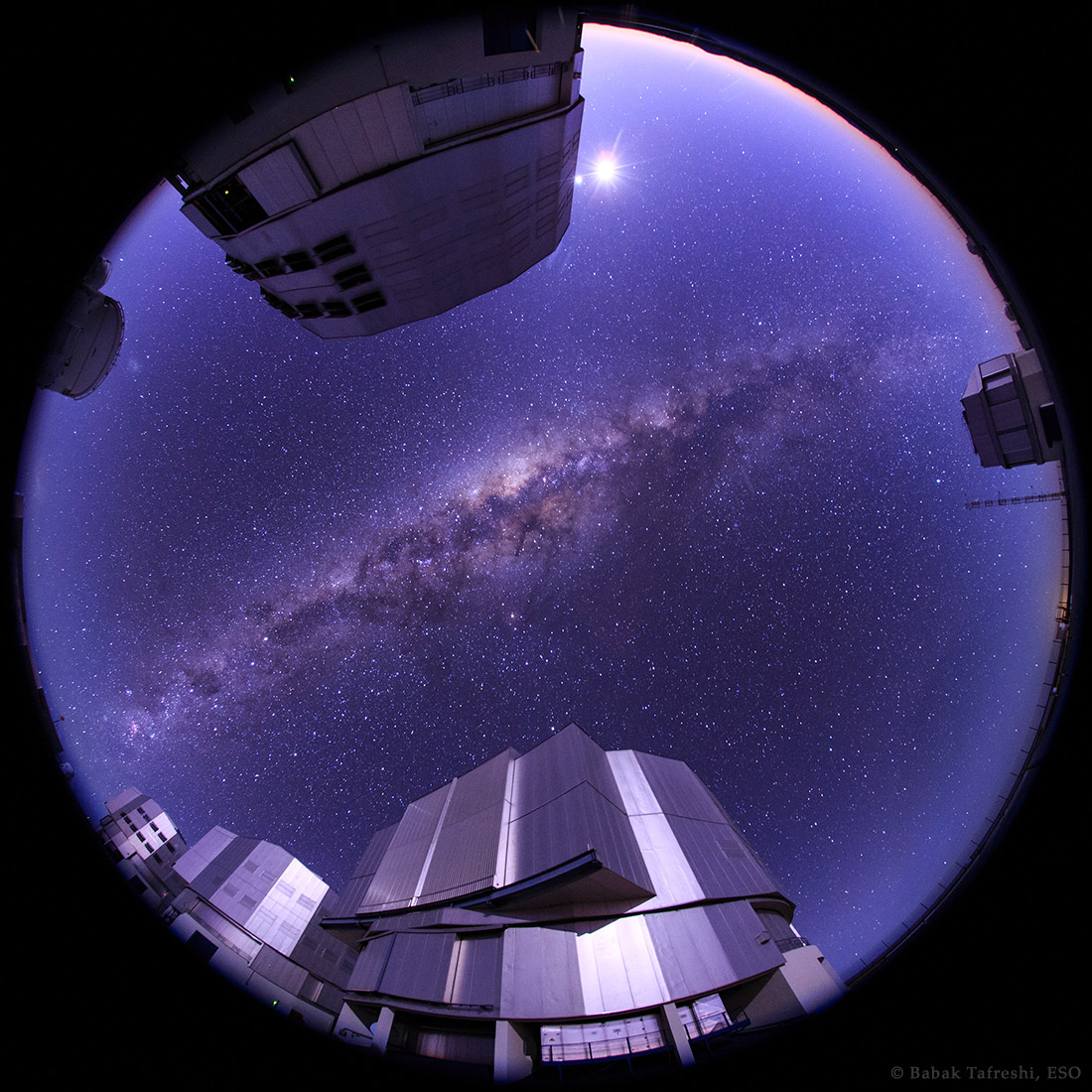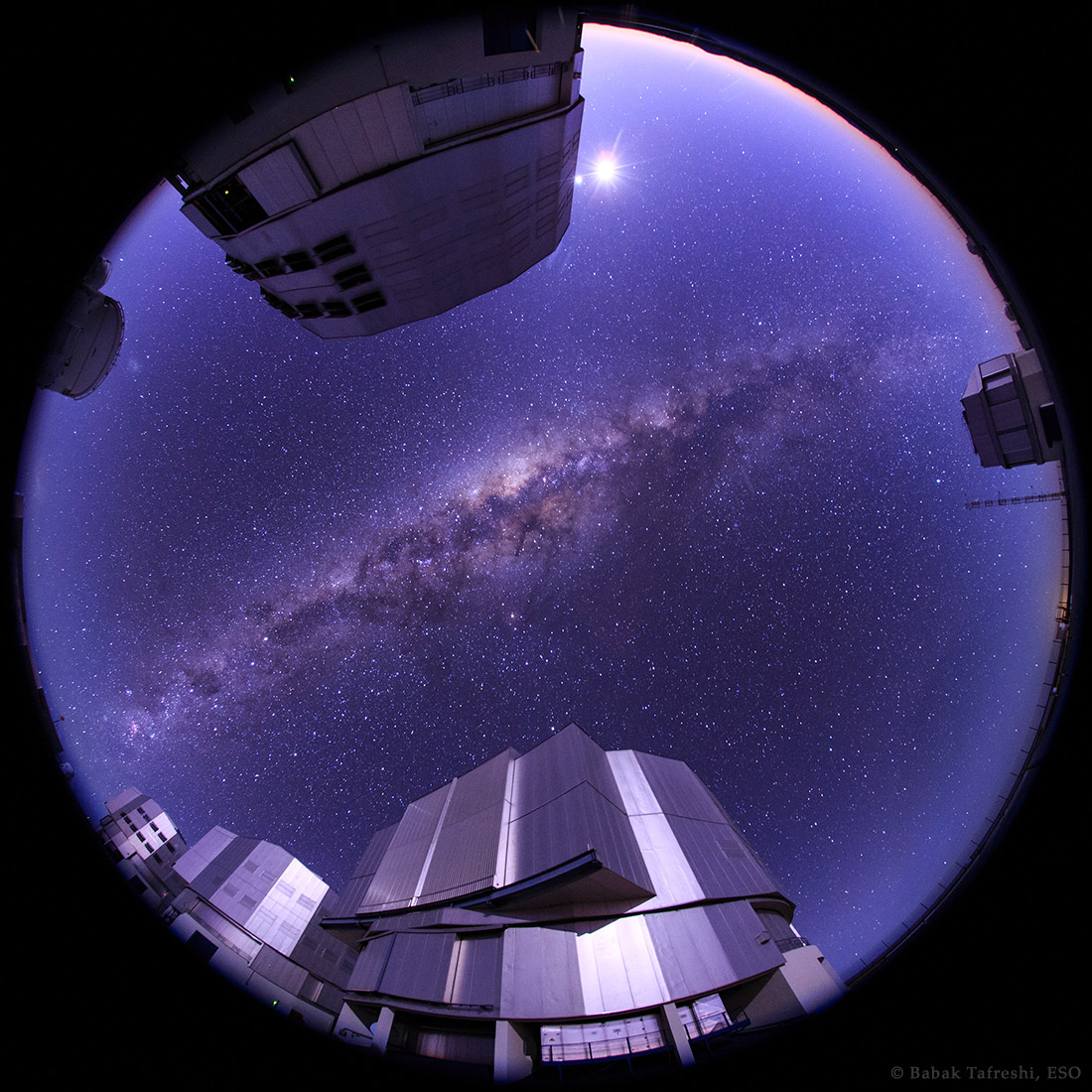
As dawn broke on March 27, the center of the Milky Way Galaxy stood almost directly above the European Southern Observatory's Paranal Observatory. In the dry, clear sky of Chile's Atacama desert, our galaxy's dusty central bulge is flanked by Paranal's four 8 meter Very Large Telescope units in this astronomical fisheye view. Along the top, Venus is close to the eastern horizon. The brilliant morning star shines very near a waning crescent Moon just at the edge of one of the telescope structures. Despite the bright pairing in the east, the Milky Way dominates the scene though. Cut by dust lanes and charged with clouds of stars and glowing nebulae, the center of our galaxy sprawls across the darker zenith even as the deep blue sky grows brighter and buildings still glint in moonlight.
Cuando amaneció el 27 de marzo, el centro de la Galaxia de la Vía Láctea se encontraba casi directamente sobre el Observatorio Paranal del Observatorio Europeo Austral. En el cielo seco y claro del desierto de Atacama en Chile, el núcleo polvoriento de nuestra galaxia está flanqueado por los cuatro telescopios Very Large Telescope de 8 metros del Observatorio Paranal en esta vista astronómica de tipo fisheye. En la parte superior, Venus está cerca del horizonte oriental. El brillante planeta del amanecer brilla muy cerca de una luna menguante en cuarto menguante, justo en el borde de una de las estructuras de los telescopios. A pesar de la brillante pareja en el este, la Vía Láctea domina la escena. Cortada por bandas de polvo y cargada de nubes de estrellas y nebulosas brillantes, el centro de nuestra galaxia se extiende a través del cielo más oscuro en el cenit, incluso a medida que el cielo de color azul profundo se vuelve más brillante y los edificios aún resplandecen bajo la luz de la luna.