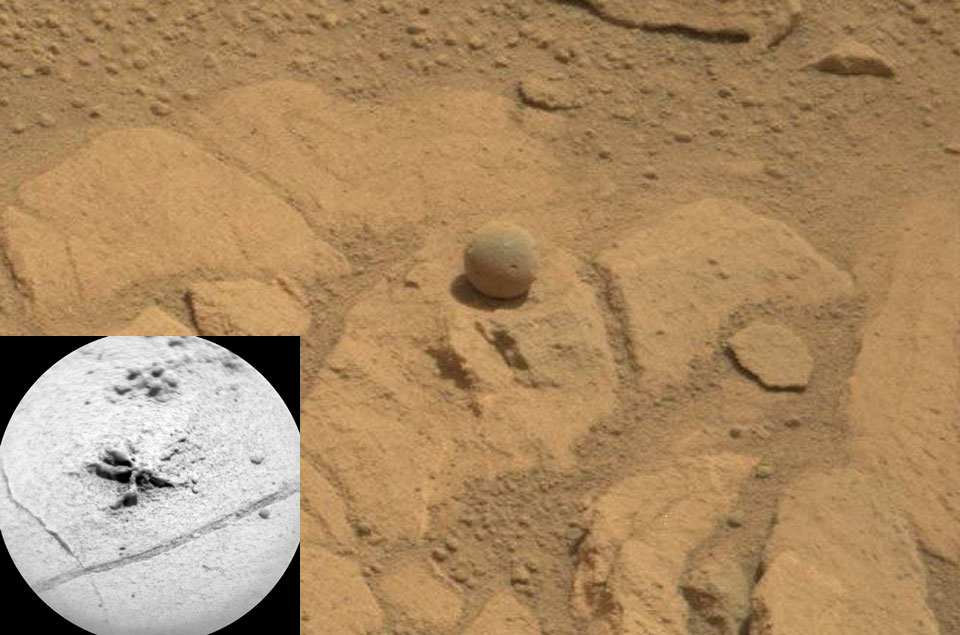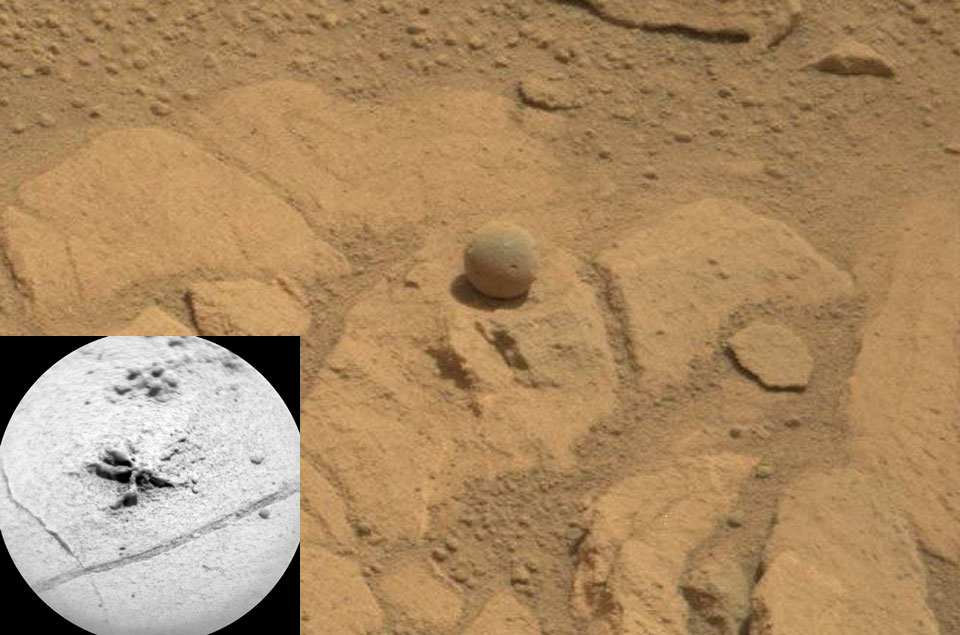
How did these Martian rocks form? As the robotic Curiosity rover has approached Pahrump Hills on Mars, it has seen an interesting and textured landscape dotted by some unusual rocks. The featured image shows a curiously round rock spanning about two centimeters across. Seemingly a larger version of numerous spherules dubbed blueberries found by the Opportunity rover on Mars in 2004, what caused this roundness remains unknown. Possibilities include frequent tumbling in flowing water, sprayed molten rock in a volcanic eruption, or a concretion mechanism. The inset image, taken a few days later, shows another small but unusually shaped rock structure. As Curiosity rolls around and up Mount Sharp, different layers of the landscape will be imaged and studied to better understand the ancient history of the region and to investigate whether Mars could once have harbored life. APOD Wall Calendar: Moons and Planets
¿Cómo se formaron estas rocas marcianas? Mientras el rover robótico Curiosity se acerca a las colinas Pahrump en Marte, ha observado un paisaje interesante y texturizado salpicado por algunas rocas inusuales. La imagen destacada muestra una roca curiosamente redonda que abarca aproximadamente dos centímetros de diámetro. Pareciendo una versión más grande de las numerosas esferas denominadas 'blueberries' encontradas por el rover Opportunity en Marte en 2004, la causa de esta redondez sigue siendo desconocida. Las posibilidades incluyen el frecuente rodar en agua fluyente, roca fundida proyectada durante una erupción volcánica, o un mecanismo de concreción. La imagen insertada, tomada unos días más tarde, muestra otra estructura rocosa pequeña pero de forma inusual. Mientras Curiosity avanza alrededor y sube el Monte Sharp, diferentes capas del paisaje serán fotografiadas y estudiadas para comprender mejor la historia antigua de la región y para investigar si Marte pudo haber albergado vida en algún momento.