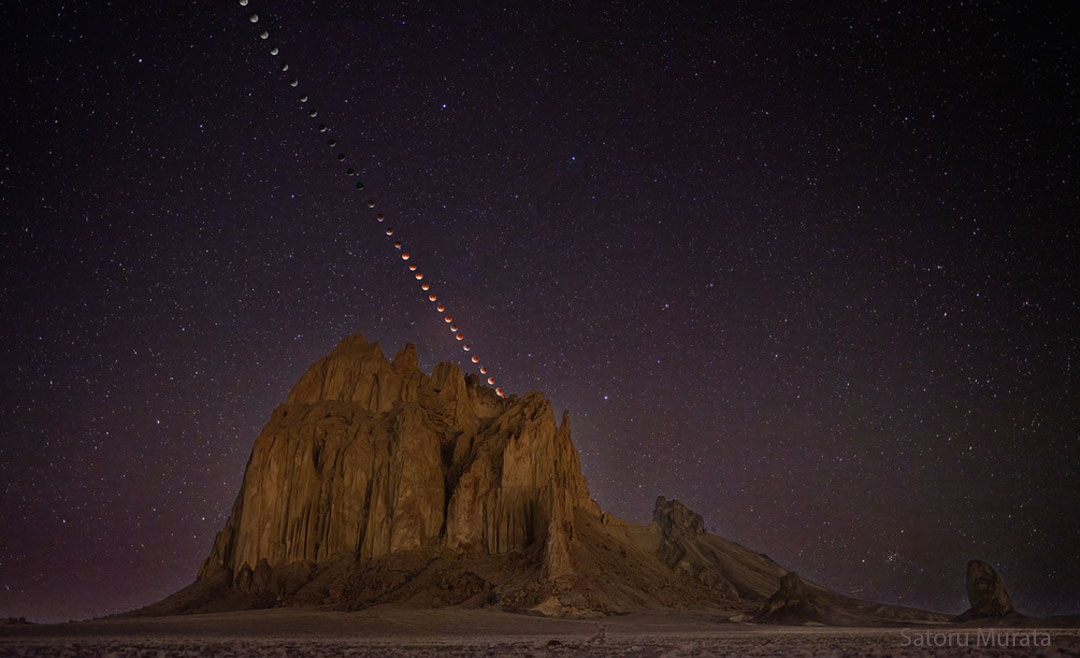
If the full Moon suddenly faded, what would you see? The answer during the total lunar eclipse of 2011 June was recorded in a dramatic time lapse video from Tajikistan. During a total lunar eclipse, the Earth moves between the Moon and the Sun, causing the moon to fade dramatically. The Moon never gets completely dark, though, since the Earth's atmosphere refracts some light. As the above video begins, the scene may appear to be daytime and sunlit, but actually it is a nighttime and lit by the glow of the full Moon. As the moon becomes eclipsed and fades, the wind dies down and background stars can be seen reflected in foreground lake. Most spectacularly, the sky surrounding the eclipsed moon suddenly appears to be full of stars and highlighted by the busy plane of our Milky Way Galaxy. The sequence repeats with a closer view, and the final image shows the placement of the eclipsed Moon near the Eagle, Swan, Trifid, and Lagoon nebulas. Nearly two hours after the eclipse started, the moon emerged from the Earth's shadow and its bright full glare again dominated the sky. The next total lunar eclipse will occur this Wednesday. APOD Wall Calendar: Moons and Planets
Si la Luna llena de repente se oscureciera, ¿qué vería? La respuesta durante el eclipse lunar total del 2011 de junio fue capturada en un video de tiempo acelerado dramático grabado en Tayikistán. Durante un eclipse lunar total, la Tierra se coloca entre la Luna y el Sol, causando que la Luna se oscurezca drásticamente. Sin embargo, la Luna nunca se vuelve completamente oscura, ya que la atmósfera terrestre refracta cierta cantidad de luz. Al comienzo del video anterior, la escena puede parecer ser de día y soleada, pero en realidad es de noche y iluminada por el resplandor de la Luna llena. A medida que la Luna se eclipsa y se oscurece, el viento disminuye y las estrellas del fondo pueden verse reflejadas en el lago del primer plano. Lo más espectacular es que el cielo que rodea la Luna eclipsada de repente parece lleno de estrellas, destacado por la banda ocupada de nuestra galaxia, la Vía Láctea. La secuencia se repite con una vista más cercana, y la imagen final muestra la posición de la Luna eclipsada cerca de las nebulosas Águila, Cisne, Trifida y Lago. Casi dos horas después de que comenzara el eclipse, la Luna emergió de la sombra terrestre y su brillante resplandor de Luna llena volvió a dominar el cielo. El próximo eclipse lunar total ocurrirá este miércoles.