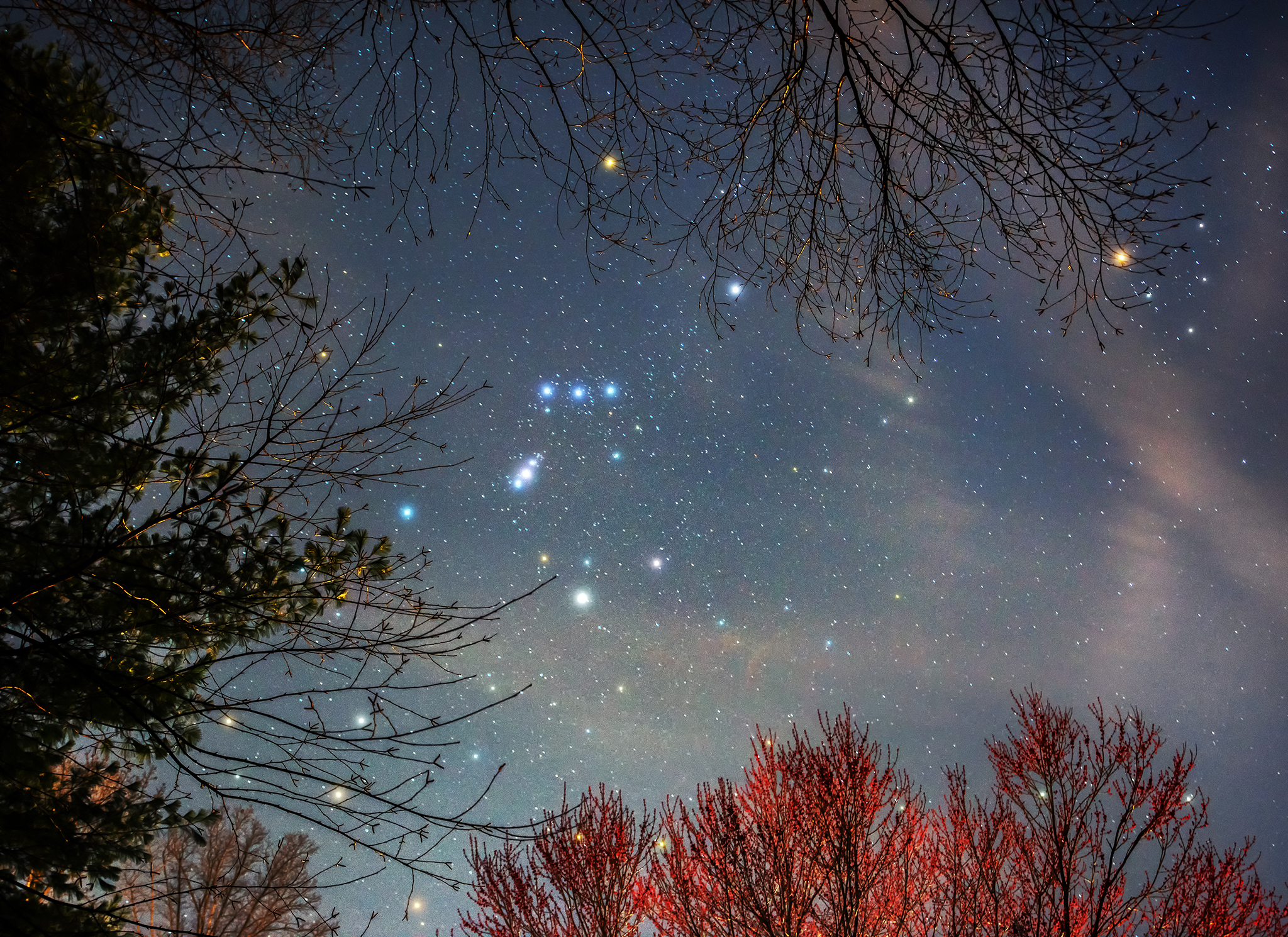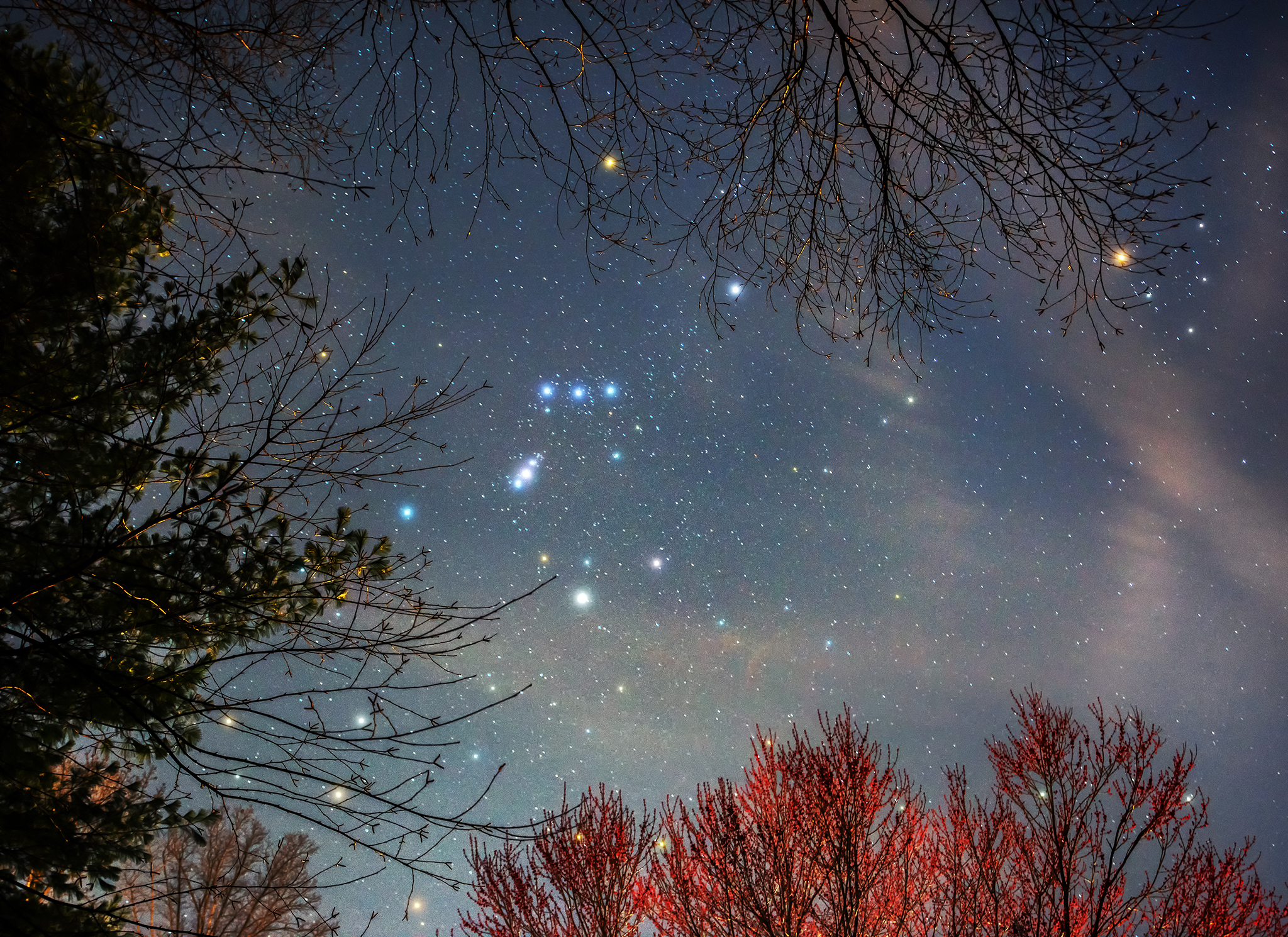
As spring comes to planet Earth's northern hemisphere, familiar winter constellation Orion sets in early evening skies and budding trees frame the Hunter's stars. The yellowish hue of cool red supergiant Alpha Orionis, the great star Betelgeuse, mingles with the branches at the top of this colorful skyscape. Orion's alpha star is joined on the far right by Alpha Tauri. Also known as Aldebaran and also a giant star cooler than the Sun, it shines with a yellow light at the head of Taurus, the Bull. Contrasting blue supergiant Rigel, Beta Orionis, is Orion's other dominant star though, and marks the Hunter's foot below center. Of course, the sword of Orion hangs from the Hunter's three blue belt stars near picture center, but the middle star in the sword is not a star at all. A slightly fuzzy pinkish glow hints at its true nature, a nearby stellar nursery visible to the unaided eye known as the Orion Nebula.
A medida que llega la primavera al hemisferio norte de la Tierra, la conocida constelación invernal de Orión se pone en el cielo de la tarde temprano, y los árboles en flor marcan las estrellas del Cazador. El tono amarillento del gigante rojo frío Alpha Orionis, la gran estrella Betelgeuse, se mezcla con las ramas en la parte superior de este colorido paisaje celeste. La estrella alfa de Orión se encuentra junto a la derecha con Alpha Tauri. También conocida como Aldebarán y también una gigante estrella más fría que el Sol, brilla con una luz amarilla en la cabeza de Taurus, el Toro. En contraste, la supergigante azul Rigel, Beta Orionis, es la otra estrella dominante de Orión, y marca el pie del Cazador, ubicado debajo del centro. Por supuesto, la espada de Orión cuelga de las tres estrellas azules de la cintura del Cazador cerca del centro de la imagen, pero la estrella del medio en la espada no es una estrella en absoluto. Una leve brillo rosado y difuso sugiere su verdadera naturaleza, un cercano criadero estelar visible a simple vista conocido como la Nebulosa de Orión.