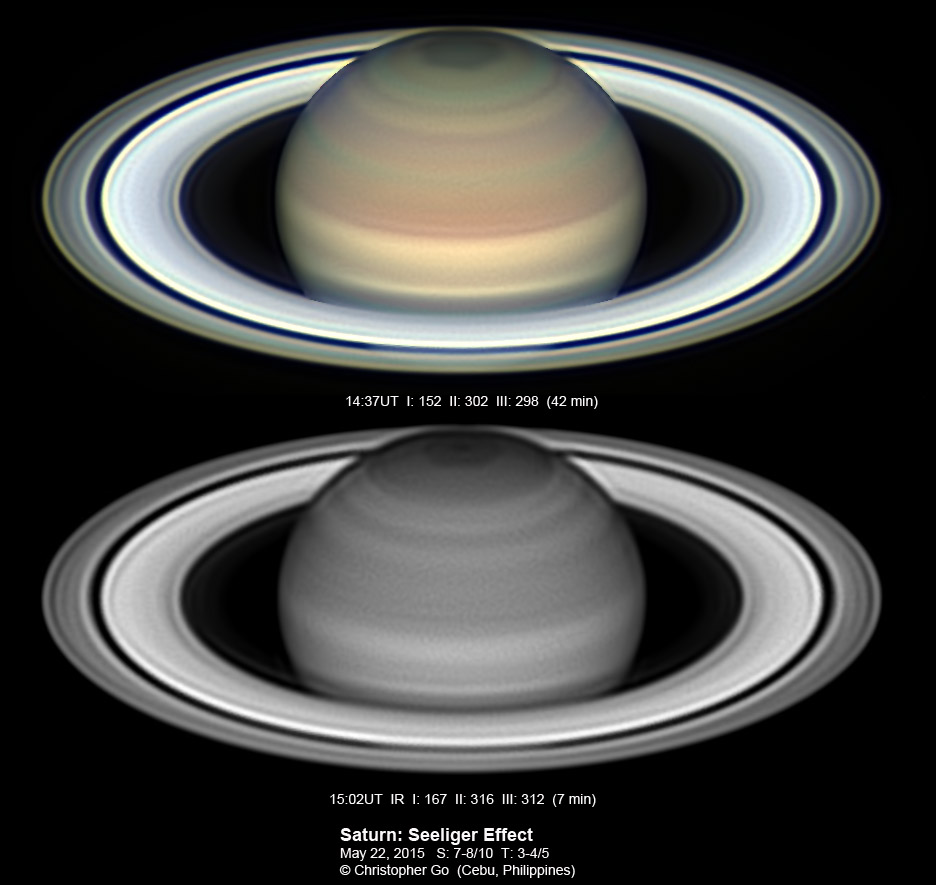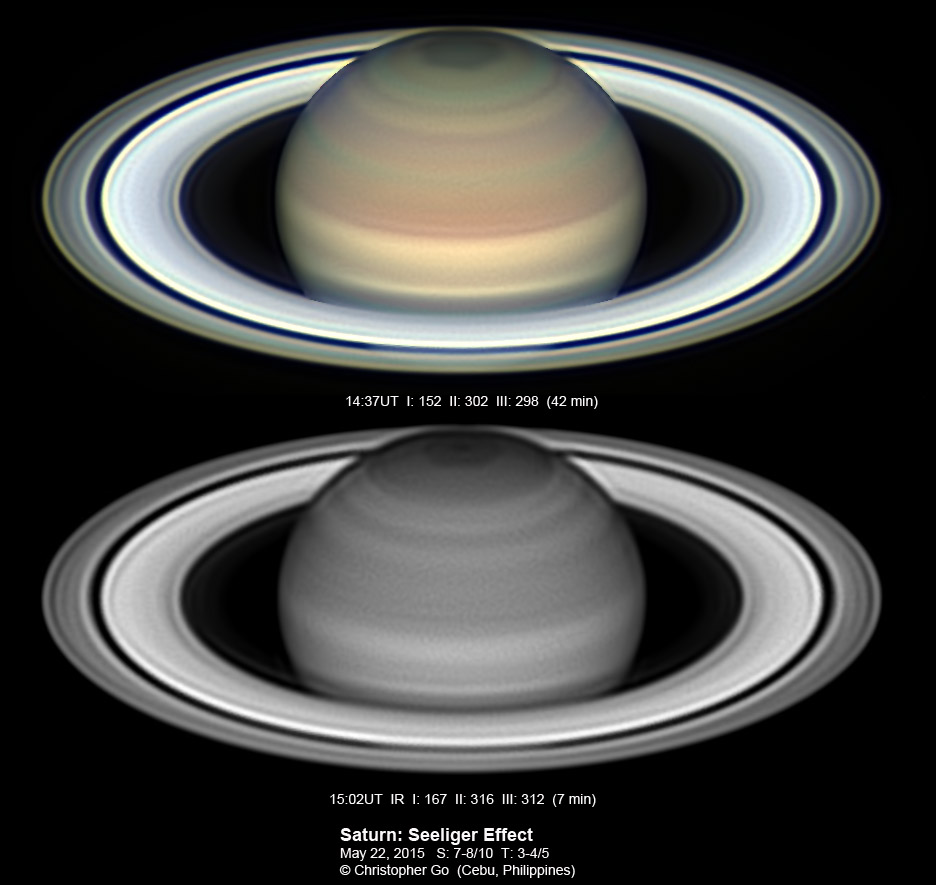
Telescopic observers on Earth have been treated to spectacular views of Saturn lately as the ringed planet reached its 2015 opposition on May 23 at 0200 UT. Of course opposition means opposite the Sun in Earth's sky. So near opposition Saturn is up all night, at its closest and brightest for the year. These sharp images taken within hours of the Sun-Earth-Saturn alignment also show the strong brightening of Saturn's rings known as the opposition surge or the Seeliger Effect. Directly illuminated, the ring's icy particles cast no shadows and strongly backscatter sunlight toward planet Earth, creating the dramatic surge in brightness. Saturn currently stands in the sky not far from bright Antares, alpha star of the constellation Scorpius.
Los observadores con telescopios en la Tierra han disfrutado de vistas espectaculares de Saturno recientemente, ya que el planeta anillado alcanzó su oposición de 2015 el 23 de mayo a las 02:00 UT. Por supuesto, la oposición significa estar opuesto al Sol en el cielo terrestre. Por lo tanto, cerca de la oposición, Saturno permanece visible durante toda la noche, a su punto más cercano y brillante del año. Estas imágenes nítidas tomadas dentro de horas de la alineación Sol-Tierra-Saturno también muestran el fuerte aumento de brillo de los anillos de Saturno conocido como el efecto de oposición o el efecto Seeliger. Iluminados directamente, las partículas heladas de los anillos no proyectan sombras y retrodifunden intensamente la luz solar hacia la Tierra, creando el dramático aumento de brillo. Actualmente, Saturno se encuentra en el cielo no muy lejos de Antares, la estrella alfa de la constelación Escorpión.