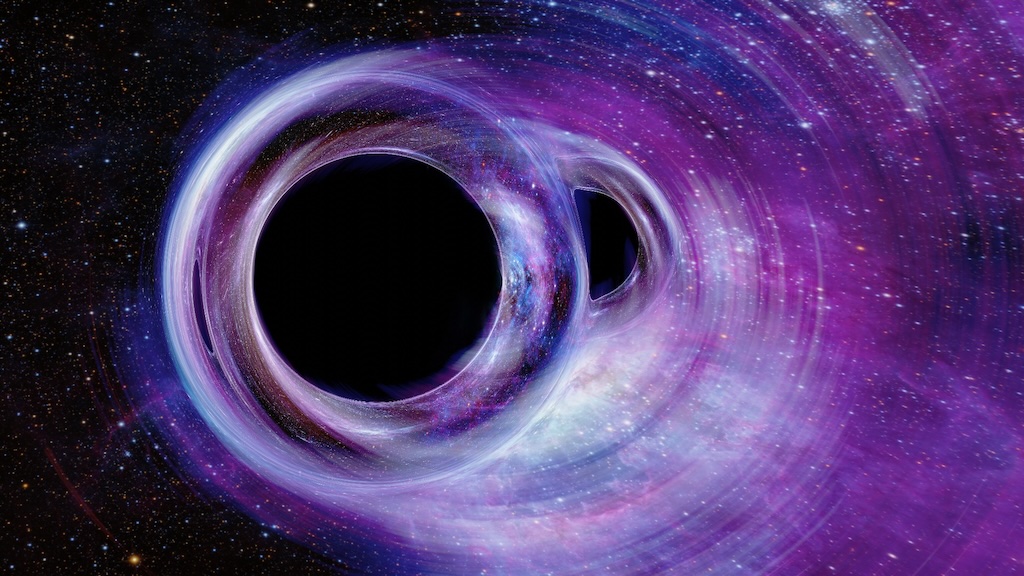
What happens when two black holes collide? This extreme scenario likely occurs in the centers of some merging galaxies and multiple star systems. The featured video shows a computer animation of the final stages of such a merger, while highlighting the gravitational lensing effects that would appear on a background starfield. The black regions indicate the event horizons of the dynamic duo, while a surrounding ring of shifting background stars indicates the position of their combined Einstein ring. All background stars not only have images visible outside of this Einstein ring, but also have one or more companion images visible on the inside. Eventually the two black holes coalesce. The end stages of such a merger may provide a strong and predictable blast of gravitational radiation, a much sought after form of radiation different than light that has never yet been directly observed. Space Music Video: APOD images from September 2015
¿Qué ocurre cuando dos agujeros negros colisionan? Este escenario extremo probablemente tiene lugar en los centros de algunas galaxias en proceso de fusión y sistemas estelares múltiples. El video destacado muestra una animación computarizada de las etapas finales de tal fusión, resaltando los efectos de lente gravitacional que se observarían en un fondo de estrellas. Las regiones oscuras indican los horizontes de sucesos de este dúo dinámico, mientras que un anillo circundante de estrellas de fondo en constante cambio indica la posición de su anillo de Einstein combinado. Todas las estrellas de fondo no solo tienen imágenes visibles fuera de este anillo de Einstein, sino que también tienen una o más imágenes compañeras visibles en su interior. Finalmente, los dos agujeros negros se fusionan. Las etapas finales de tal fusión podrían producir una fuerte y predecible explosión de radiación gravitacional, una forma de radiación muy buscada, diferente de la luz, que aún no ha sido observada directamente. Video musical del espacio: imágenes de APOD de septiembre de 2015