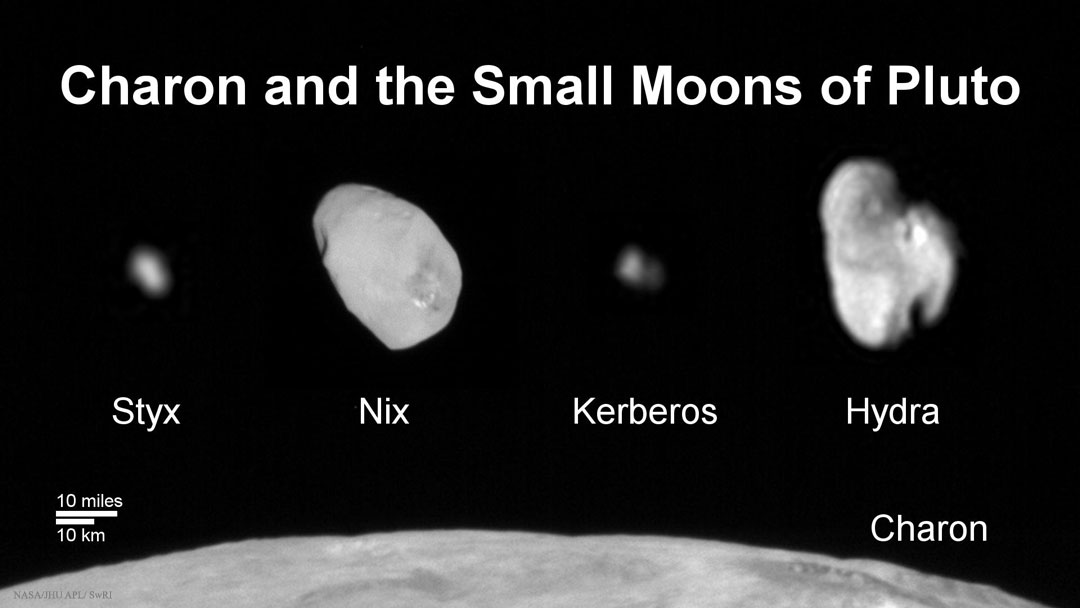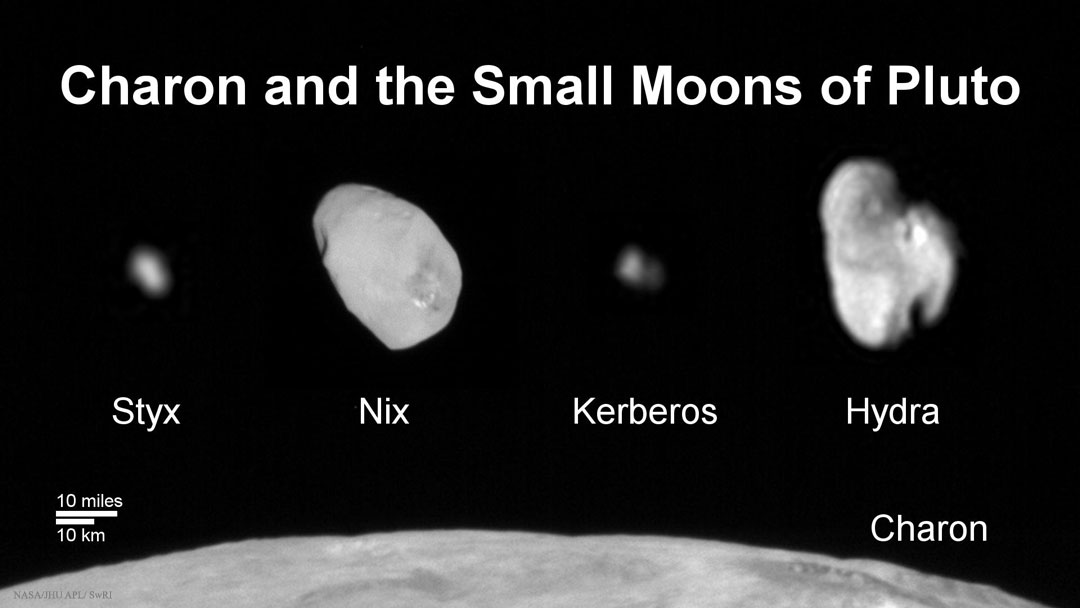
What do the moons of Pluto look like? Before a decade ago, only the largest moon Charon was known, but never imaged. As the robotic New Horizons spacecraft was prepared and launched, other moons were identified on Hubble images but remained only specks of light. Finally, this past summer, New Horizons swept right past Pluto, photographed Pluto and Charon in detail, and took the best images of Styx, Nix, Kerberos, and Hydra that it could. The featured image composite shows the results -- each moon is seen to have a distinct shape, while underlying complexity is only hinted. Even though not satisfyingly resolved, these images are likely to be the best available to humanity for some time. This is because the moons are too small and distant for contemporary Earth-based telescopes to resolve, and no new missions to the Pluto system are planned. Gallery: October's Venus, Jupiter, & Mars Conjunction
¿Cómo se ven los satélites de Plutón? Hace una década, solo se conocía el mayor satélite, Caronte, pero nunca se había obtenido una imagen de él. Mientras se preparaba y lanzaba la nave espacial robótica New Horizons, otros satélites fueron identificados en imágenes del telescopio espacial Hubble, pero permanecieron solo como puntos de luz. Finalmente, este verano, New Horizons pasó muy cerca de Plutón, tomó imágenes detalladas de Plutón y Caronte, y capturó las mejores imágenes posibles de Styx, Nix, Kerberos y Hydra. La imagen compuesta mostrada en esta entrada revela los resultados: cada satélite tiene una forma distintiva, aunque la complejidad subyacente solo se intuye. Aunque no están resueltos con suficiente claridad, estas imágenes probablemente serán las mejores disponibles para la humanidad durante algún tiempo. Esto se debe a que los satélites son demasiado pequeños y distantes para que los telescopios terrestres modernos los resuelvan, y no se planean nuevas misiones al sistema de Plutón.