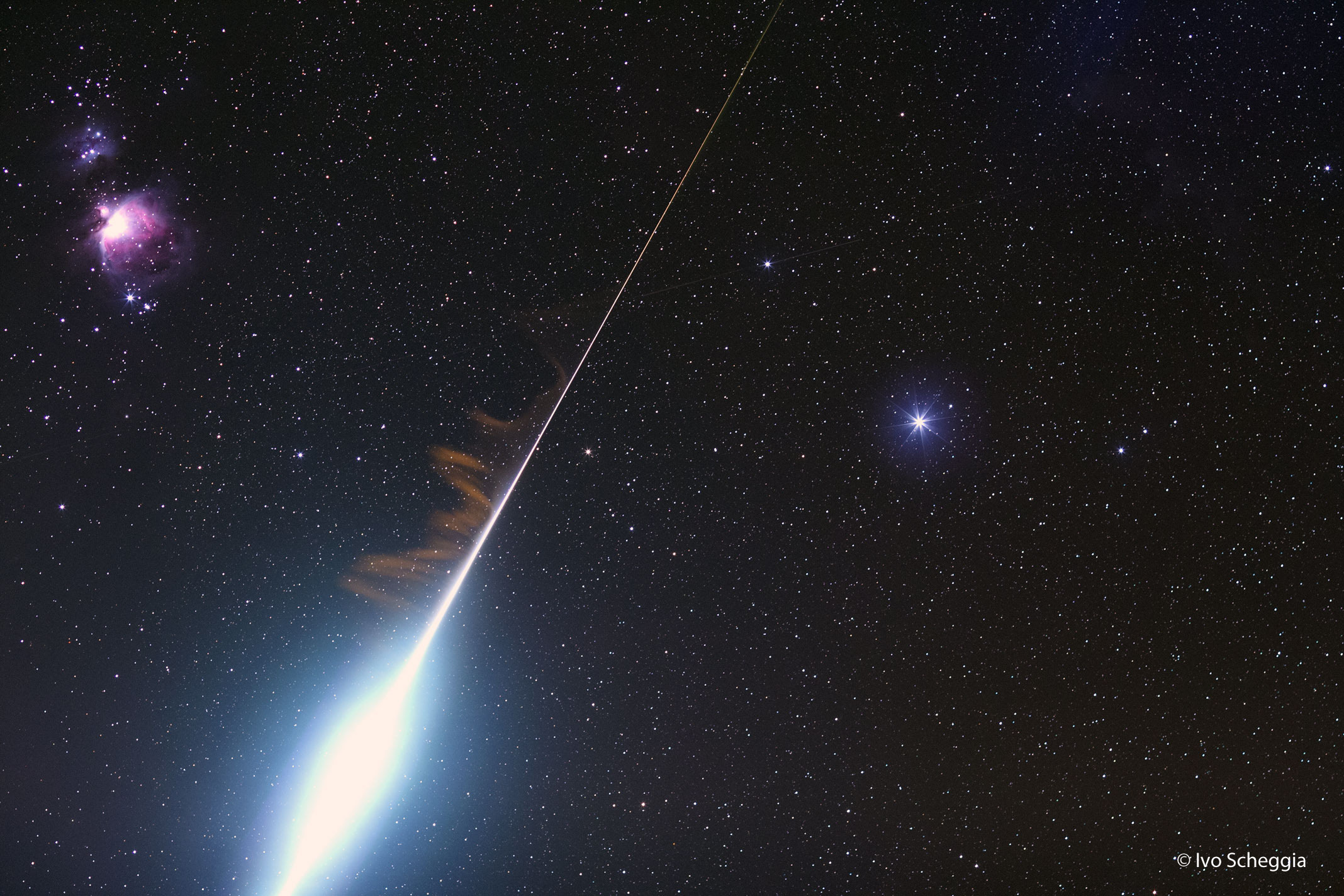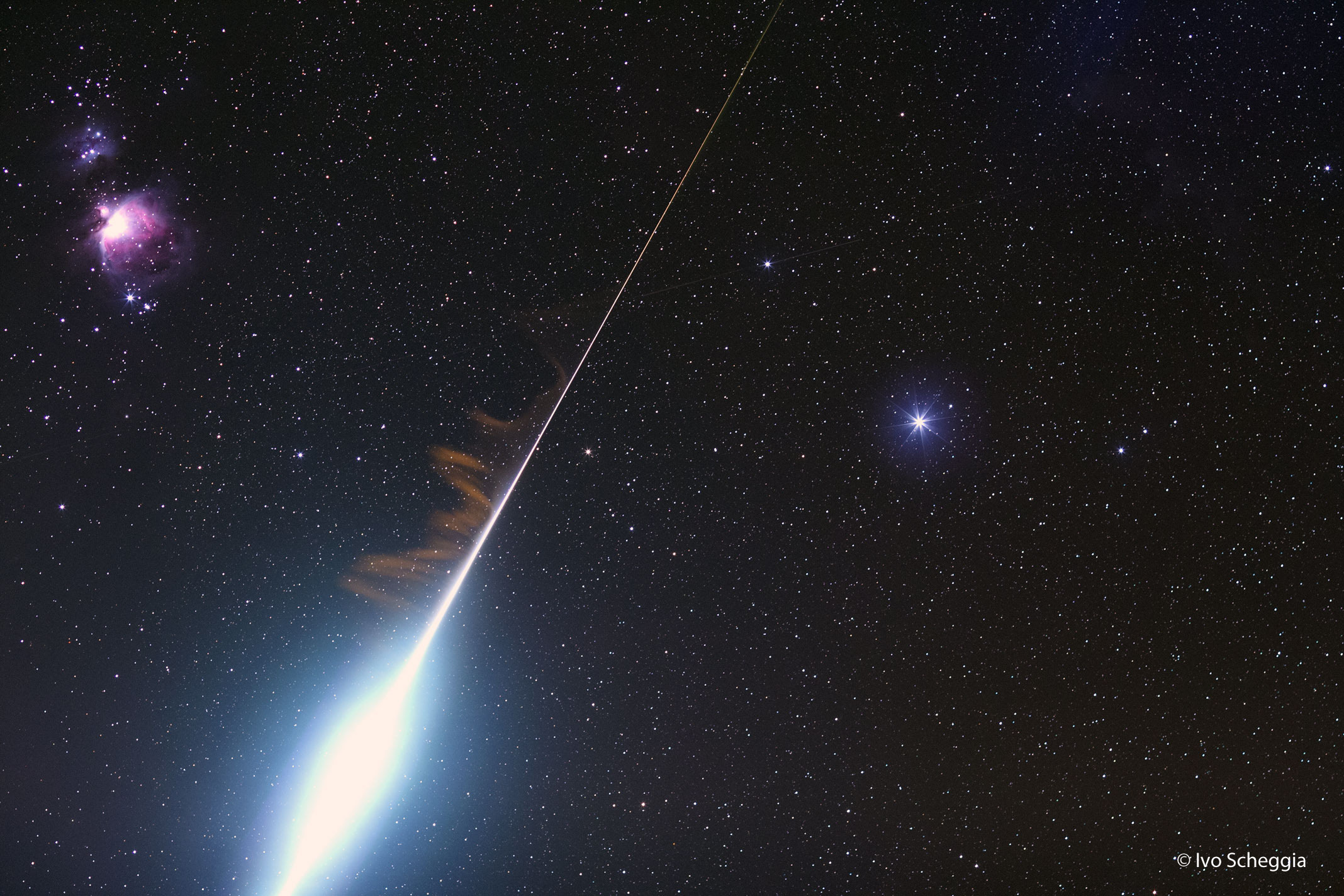
What's happening to that meteor? A few days ago, a bright fireball was photographed from the Alps mountain range in Switzerland as it blazed across the sky. The fireball, likely from the Taurids meteor shower, was notable not only for how bright it was, but for the rare orange light it created that lingered for several minutes. Initially, the orange glow made it seem like the meteor trail was on fire. However, the orange glow, known as a persistent train, originated neither from fire nor sunlight-reflecting smoke. Rather, the persistent train's glow emanated from atoms in the Earth's atmosphere in the path of the meteor -- atoms that had an electron knocked away and emit light during reacquisition. Persistent trains often drift, so that the long 3-minute exposure actually captured the initial wind-blown displacement of these bright former ions. The featured image was acquired when trying to image the famous Orion Nebula, visible on the upper left. The bright blue star Rigel, part of the constellation of Orion, is visible to the right. This week the fireball-rich Taurids meteor shower continues to be active even though it has passed its peak, while the more active Leonids meteor shower is just peaking. Follow APOD on: Facebook, Google Plus, or Twitter
¿Qué está sucediendo con ese meteorito? Hace unos días, un brillante bola de fuego fue fotografiada desde la cadena montañosa de los Alpes en Suiza mientras brillaba en el cielo. La bola de fuego, probablemente proveniente de la lluvia de meteoros Tauridos, fue notable no solo por su brillo, sino también por la rara luz naranja que creó y que permaneció durante varios minutos. Inicialmente, el brillo naranja hizo parecer que la trayectoria del meteorito estaba en llamas. Sin embargo, el brillo naranja, conocido como una cola persistente, no provino ni del fuego ni del humo que reflejaba la luz solar. En cambio, el brillo de la cola persistente emitió luz de átomos en la atmósfera terrestre en el camino del meteorito — átomos que tenían un electrón arrancado y emitían luz durante su reacuquisición. Las colas persistentes suelen desplazarse, por lo que la exposición prolongada de 3 minutos capturó realmente el desplazamiento inicial provocado por el viento de estos iones brillantes anteriores. La imagen destacada fue capturada al intentar fotografiar la famosa Nebulosa de Orión, visible en la parte superior izquierda. La brillante estrella azul Rigel, parte de la constelación de Orión, es visible a la derecha. Esta semana, la lluvia de meteoros Tauridos, rica en bolas de fuego, sigue activa aunque ya pasó su pico, mientras que la más activa lluvia de meteoros Leonidos está alcanzando su máximo.