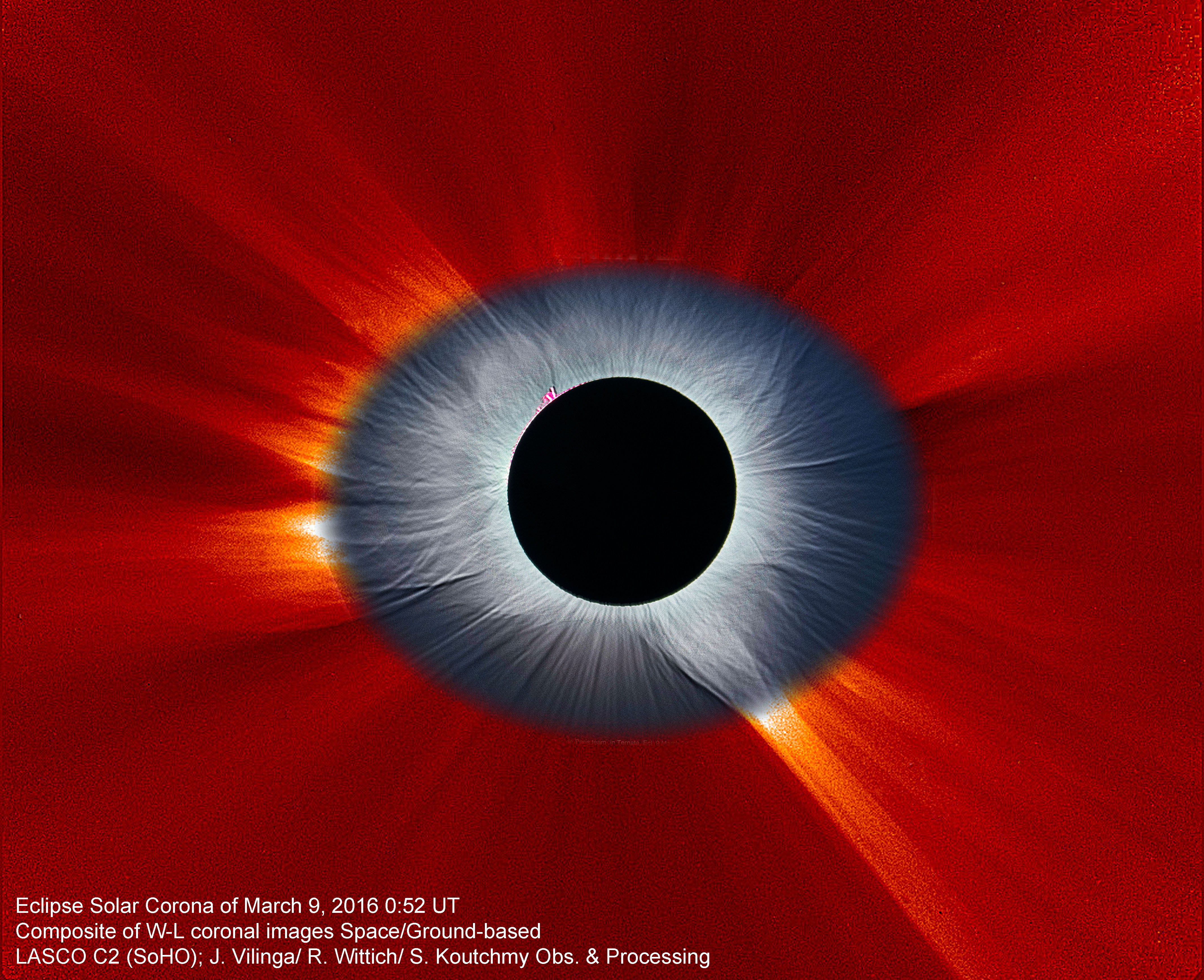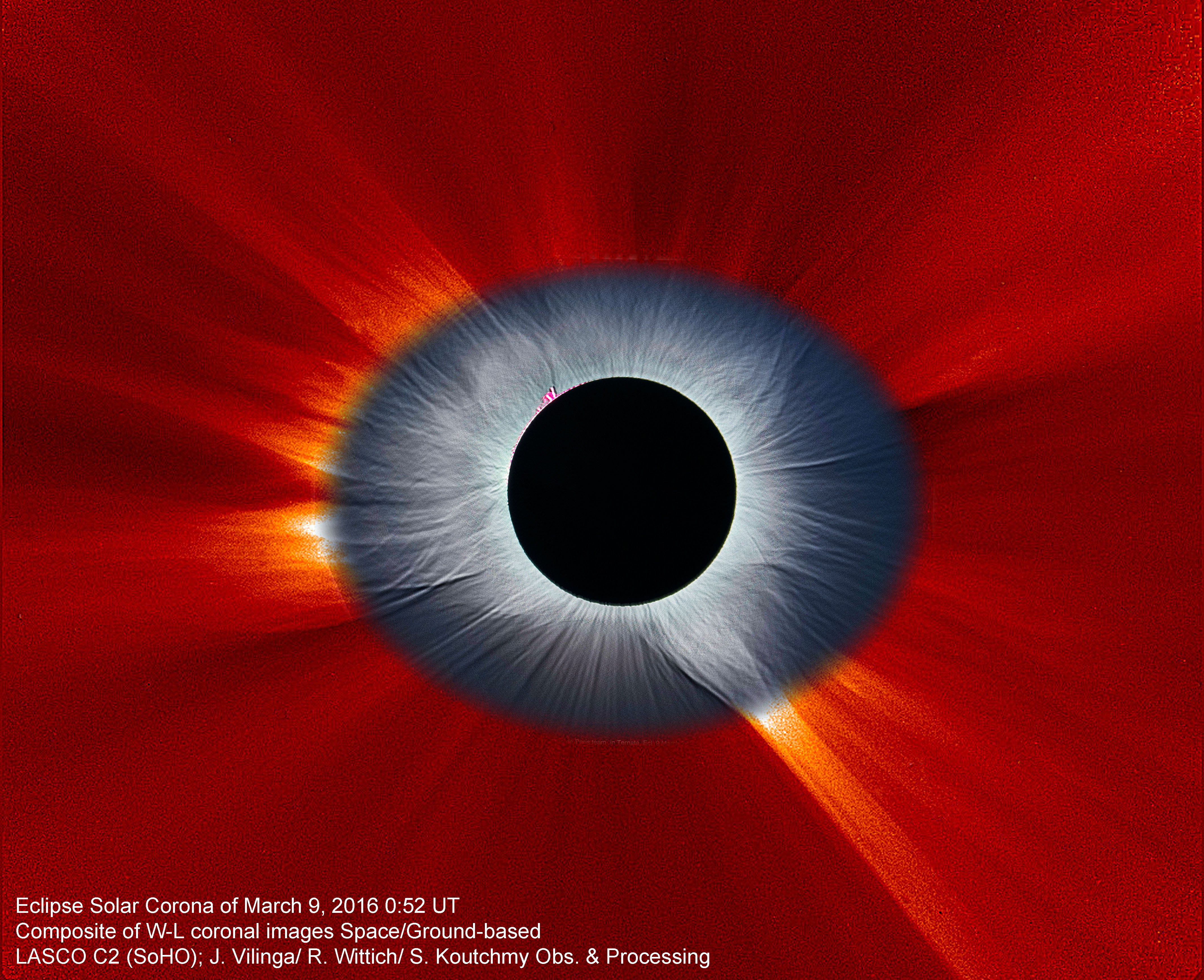
Sometimes, a total eclipse is a good time to eye the Sun. Taking advantage of an unusual juxtaposition of Earth, Moon and Sun, the featured image depicts the total solar eclipse that occurred last month as it appeared -- nearly simultaneously -- from both Earth and space. The innermost image shows the total eclipse from the ground, with the central pupil created by the bright Sun covered by a comparatively dark Moon. Surrounding the blocked solar disk is the tenuous corona of Sun imaged in white light, easily visible from the ground only during an eclipse. Normally, this corona is hard to track far from the Sun, but the featured montage matches it to false-colored observations of the Sun from NASA and ESA's space-based, Sun-orbiting, Solar and Heliospheric Observatory (SOHO). Observations like this allow the study of the constantly changing magnetic activity both near and far from the Sun, the same activity that ultimately drives Earth's auroras. APOD is also available in: Arabic, Bahasa Indonesian, Catalan, Chinese, Chinese, Croatian, Czech, Dutch, Farsi, Farsi, Galego, German, French, Hebrew, Japanese, Korean, Montenegrin, Polish, Romanian, Russian, Serbian, Slovenian, Spanish, and Turkish
A veces, un eclipse total es una buena oportunidad para observar al Sol. Aprovechando una alineación inusual de la Tierra, la Luna y el Sol, la imagen destacada muestra el eclipse total que ocurrió el mes pasado tal como se apareció —casi simultáneamente— desde la Tierra y desde el espacio. La imagen más interna muestra el eclipse total visto desde el suelo, con el disco solar brillante cubierto por la Luna relativamente oscura, creando un punto central. Alrededor del disco solar bloqueado se encuentra la tenue corona solar, capturada en luz blanca, visible desde el suelo solo durante un eclipse. Normalmente, esta corona es difícil de observar lejos del Sol, pero la montaje mostrado la relaciona con observaciones en color falso del Sol obtenidas por la misión Solar and Heliospheric Observatory (SOHO) de NASA y ESA, que orbita alrededor del Sol. Observaciones como esta permiten el estudio de la actividad magnética en constante cambio tanto cerca como lejos del Sol, la misma actividad que finalmente impulsa las auroras terrestres.