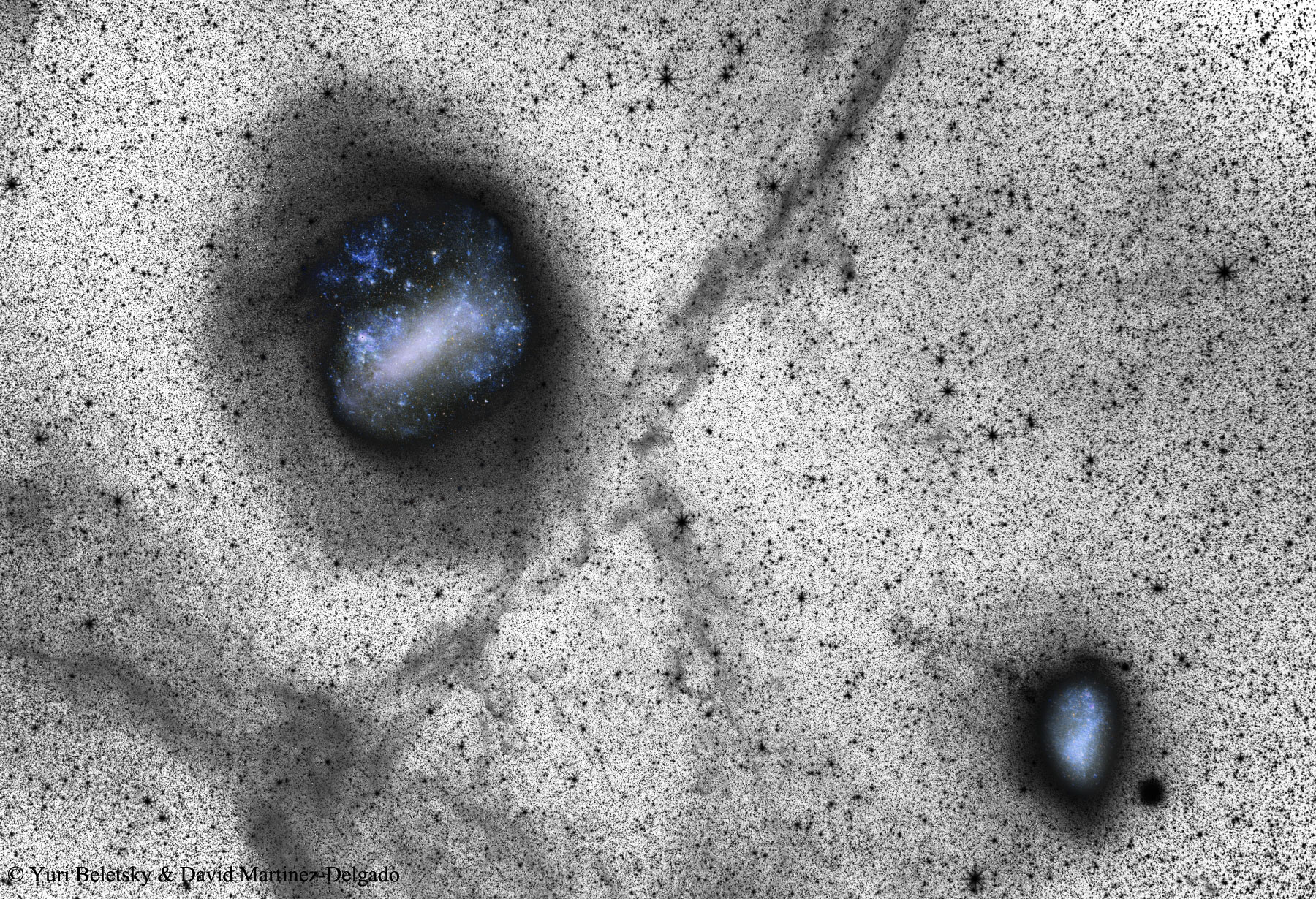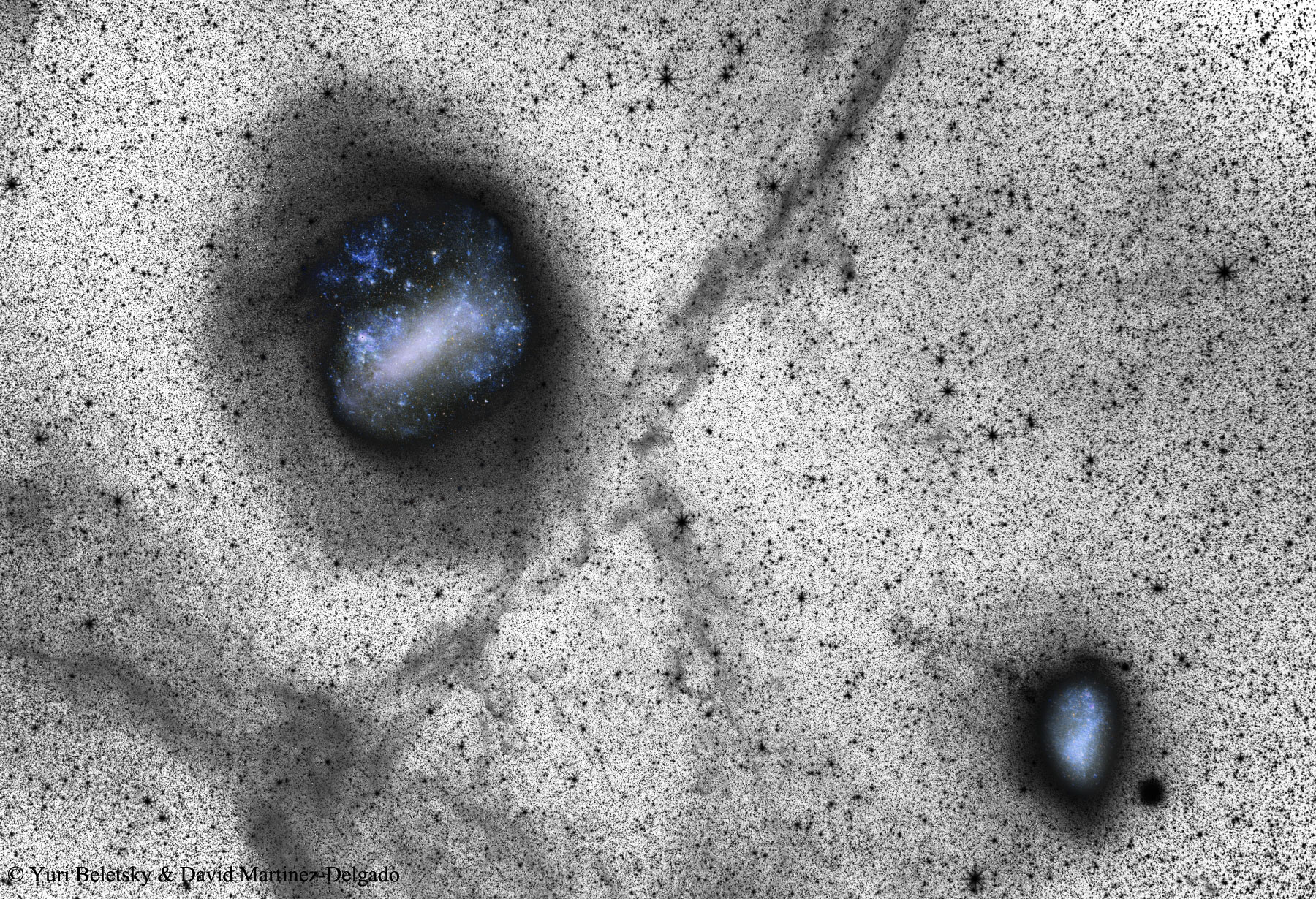
Did the two most famous satellite galaxies of our Milky Way Galaxy once collide? No one knows for sure, but a detailed inspection of deep images like that featured here give an indication that they have. Pictured, the Large Magellanic Cloud (LMC) is on the top left and the Small Magellanic Cloud (SMC) is on the bottom right. The surrounding field is monochrome color-inverted to highlight faint filaments, shown in gray. Perhaps surprisingly, the featured research-grade image was compiled with small telescopes to cover the large angular field -- nearly 40 degrees across. Much of the faint nebulosity is Galactic Cirrus clouds of thin dust in our own Galaxy, but a faint stream of stars does appear to be extending from the SMC toward the LMC. Also, stars surrounding the LMC appear asymmetrically distributed, indicating in simulations that they could well have been pulled off gravitationally in one or more collisions. Both the LMC and the SMC are visible to the unaided eye in southern skies. Future telescopic observations and computer simulations are sure to continue in a continuing effort to better understand the history of our Milky Way and its surroundings.
¿Colisionaron alguna vez las dos galaxias satélites más famosas de nuestra Galaxia Vía Láctea? Nadie lo sabe con certeza, pero una inspección detallada de imágenes profundas como la que se muestra aquí sugiere que así fue. En la imagen, la Nube Magellánica Grande (LMC) se encuentra en la parte superior izquierda y la Nube Magellánica Pequeña (SMC) está en la parte inferior derecha. El campo circundante está invertido en color para resaltar filamentos tenues, mostrados en gris. Sorprendentemente, la imagen de calidad de investigación mostrada fue compilada con telescopios pequeños para cubrir un gran campo angular —casi 40 grados de ancho. Gran parte de la nebulosidad tenue corresponde a nubes de polvo delgadas llamadas Cirrus Galácticas en nuestra propia Galaxia, pero también aparece una tenue corriente de estrellas que parece extenderse desde la SMC hacia la LMC. Además, las estrellas que rodean la LMC aparecen distribuidas de manera asimétrica, lo que indica en simulaciones que podrían haber sido arrancadas gravitacionalmente en una o más colisiones. Tanto la LMC como la SMC son visibles a simple vista en los cielos del hemisferio sur. Las observaciones telescopicas futuras y las simulaciones por computadora seguramente continuarán en un esfuerzo constante por comprender mejor la historia de nuestra Vía Láctea y su entorno.