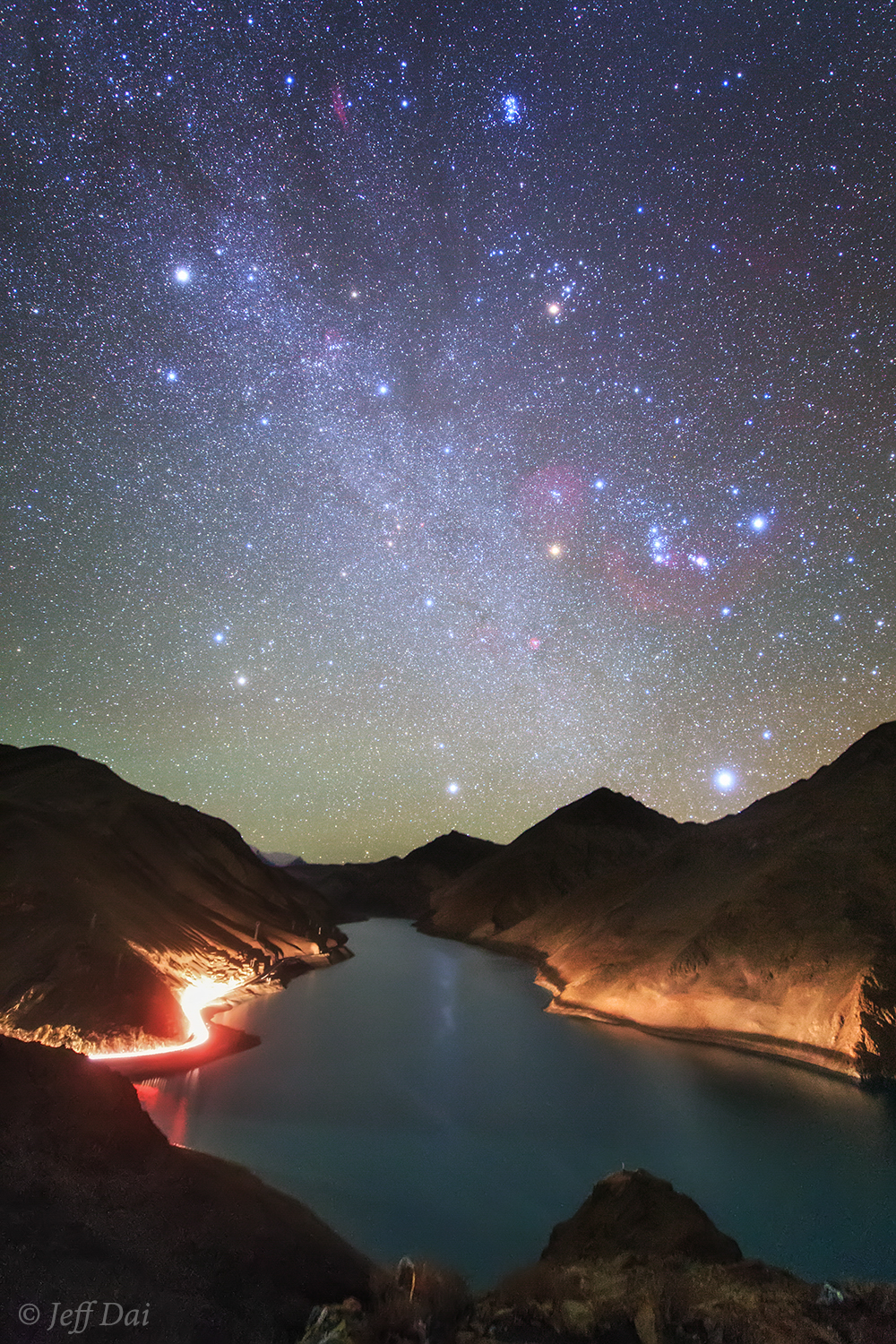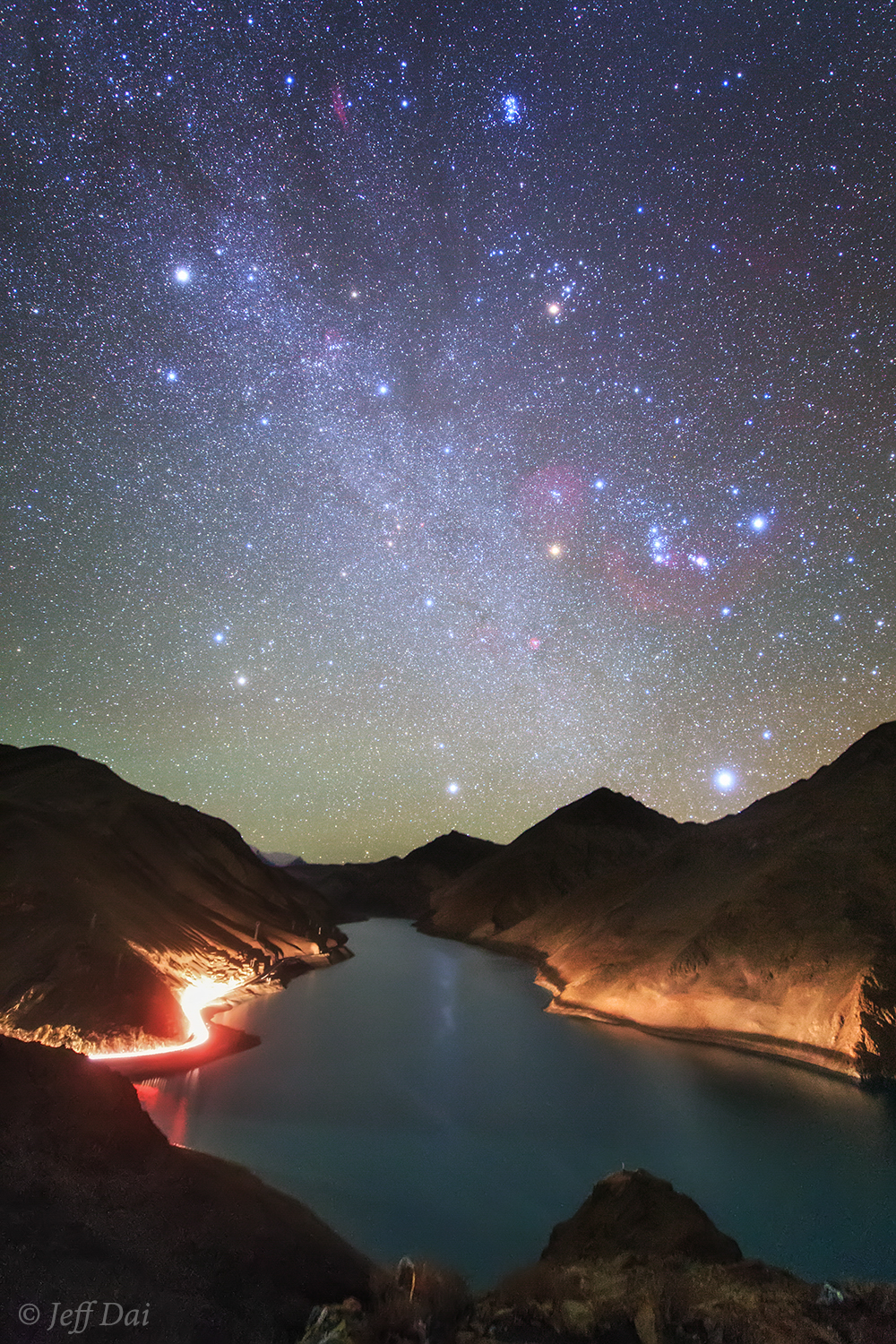
If you can find Orion, you might be able to find the Winter Hexagon. The Winter Hexagon involves some of the brightest stars visible, together forming a large and easily found pattern in the winter sky of Earth's northern hemisphere. The stars involved can usually be identified even in the bright night skies of a big city, although here they appeared recently in dark skies above the Manla Reservoir in Tibet, China. The six stars that compose the Winter Hexagon are Aldebaran, Capella, Castor (and Pollux), Procyon, Rigel, and Sirius. Here, the band of our Milky Way Galaxy runs through the center of the Winter Hexagon, while the Pleiades open star cluster is visible just above. The Winter Hexagon asterism engulfs several constellations including much of the iconic steppingstone Orion. Follow APOD on: Facebook, Google Plus, or Twitter
Si puedes localizar a Orión, podrías poder localizar también el Hexágono Invernal. El Hexágono Invernal incluye algunas de las estrellas más brillantes visibles, juntas formando un gran y fácilmente identificable patrón en el cielo invernal del hemisferio norte de la Tierra. Estas estrellas suelen poder identificarse incluso en los cielos nocturnos brillantes de una gran ciudad, aunque aquí aparecieron recientemente en cielos oscuros sobre el Embalse de Manla en el Tíbet, China. Las seis estrellas que componen el Hexágono Invernal son Aldebarán, Capella, Castor (y Pollux), Procyón, Rigel y Sirio. Aquí, la banda de nuestra Galaxia de la Vía Láctea atraviesa el centro del Hexágono Invernal, mientras que el cúmulo estelar abierto de las Pléyades es visible justo por encima. El asterismo del Hexágono Invernal abarca varias constelaciones, incluyendo gran parte del icónico camino de Orión.