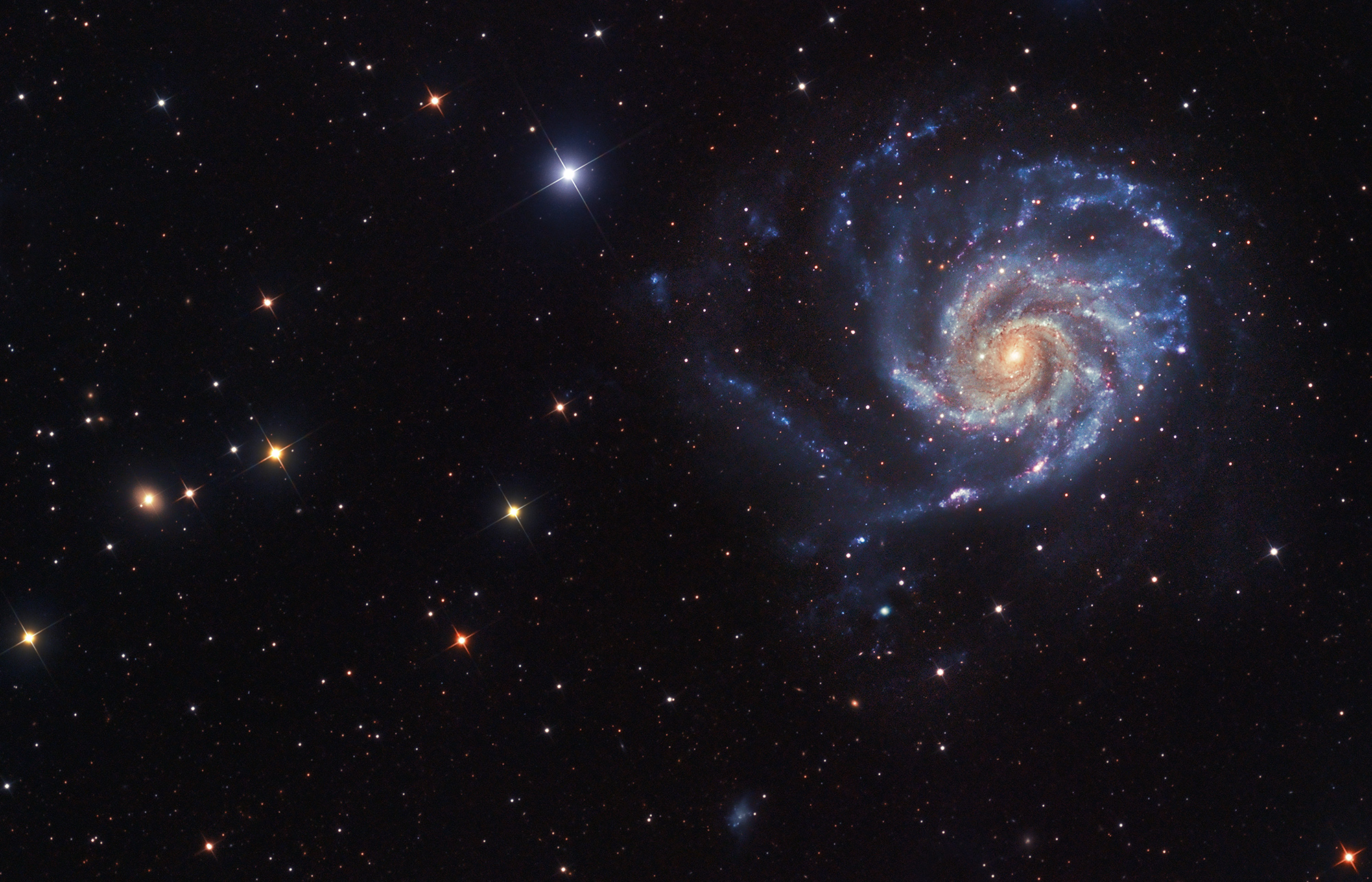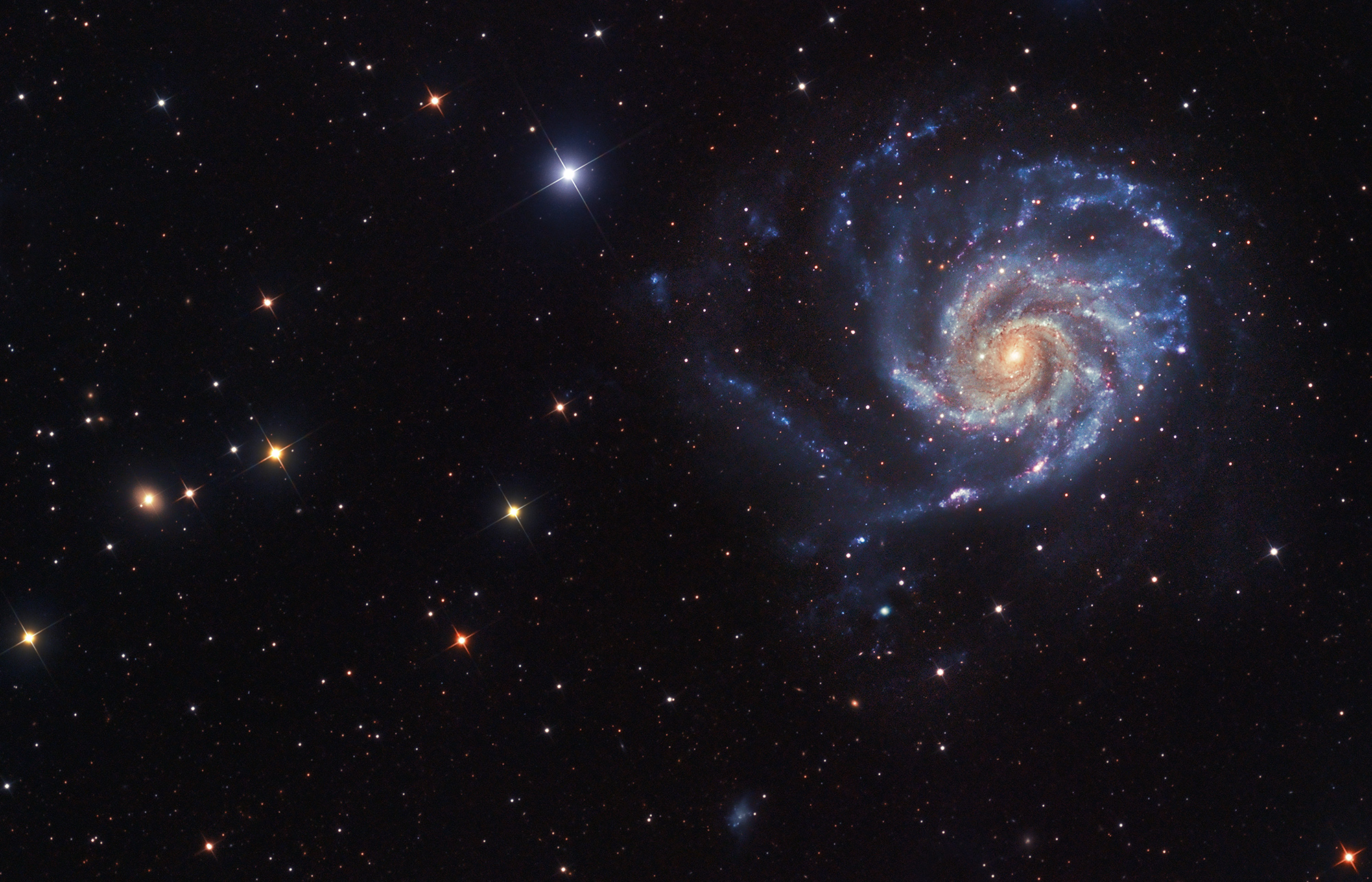
Big, beautiful spiral galaxy M101 is one of the last entries in Charles Messier's famous catalog, but definitely not one of the least. About 170,000 light-years across, this galaxy is enormous, almost twice the size of our own Milky Way galaxy. M101 was also one of the original spiral nebulae observed by Lord Rosse's large 19th century telescope, the Leviathan of Parsontown. M101 shares this modern telescopic field of view with spiky foreground stars within the Milky Way, and more distant background galaxies. The colors of the Milky Way stars can also be found in the starlight from the large island universe. Its core is dominated by light from cool yellowish stars. Along its grand spiral arms are the blue colors of hotter, young stars mixed with obscuring dust lanes and pinkish star forming regions. Also known as the Pinwheel Galaxy, M101 lies within the boundaries of the northern constellation Ursa Major, about 25 million light-years away.
La galaxia espiral grande y bella M101 es una de las últimas entradas en el famoso catálogo de Charles Messier, pero ciertamente no una de las menos importantes. Con un diámetro de aproximadamente 170 000 años luz, esta galaxia es enorme, casi el doble de grande que nuestra propia galaxia, la Vía Láctea. M101 fue también una de las primeras nebulosas espirales observadas con el gran telescopio del siglo XIX de Lord Rosse, el Leviathan de Parsontown. M101 comparte este campo de visión moderno con estrellas delanteras puntiagudas dentro de la Vía Láctea, y galaxias más distantes en el fondo. Los colores de las estrellas de la Vía Láctea también se pueden encontrar en la luz estelar de este gran universo insular. Su núcleo está dominado por la luz de estrellas amarillentas frías. A lo largo de sus grandes brazos espirales se ven los colores azules de estrellas más calientes y jóvenes mezclados con zonas de polvo oscurecedor y regiones de formación estelar de tonos rosados. También conocida como la Galaxia Pino, M101 se encuentra dentro de los límites de la constelación norteña Ursa Major, a unos 25 millones de años luz de distancia.