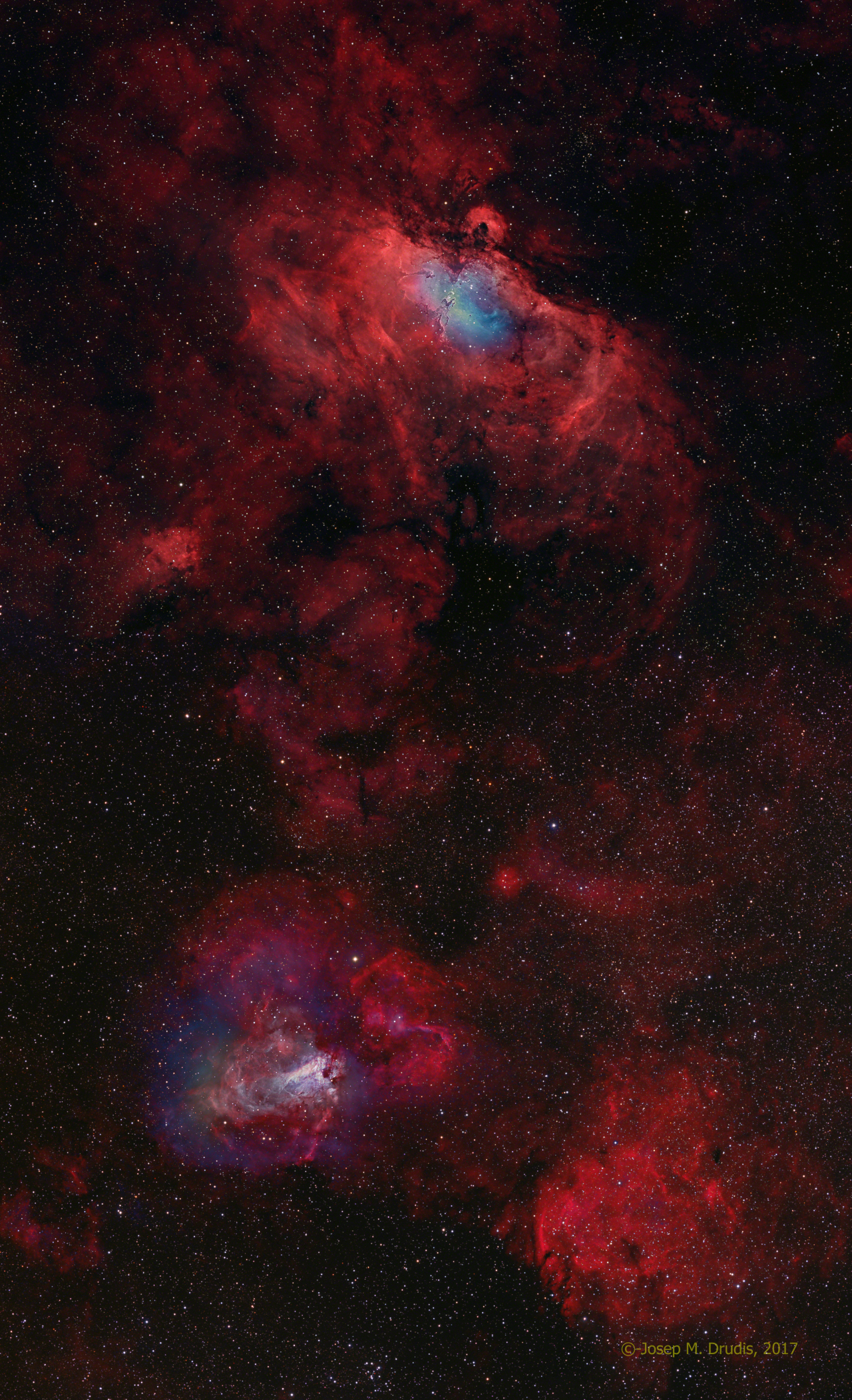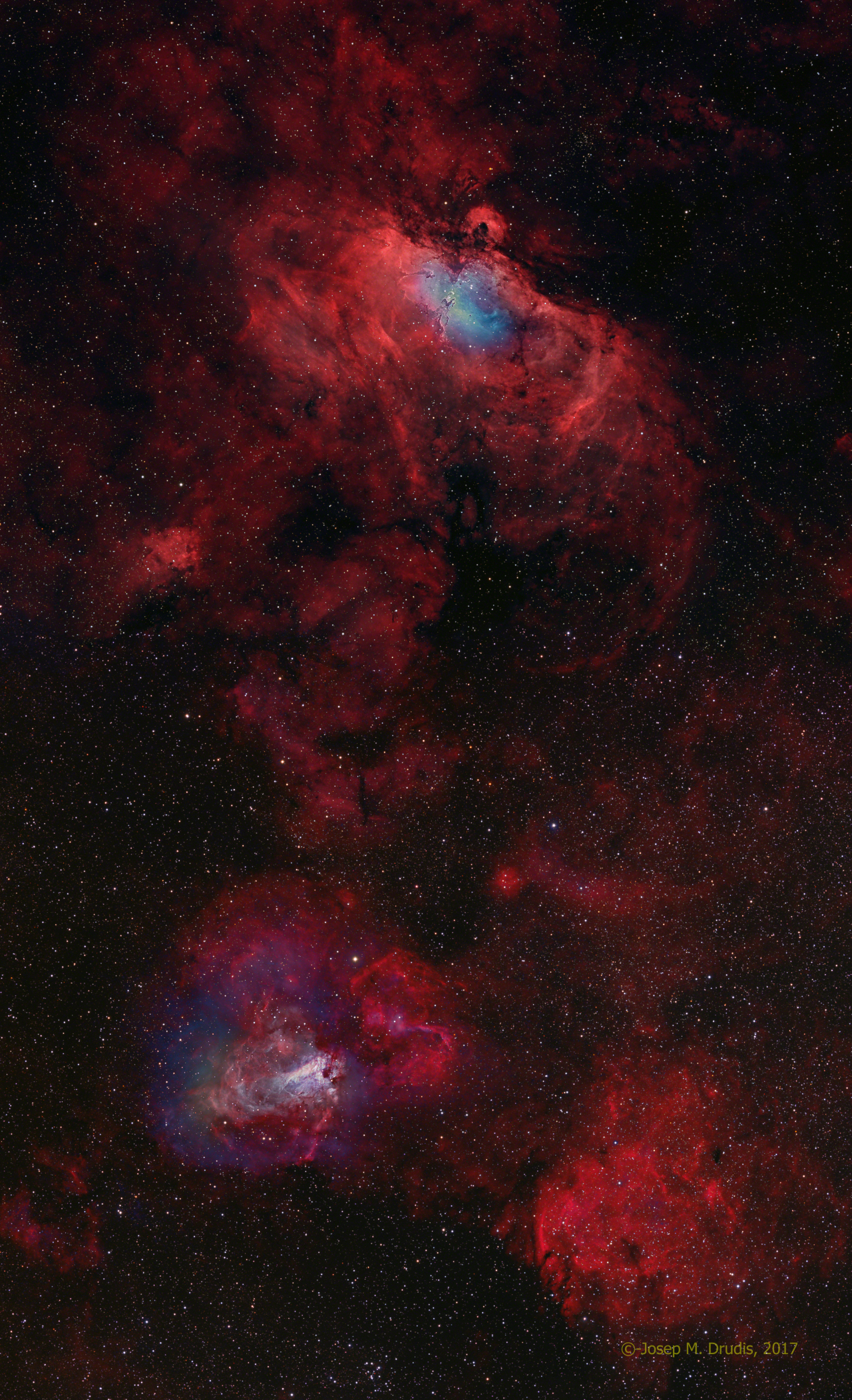
The Eagle Nebula and the Swan Nebula span this broad starscape, a telescopic view toward the Sagittarius spiral arm and the center of our Milky Way galaxy. The Eagle, also known as M16, is at top and M17, the Swan, at bottom of the frame showing the cosmic clouds as brighter regions of active star-formation. They lie along the spiral arm suffused with reddish emission charactistic of atomic hydrogen gas, and dusty dark nebulae. M17, also called the Omega Nebula, is about 5500 light-years away, while M16 is some 6500 light-years distant. The center of both nebulae are locations of well-known close-up images of star formation from the Hubble Space Telescope. In this mosaic image that extends about 3 degrees across the sky, narrowband, high-resultion image data has been used to enhance the central regions of the Eagle and Swan. The extended wings of the Eagle Nebula spread almost 120 light-years. The Swan is over 30 light-years across.
La Nebulosa del Águila y la Nebulosa del Cisne abarcan este amplio paisaje estelar, una vista telescópica hacia el brazo espiral de Sagitario y el centro de nuestra galaxia Vía Láctea. El Águila, también conocida como M16, se encuentra en la parte superior, mientras que M17, el Cisne, se encuentra en la parte inferior del marco, mostrando las nubes cósmicas como regiones más brillantes de formación estelar activa. Ambas se encuentran a lo largo del brazo espiral impregnado de emisión rojiza característica del gas hidrógeno atómico, y de nebulosas oscuras polvorientas. M17, también llamada Nebulosa Omega, se encuentra a unos 5500 años luz de distancia, mientras que M16 se encuentra a unos 6500 años luz. El centro de ambas nebulosas son lugares de imágenes bien conocidas de formación estelar tomadas por el Telescopio Espacial Hubble. En esta imagen mosaico que abarca aproximadamente 3 grados del cielo, se han utilizado datos de imágenes de banda estrecha y alta resolución para resaltar las regiones centrales de El Águila y El Cisne. Las alas extendidas de la Nebulosa del Águila se extienden casi 120 años luz. El Cisne tiene más de 30 años luz de ancho.