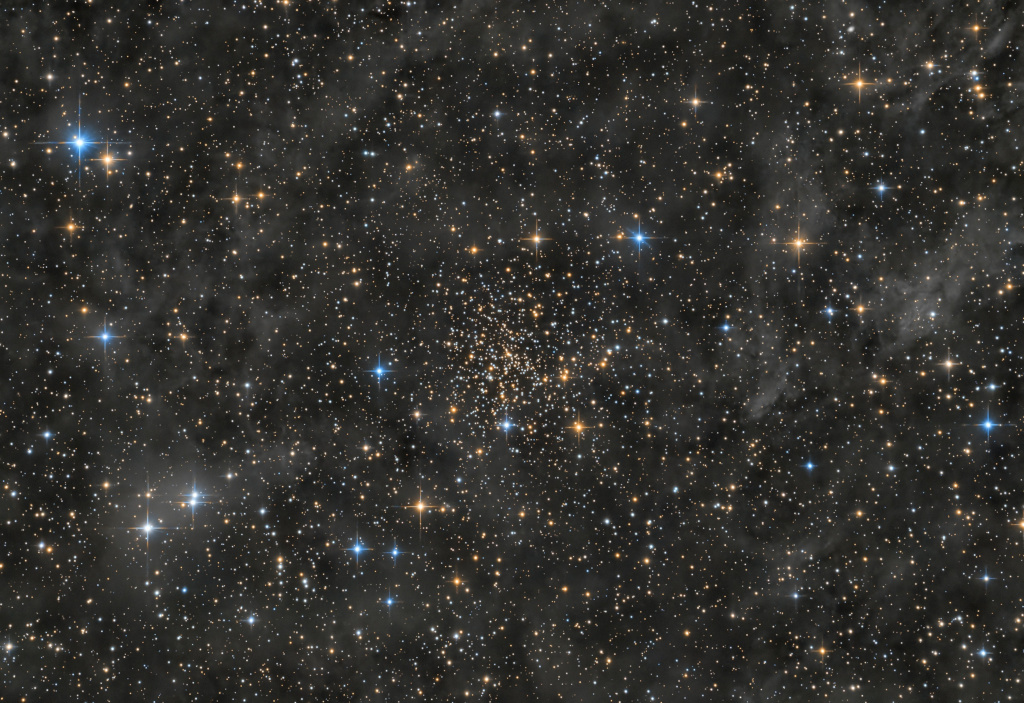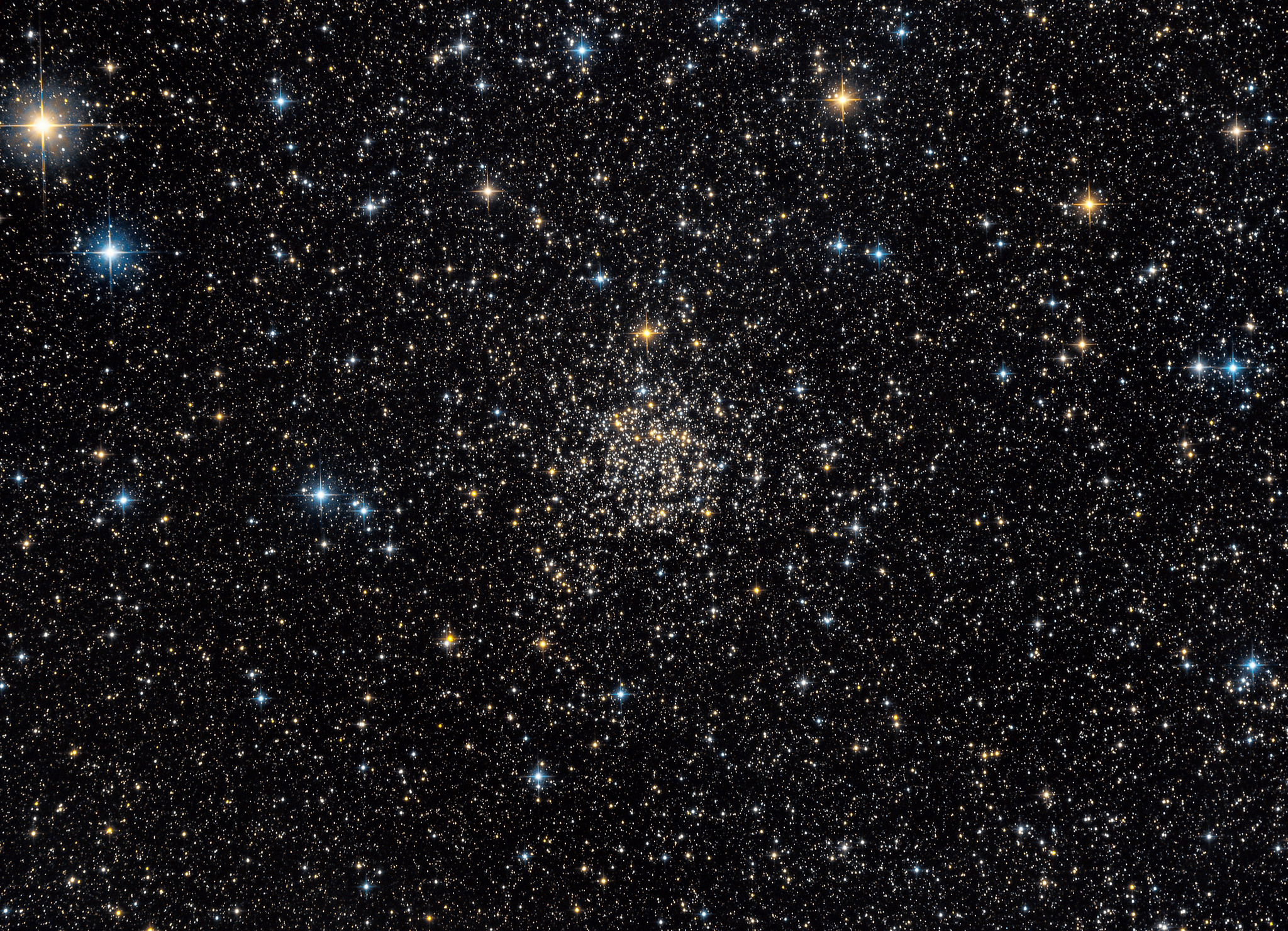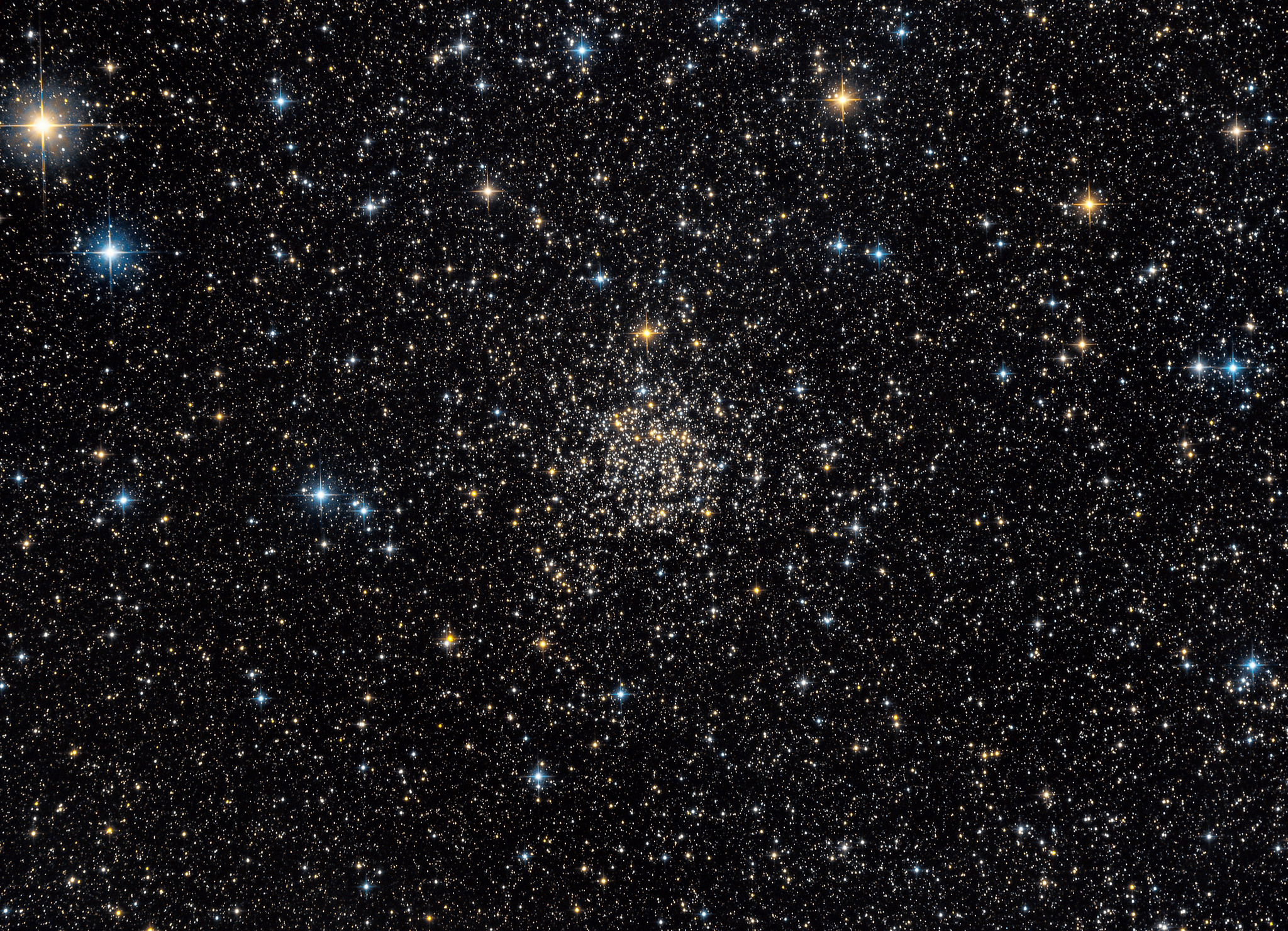
Found among the rich starfields of the Milky Way, star cluster NGC 7789 lies about 8,000 light-years away toward the constellation Cassiopeia. A late 18th century deep sky discovery of astronomer Caroline Lucretia Herschel, the cluster is also known as Caroline's Rose. Its flowery visual appearance in small telescopes is created by the cluster's nestled complex of stars and voids. Now estimated to be 1.6 billion years young, the galactic or open cluster of stars also shows its age. All the stars in the cluster were likely born at the same time, but the brighter and more massive ones have more rapidly exhausted the hydrogen fuel in their cores. These have evolved from main sequence stars like the Sun into the many red giant stars shown with a yellowish cast in this lovely color composite. Using measured color and brightness, astronomers can model the mass and hence the age of the cluster stars just starting to "turn off" the main sequence and become red giants. Over 50 light-years across, Caroline's Rose spans about half a degree (the angular size of the Moon) near the center of the wide-field telescopic image.
Ubicado entre las ricas regiones estelares de la Vía Láctea, el cúmulo estelar NGC 7789 se encuentra a unos 8.000 años luz de distancia, en dirección a la constelación de Casiopea. Descubierto en el siglo XVIII por la astrónoma Caroline Lucretia Herschel, el cúmulo también es conocido como La Rosa de Caroline. Su apariencia floral en telescopios pequeños se debe a la compleja distribución de estrellas y vacíos dentro del cúmulo. Actualmente estimado en unos 1.600 millones de años, este cúmulo galáctico o abierto también muestra su edad. Todas las estrellas del cúmulo probablemente nacieron al mismo tiempo, pero las más brillantes y masivas han agotado más rápidamente el hidrógeno en sus núcleos. Estas han evolucionado desde estrellas en la secuencia principal, como el Sol, hasta las muchas estrellas gigantes rojas que se muestran con un tono amarillento en esta hermosa imagen compuesta en color. Utilizando mediciones de color y brillo, los astrónomos pueden modelar la masa y, por lo tanto, la edad de las estrellas del cúmulo que comienzan a 'alejarse' de la secuencia principal y convertirse en gigantes rojas. Con más de 50 años luz de diámetro, La Rosa de Caroline abarca aproximadamente medio grado (el tamaño angular de la Luna) cerca del centro de la imagen obtenida con un telescopio de campo amplio.