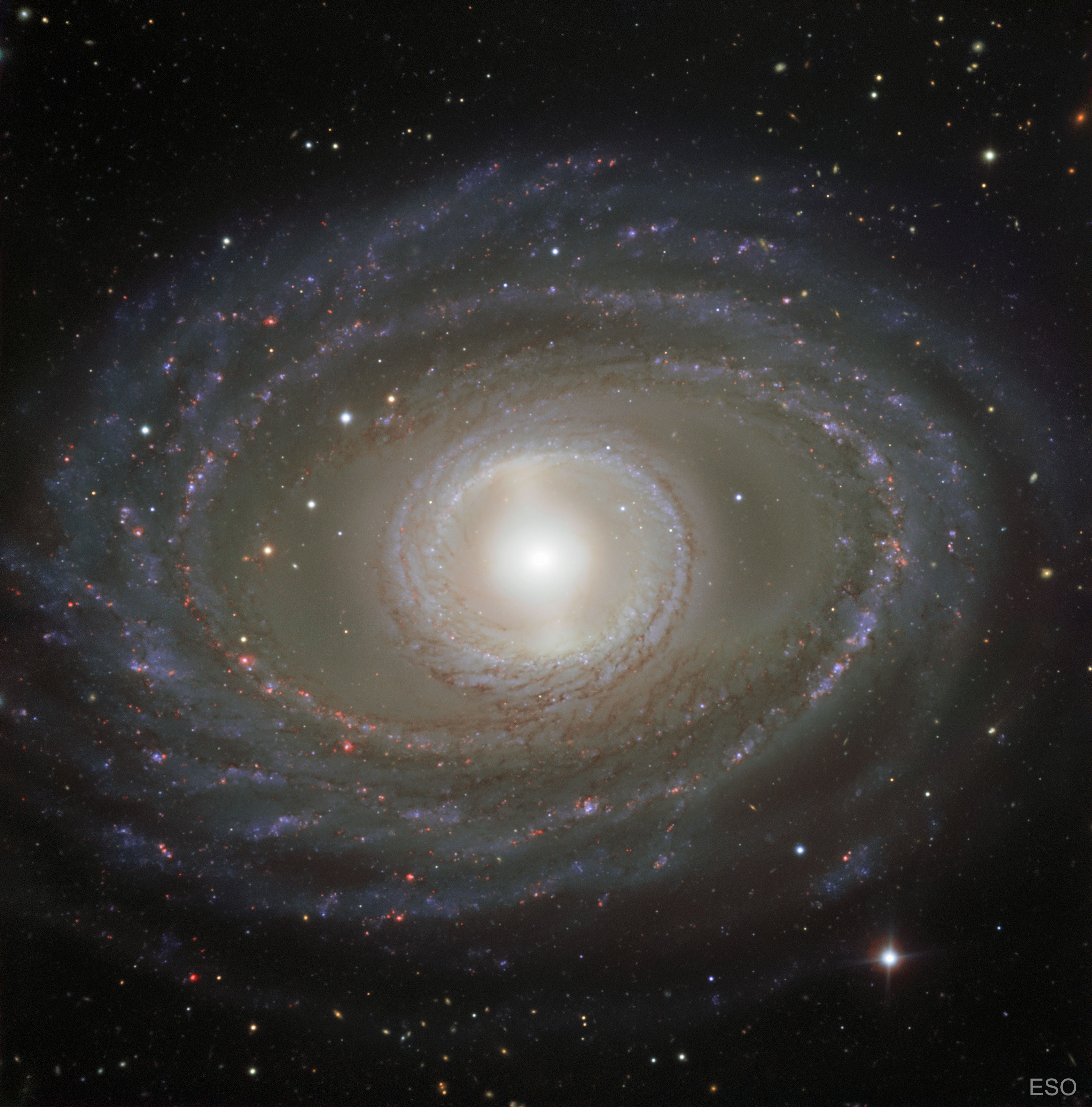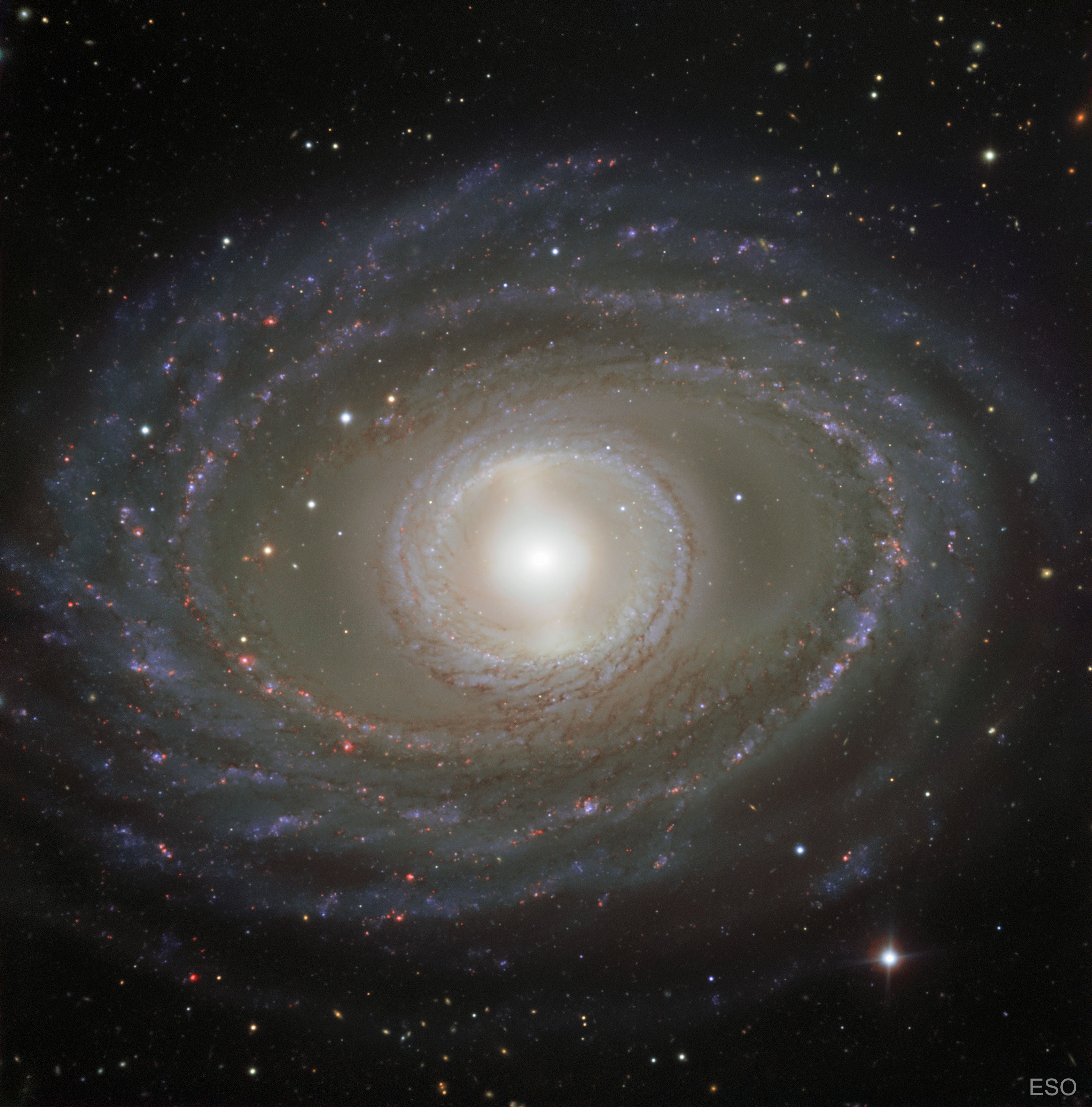
Why do some spiral galaxies have a ring around the center? Spiral galaxy NGC 1398 not only has a ring of pearly stars, gas and dust around its center, but a bar of stars and gas across its center, and spiral arms that appear like ribbons farther out. The featured image was taken with ESO's Very Large Telescope at the Paranal Observatory in Chile and resolves this grand spiral in impressive detail. NGC 1398 lies about 65 million light years distant, meaning the light we see today left this galaxy when dinosaurs were disappearing from the Earth. The photogenic galaxy is visible with a small telescope toward the constellation of the Furnace (Fornax). The ring near the center is likely an expanding density wave of star formation, caused either by a gravitational encounter with another galaxy, or by the galaxy's own gravitational asymmetries.
¿Por qué algunas galaxias espirales tienen un anillo alrededor del centro? La galaxia espiral NGC 1398 no solo tiene un anillo de estrellas, gas y polvo perlado alrededor de su centro, sino también una barra de estrellas y gas atravesando su centro, y brazos espirales que parecen cintas más allá. La imagen destacada fue tomada con el Telescopio Muy Grande del ESO en el Observatorio Paranal en Chile y resuelve esta gran espiral con un detalle impresionante. NGC 1398 se encuentra a unos 65 millones de años luz de distancia, lo que significa que la luz que vemos hoy salió de esta galaxia cuando los dinosaurios desaparecían de la Tierra. La galaxia fotogénica es visible con un pequeño telescopio hacia la constelación de la Forja (Fornax). El anillo cerca del centro probablemente sea una onda de densidad expansiva de formación estelar, causada ya sea por un encuentro gravitacional con otra galaxia, o por las propias asimetrías gravitacionales de la galaxia.