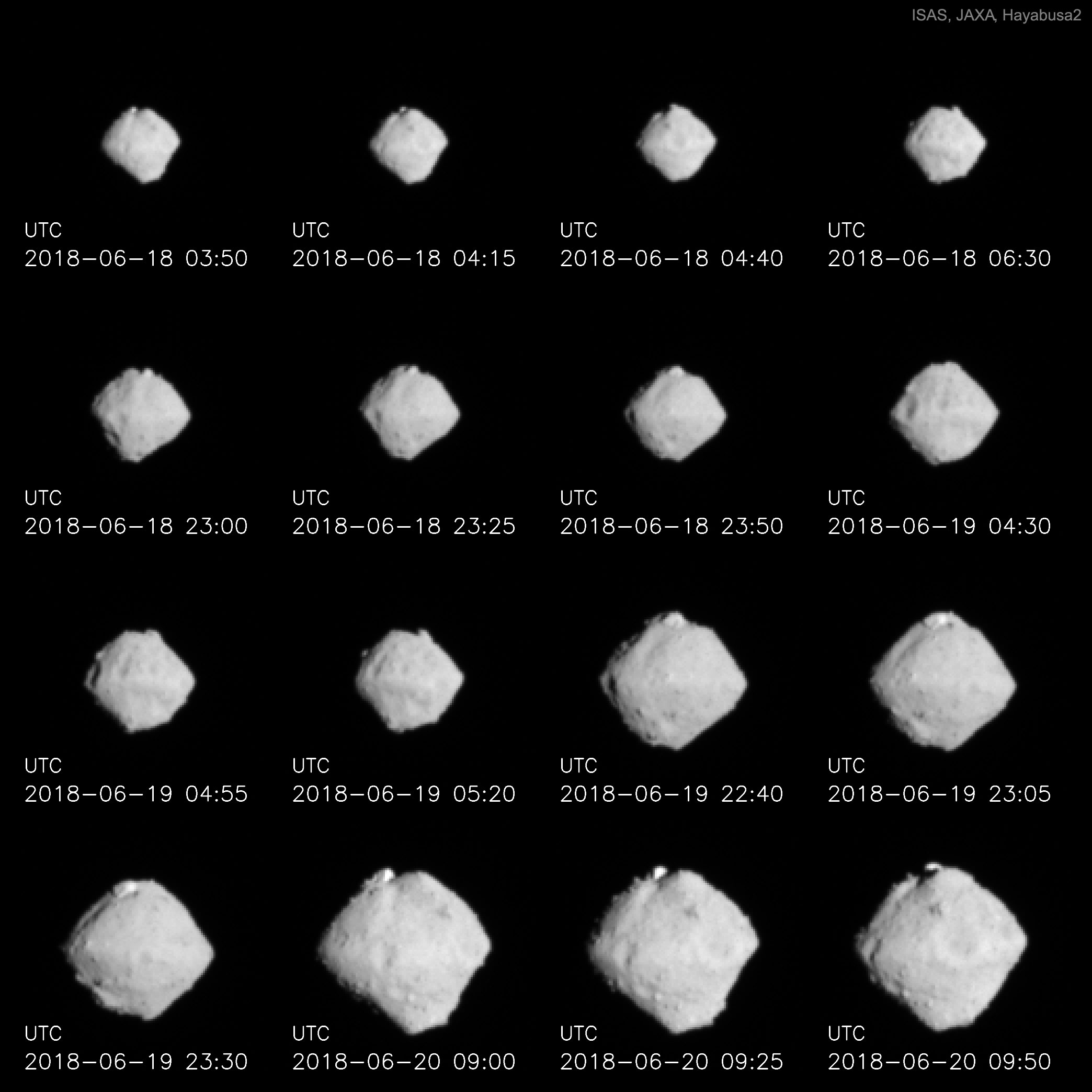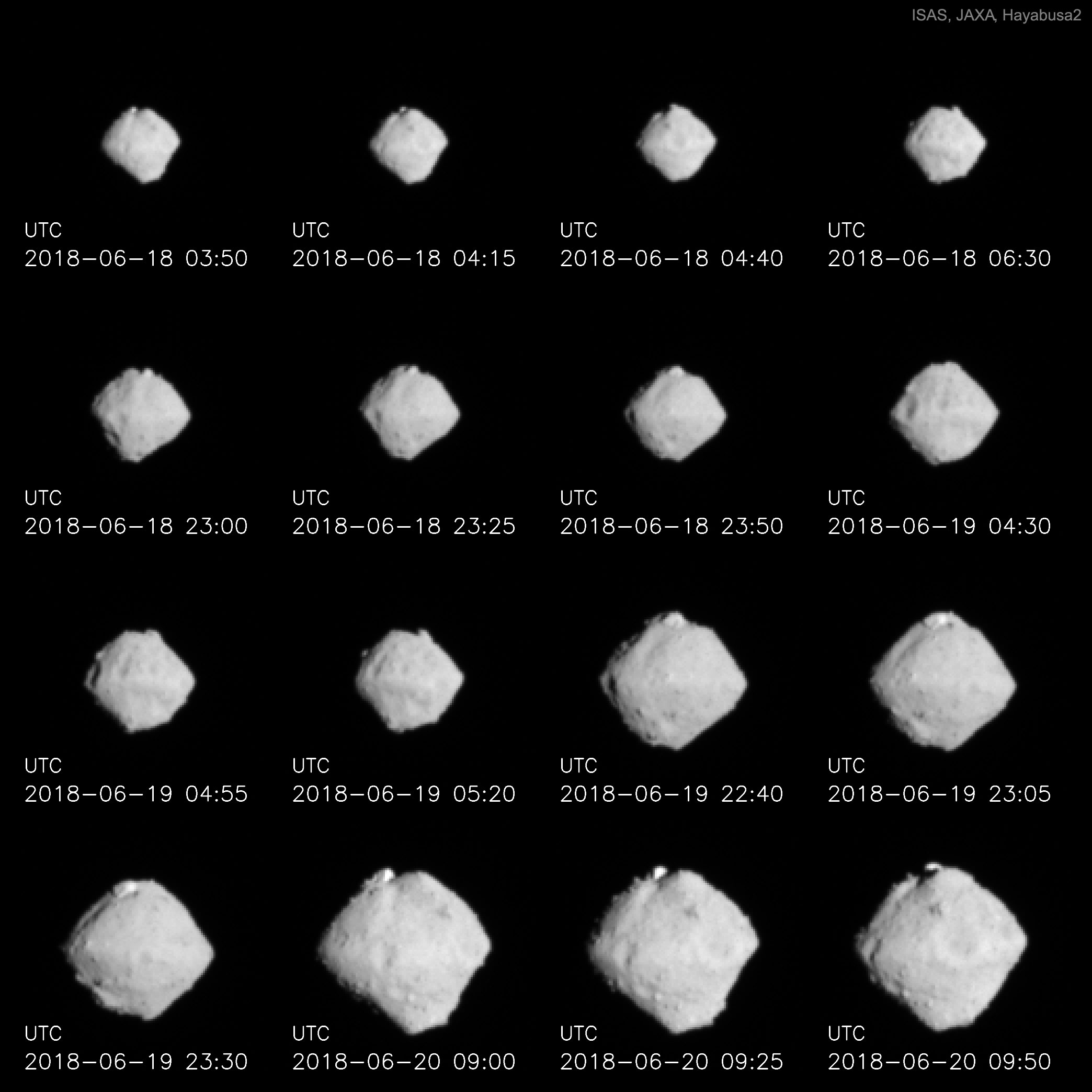
It looks like a big space diamond -- but with craters. It's 162173 Ryugu (Dragon's Castle), and Japan's robotic Hayabusa2 mission is now arriving at this near-Earth asteroid. Ambitious Hayabusa2 is carrying an armada of separable probes, including two impactors, four small close-proximity hoverers, three small surface hoppers, and the Mobile Asteroid Surface Scout (MASCOT) which will land, study, and move around on Ryugu's surface. Most of these are equipped with cameras. Moreover, Hayabusa2 itself is scheduled to collect surface samples and return these samples to Earth for a detailed analysis near the end of 2020. Previously, what was known about asteroid Ryugu was its orbit, that it spans about one kilometer, and that it has a dark surface that reflects unusual colors. Studying Ryugu could tell humanity not only about Ryugu's surface and interior, but about what materials were available in the early Solar System for the development of life. Pictured, a series of approach images shows features suggestive of large boulders and craters.
Se parece a un gran diamante en el espacio, pero con cráteres. Se trata de 162173 Ryugu (Castillo del Dragón), y la misión robótica japonesa Hayabusa2 está llegando ahora a este asteroide cercano a la Tierra. La ambiciosa Hayabusa2 lleva una flota de sondas separables, incluyendo dos impactores, cuatro pequeños vehículos de proximidad, tres pequeños saltadores de superficie y el Mobile Asteroid Surface Scout (MASCOT), que aterrizará, estudiará y se moverá por la superficie de Ryugu. La mayoría de estos están equipados con cámaras. Además, Hayabusa2 está programada para recoger muestras de la superficie y devolver estas muestras a la Tierra para un análisis detallado a finales de 2020. Antes de esto, lo que se sabía sobre el asteroide Ryugu era su órbita, que abarca aproximadamente un kilómetro, y que tiene una superficie oscura que refleja colores inusuales. Estudiar Ryugu podría decirnos no solo sobre su superficie y su interior, sino también sobre qué materiales estaban disponibles en el Sistema Solar primitivo para el desarrollo de la vida. En la imagen, una serie de imágenes de acercamiento muestra características sugestivas de grandes rocas y cráteres.