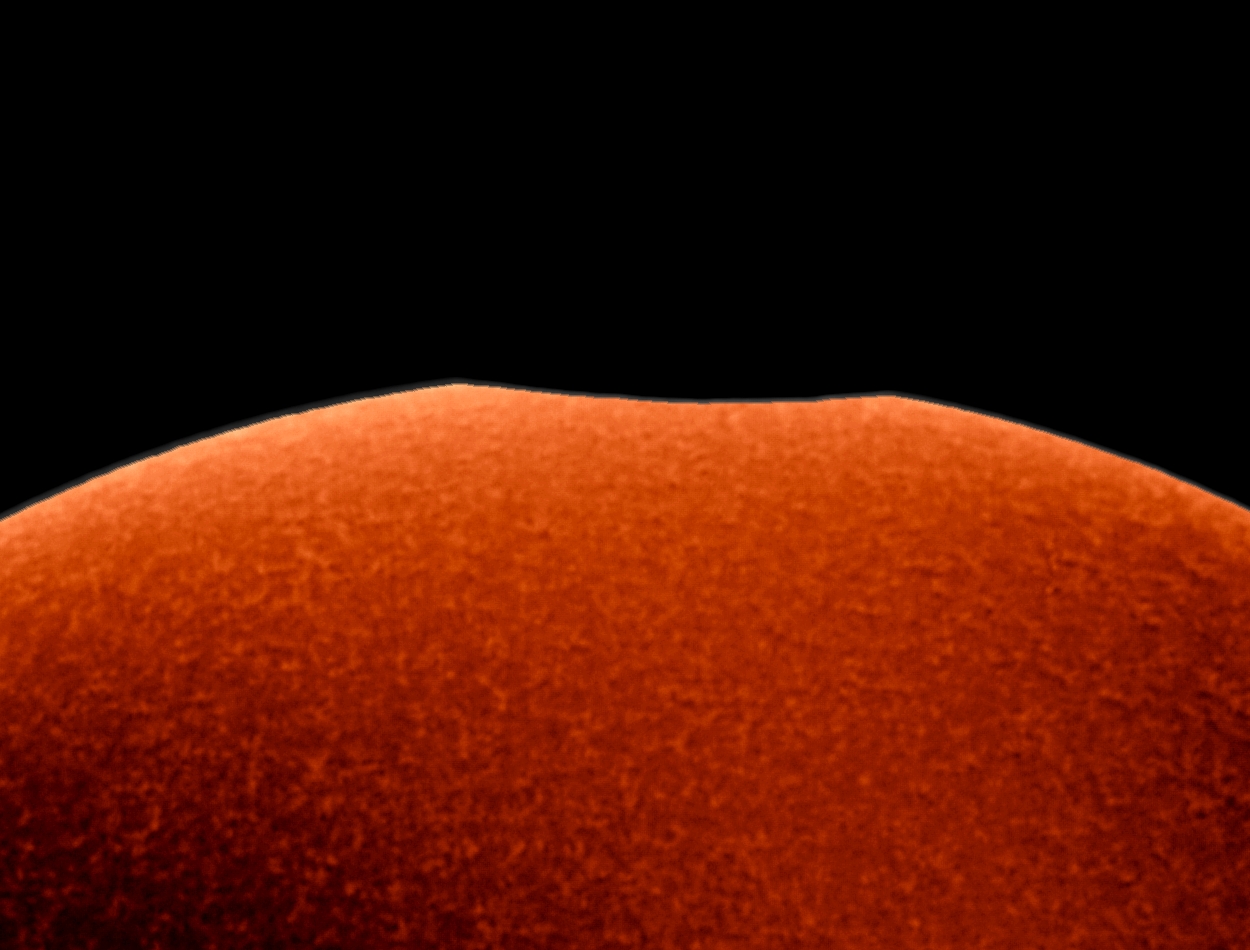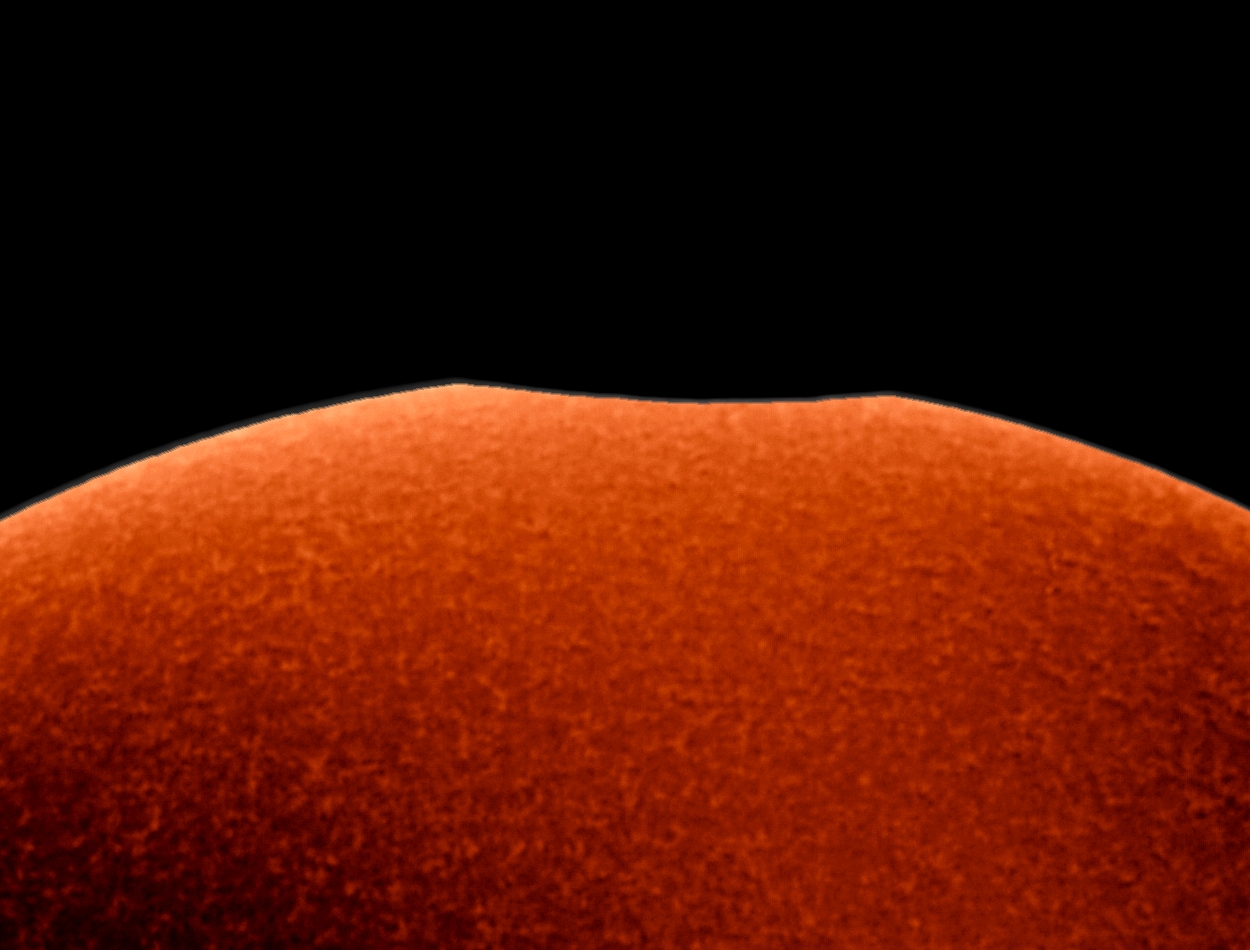
The smallest of the three partial solar eclipses during 2018 was just yesterday, Friday, July 13. It was mostly visible over the open ocean between Australia and Antarctica. Still, this video frame of a tiny nibble on the Sun was captured through a hydrogen-alpha filter from Port Elliott, South Australia, during the maximum eclipse visible from that location. There, the New Moon covered about 0.16 percent of the solar disk. The greatest eclipse, about one-third of the Sun's diameter blocked by the New Moon, could be seen from East Antarctica near Peterson Bank, where the local emperor penguin colony likely had the best view. During this prolific eclipse season, the coming Full Moon will bring a total lunar eclipse on July 27, followed by yet another partial solar eclipse at the next New Moon on August 11.
El más pequeño de los tres eclipses solares parciales de 2018 tuvo lugar ayer, viernes 13 de julio. Fue principalmente visible sobre el océano abierto entre Australia y la Antártida. Sin embargo, este fotograma de video de un pequeño mordisco en el Sol fue capturado a través de un filtro de hidrógeno alfa desde Port Elliott, en el sur de Australia, durante el máximo eclipse visible desde esa ubicación. Allí, la Luna Nueva cubrió aproximadamente el 0.16 por ciento del disco solar. El eclipse más profundo, en el que la Luna Nueva bloqueó aproximadamente un tercio del diámetro del Sol, pudo verse desde la Antártida Oriental cerca del Banco Peterson, donde probablemente la colonia local de pingüinos emperadores tuvo la mejor vista. Durante esta temporada de eclipses prolífica, la próxima Luna Llena traerá un eclipse lunar total el 27 de julio, seguido por otro eclipse solar parcial en la próxima Luna Nueva del 11 de agosto.