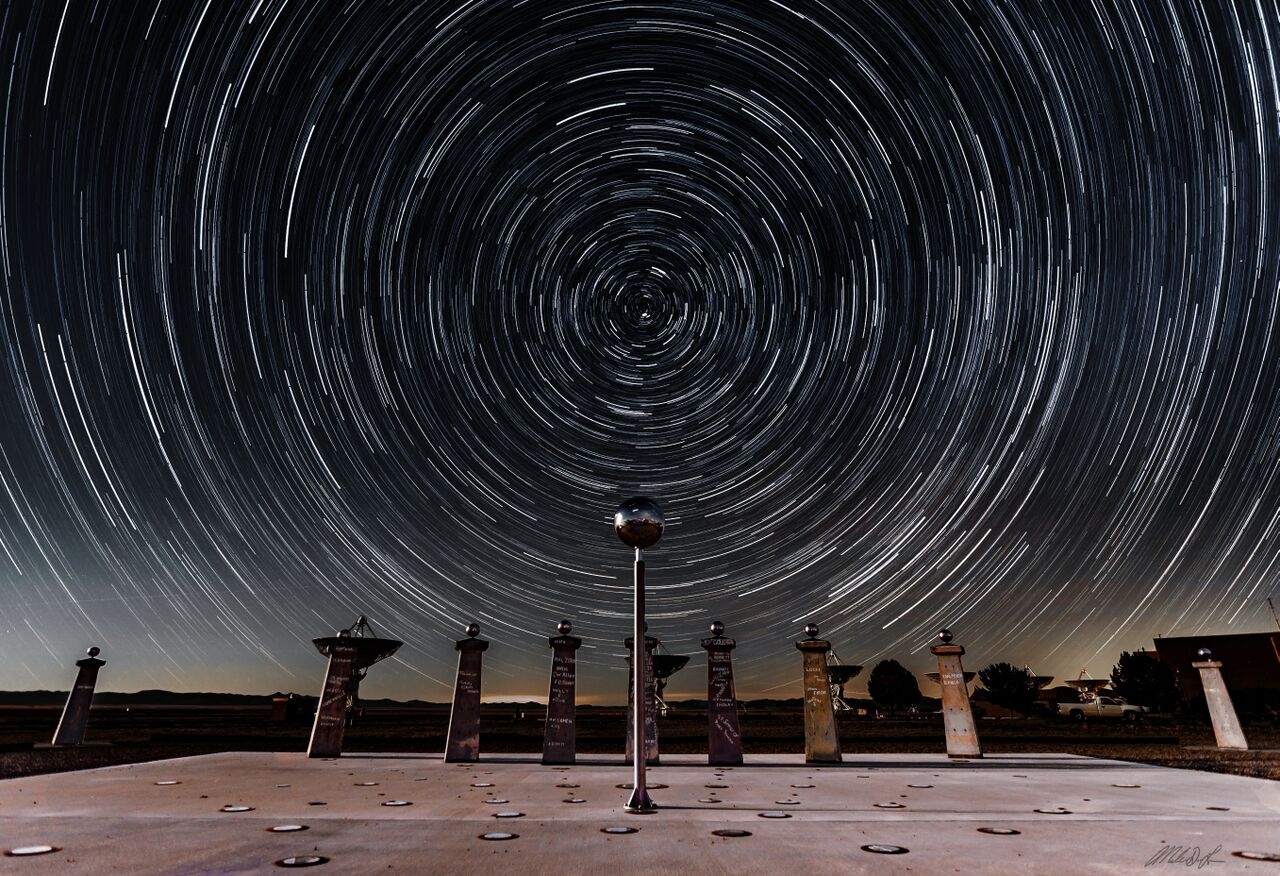
Sundials use the location of a shadow to measure the Earth's rotation and indicate the time of day. So it's fitting that this sundial, at the Very Large Array Radio Telescope Observatory in New Mexico, commemorates the history of radio astronomy and radio astronomy pioneer Ronald Bracewell. The radio sundial was constructed using pieces of a solar mapping radio telescope array that Bracewell orginaly built near the Stanford University campus. Bracewell's array was used to contribute data to plan the first Moon landing, its pillars signed by visiting scientists and radio astronomers, including two Nobel prize winners. As for most sundials the shadow cast by the central gnomon follows markers that show the solar time of day, along with solstices and equinoxes. But markers on the radio sundial are also laid out according to local sidereal time. They show the position of the invisible radio shadows of three bright radio sources in Earth's sky, supernova remnant Cassiopeia A, active galaxy Cygnus A, and active galaxy Centaurus A. Sidereal time is just star time, the Earth's rotation as measured with the stars and distant galaxies. That rotation is reflected in this composited hour-long exposure. Above the Bracewell Radio Sundial, the stars trace concentric trails around the north celestial pole.
Los relojes solares usan la ubicación de una sombra para medir la rotación de la Tierra e indicar la hora del día. Por lo tanto, es apropiado que este reloj solar, ubicado en la Observatorio del Telescopio de Radio Very Large Array en Nuevo México, conmemore la historia de la astronomía de radio y al pionero en astronomía de radio Ronald Bracewell. El reloj solar de radio fue construido utilizando piezas de una matriz de telescopios de radio para mapeo solar que Bracewell originalmente construyó cerca del campus de la Universidad de Stanford. La matriz de Bracewell se utilizó para contribuir datos en la planificación del primer alunizaje, y sus pilares estaban firmados por científicos y astrónomos de radio visitantes, incluyendo a dos ganadores del Premio Nobel. Al igual que la mayoría de los relojes solares, la sombra proyectada por el gnomón central sigue marcadores que muestran la hora solar del día, junto con los solsticios y equinoccios. Pero los marcadores en el reloj solar de radio también están dispuestos según el tiempo sidéreo local. Muestran la posición de las invisibles sombras de radio de tres fuentes de radio brillantes en el cielo terrestre, el resto de supernova Cassiopeia A, la galaxia activa Cygnus A y la galaxia activa Centaurus A. El tiempo sidéreo es simplemente el tiempo estelar, la rotación de la Tierra medida con las estrellas y galaxias distantes. Esa rotación se refleja en esta exposición compuesta de una hora. Sobre el Reloj Solar de Radio de Bracewell, las estrellas trazan rastros concéntricos alrededor del polo celeste norte.