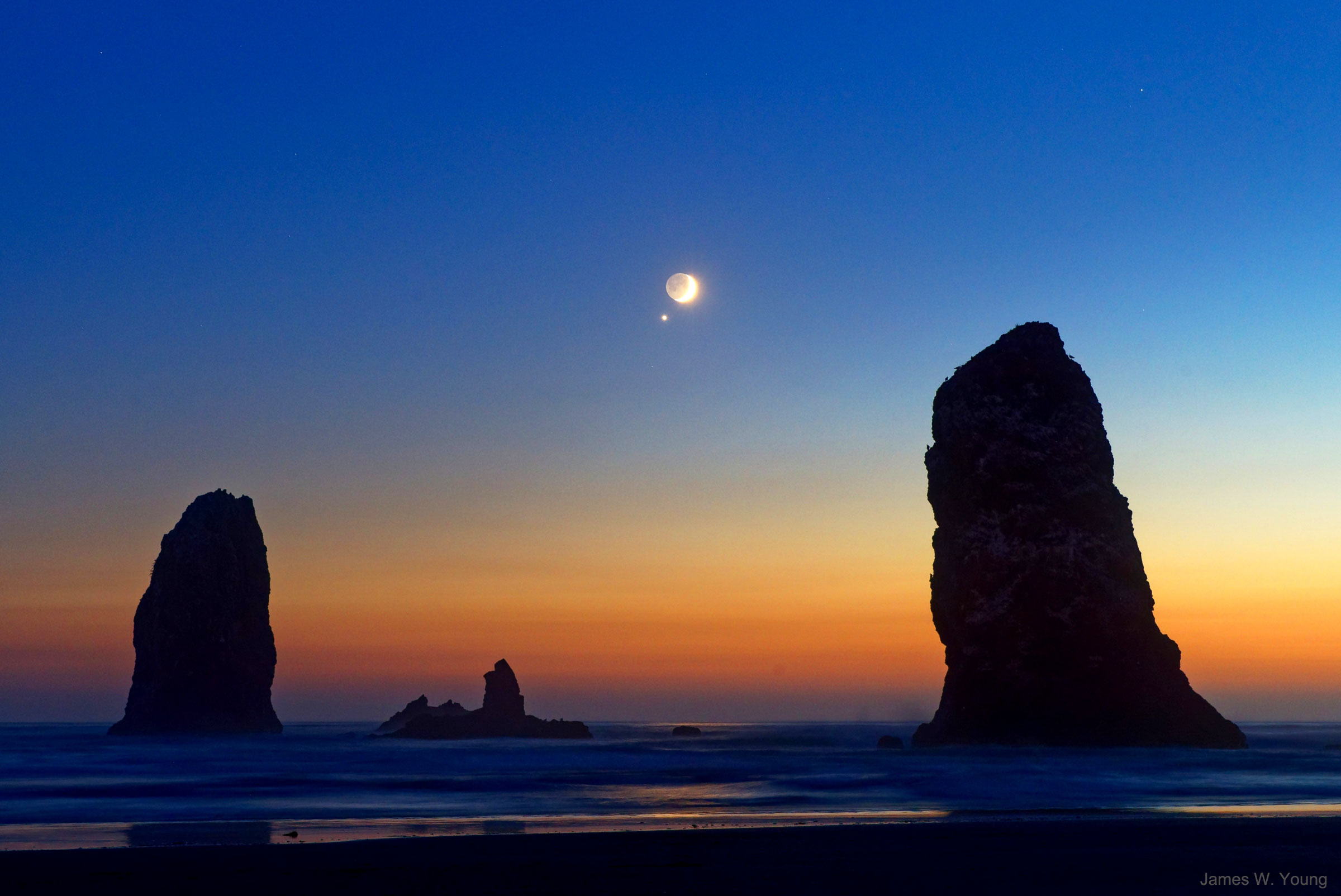
What's that spot next to the Moon? Venus. Two days ago, the crescent Moon slowly drifted past Venus, appearing within just one degree at its closest. This conjunction, though, was just one of several photographic adventures for our Moon this month (moon-th), because, for one, a partial solar eclipse occurred just a few days before, on July 12. Currently, the Moon appears to be brightening, as seen from the Earth, as the fraction of its face illuminated by the Sun continues to increase. In a few days, the Moon will appear more than half full, and therefore be in its gibbous phase. Next week the face of the Moon that always faces the Earth will become, as viewed from the Earth, completely illuminated by the Sun. Even this full phase will bring an adventure, though, as a total eclipse of this Thunder Moon will occur on July 27. Don't worry about our Luna getting tired, though, because she'll be new again next month (moon-th) -- August 11 to be exact -- just as she causes another partial eclipse of the Sun. Pictured, Venus and the Moon were captured from Cannon Beach above a rock formation off the Oregon (USA) coast known as the Needles. About an hour after this image was taken, the spin of the Earth caused both Venus and the Moon to set.
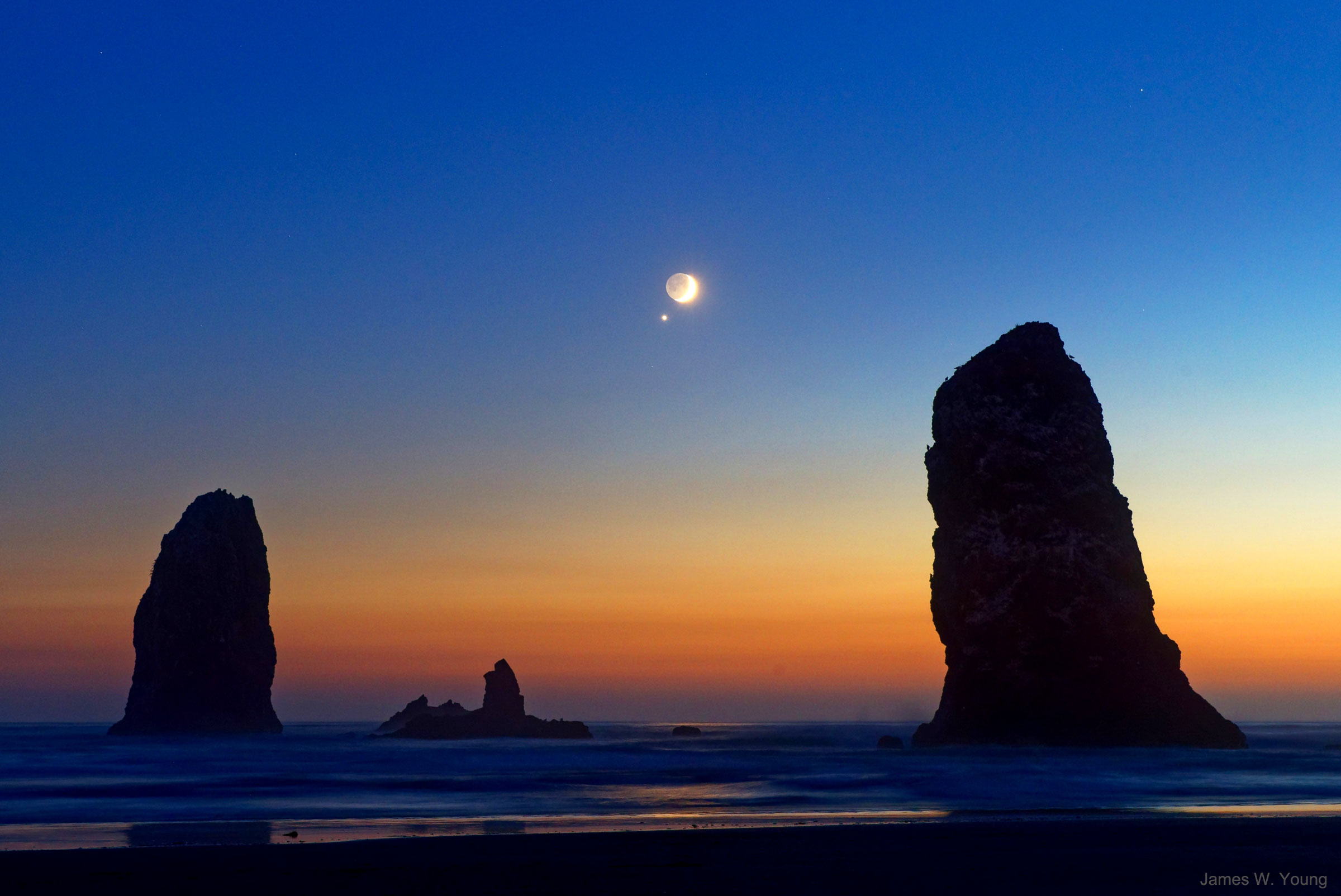
¿Qué es ese punto junto a la Luna? Venus. Hace dos días, la Luna creciente se desplazó lentamente junto a Venus, acercándose a menos de un grado en su punto más cercano. Esta conjunción, sin embargo, fue solo una de varias aventuras fotográficas para nuestra Luna este mes (moon-th), ya que, por ejemplo, un eclipse parcial del Sol tuvo lugar unos días antes, el 12 de julio. Actualmente, la Luna parece estar brillando cada vez más, vista desde la Tierra, ya que la fracción de su cara iluminada por el Sol sigue aumentando. En unos días, la Luna aparecerá más del 50% llena, por lo tanto, estará en su fase gibosa. La semana que viene, la cara de la Luna que siempre mira hacia la Tierra se iluminará completamente por el Sol, vista desde la Tierra. Incluso esta fase llena traerá una aventura, ya que un eclipse total de esta Luna de Trueno ocurrirá el 27 de julio. No te preocupes por que nuestra Luna se canse, ya que volverá a ser nueva el próximo mes (moon-th) —el 11 de agosto, para ser exactos—, justo cuando cause otro eclipse parcial del Sol. En la imagen, Venus y la Luna fueron capturados desde Cannon Beach, sobre una formación rocosa en la costa de Oregon (EE.UU.) conocida como las Needles. Aproximadamente una hora después de que se tomara esta imagen, la rotación de la Tierra hizo que tanto Venus como la Luna se ocultaran.