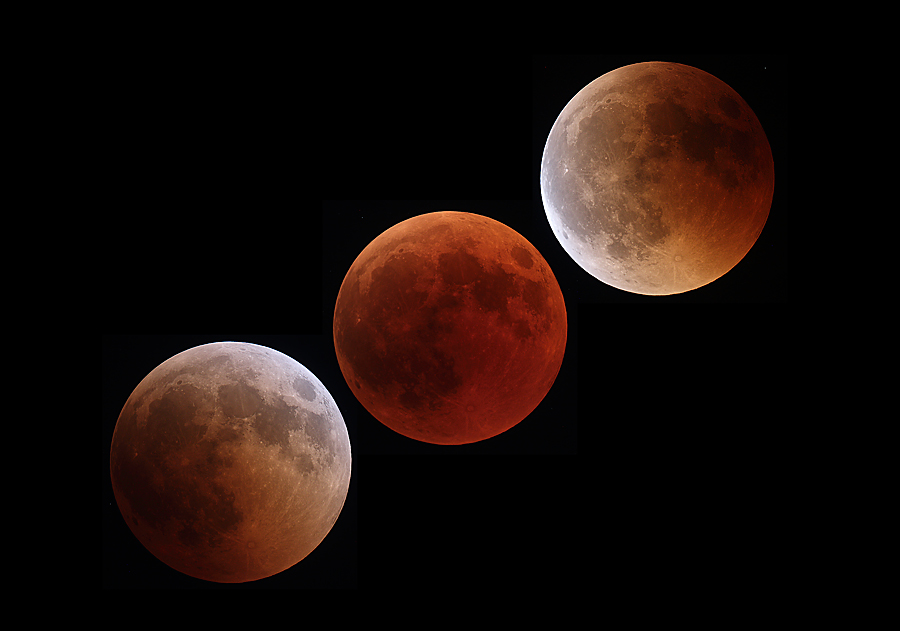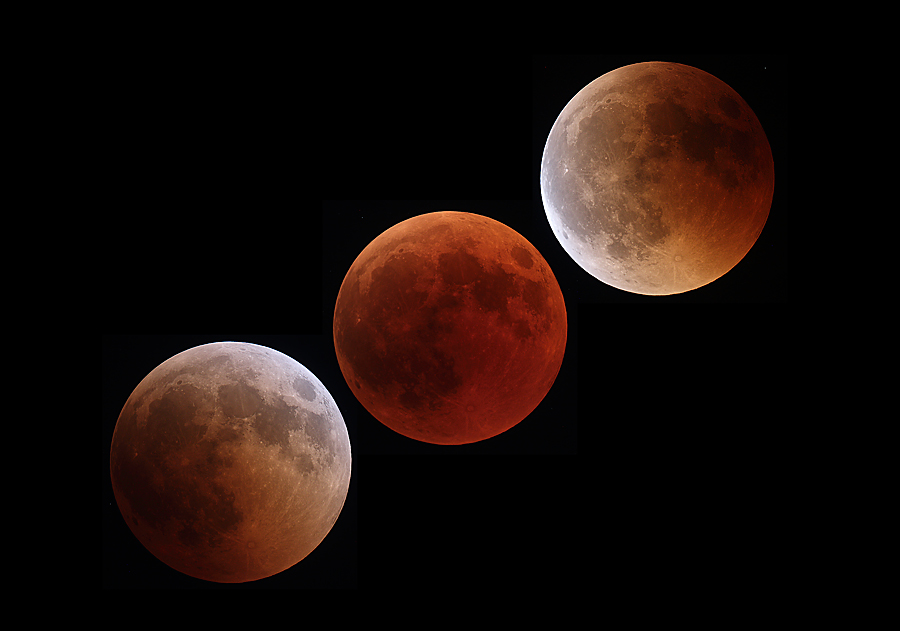
Reddened by scattered sunlight, the Moon in the center is passing through the center of Earth's dark umbral shadow in this July 27 lunar eclipse sequence. Left to right the three images are from the start, maximum, and end to 103 minutes of totality from the longest lunar eclipse of the 21st century. The longest path the Moon can follow through Earth's shadow does cross the shadow's center, that's what makes such central lunar eclipses long ones. But July 27 was also the date of lunar apogee, and at the most distant part of its elliptical orbit the Moon moves slowest. For the previous lunar eclipse, last January 31, the Moon was near its orbital perigee. Passing just south of the Earth shadow central axis, totality lasted only 76 minutes. Coming up on January 21, 2019, a third consecutive total lunar eclipse will also be off center and find the Moon near perigee. Then totality will be a mere 62 minutes long.
Acutizada por la luz solar dispersa, la Luna en el centro está pasando por el centro de la sombra oscura umbral de la Tierra en esta secuencia del eclipse lunar del 27 de julio. De izquierda a derecha, las tres imágenes son del inicio, el máximo y el final de 103 minutos de totalidad, correspondientes al eclipse lunar más largo del siglo XXI. La trayectoria más larga que la Luna puede seguir a través de la sombra de la Tierra cruza el centro de la sombra, lo que hace que los eclipses lunares centrales sean los más largos. Pero el 27 de julio también fue la fecha del apogeo lunar, y en la parte más distante de su órbita elíptica, la Luna se mueve más lentamente. Para el eclipse lunar anterior, del 31 de enero pasado, la Luna estaba cerca de su perigeo orbital. Al pasar justo al sur del eje central de la sombra terrestre, la totalidad duró solo 76 minutos. El 21 de enero de 2019, un tercer eclipse lunar total consecutivo también será desviado del centro y encontrará a la Luna cerca del perigeo. Entonces, la totalidad durará apenas 62 minutos.