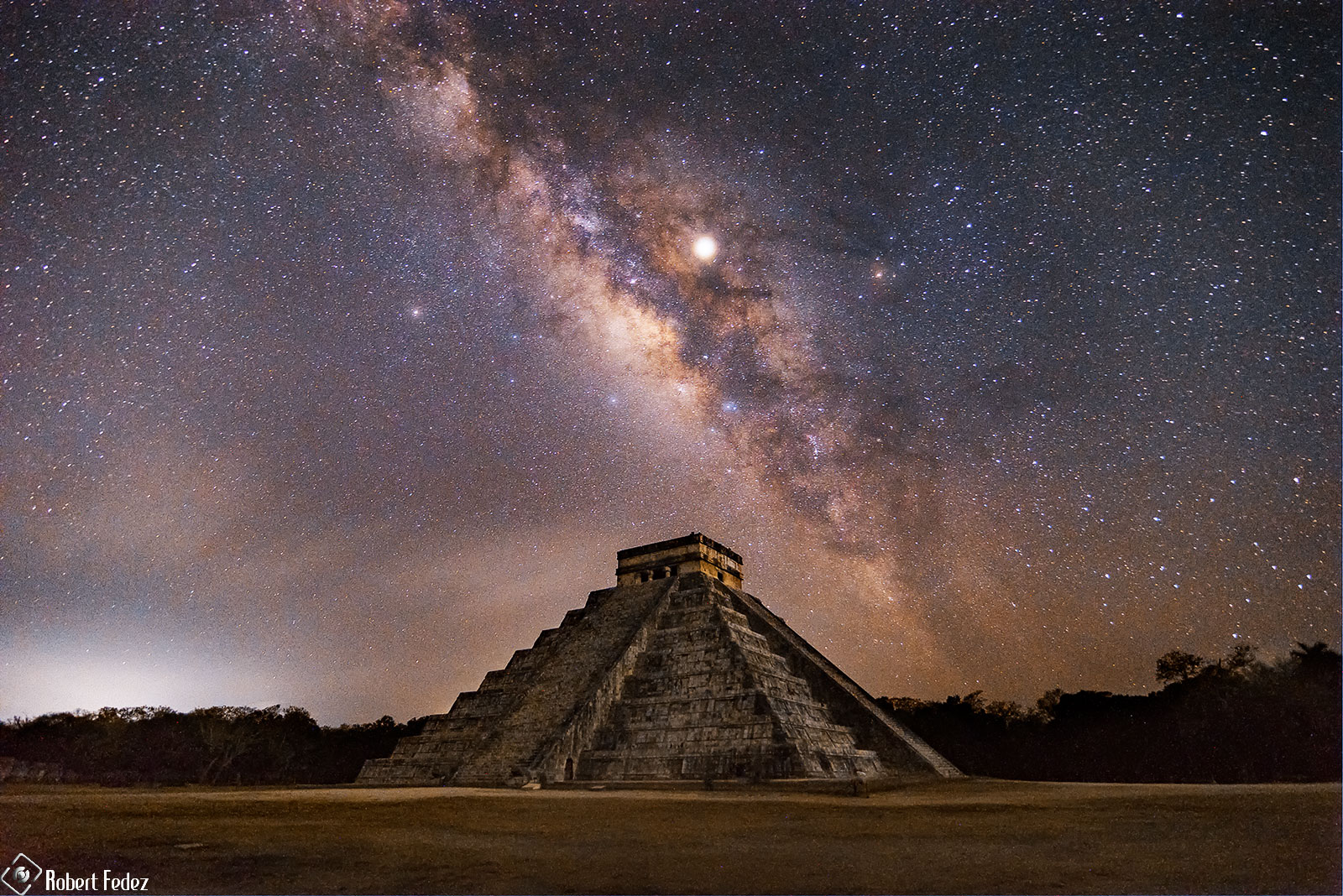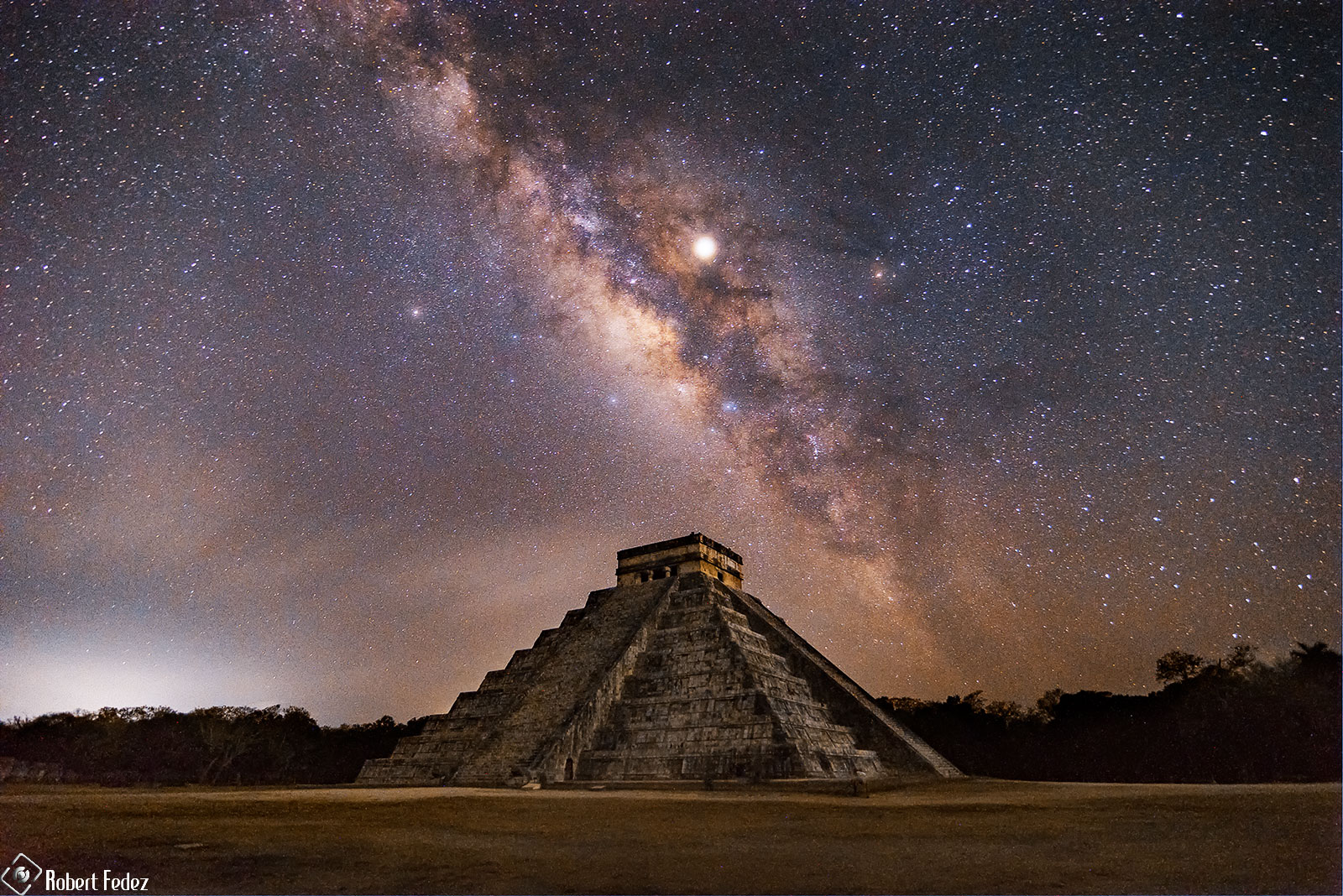
To see the feathered serpent descend the Mayan pyramid requires exquisite timing. You must visit El Castillo -- in Mexico's Yucat�n Peninsula -- near an equinox. Then, during the late afternoon if the sky is clear, the pyramid's own shadows create triangles that merge into the famous illusion of the slithering viper. Also known as the Temple of Kukulkan, the impressive step-pyramid stands 30 meters tall and 55 meters wide at the base. Built up as a series of square terraces by the pre-Columbian civilization between the 9th and 12th century, the structure can be used as a calendar and is noted for astronomical alignments. To see the central band of our Milky Way Galaxy descend overhead the Mayan pyramid, however, requires less exquisite timing. Even the ancient Mayans might have been impressed, though, to know that the exact positions of the Milky Way, Saturn (left) and Jupiter (right) in the featured image give it a time stamp more specific than equinox -- in fact 2019 April 7 at 5 am.
Crédito: NASA, CGRO SSC Para ver a la serpiente emplumada descender por la pirámide maya se requiere un timing exquisito. Debes visitar El Castillo, en la península de Yucatán en México, cerca de un equinoccio. Luego, durante la tarde tardía si el cielo está despejado, las sombras propias de la pirámide forman triángulos que se fusionan en la famosa ilusión óptica de la serpiente que se arrastra. También conocida como el Templo de Kukulkan, la impresionante pirámide escalonada tiene 30 metros de altura y 55 metros de ancho en la base. Construida como una serie de terrazas cuadradas por la civilización precolombina entre los siglos IX y XII, la estructura puede usarse como un calendario y es conocida por sus alineaciones astronómicas. Para ver la banda central de nuestra Galaxia Vía Láctea pasar sobre la pirámide maya, sin embargo, se requiere menos precisión temporal. Incluso los antiguos mayas podrían haber estado impresionados, aunque, al saber que las posiciones exactas de la Vía Láctea, Saturno (a la izquierda) y Júpiter (a la derecha) en la imagen destacada le dan una marca de tiempo más específica que el equinoccio: de hecho, el 7 de abril de 2019 a las 5 am.