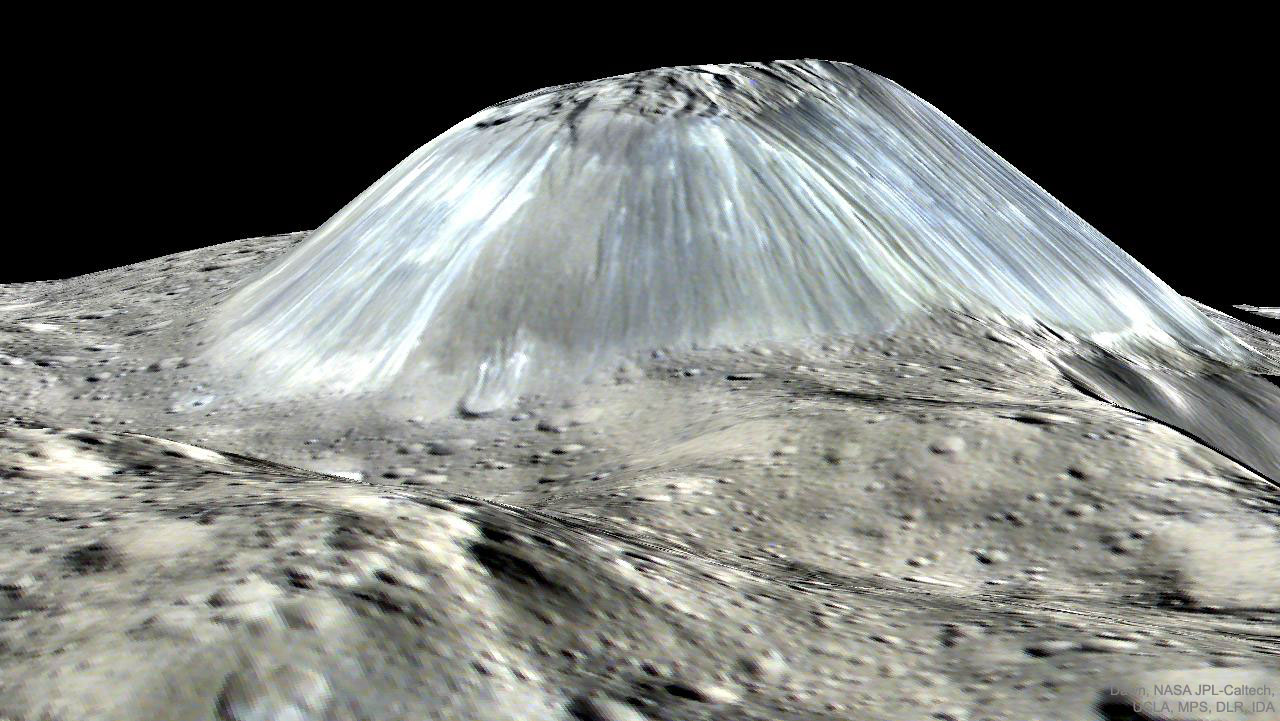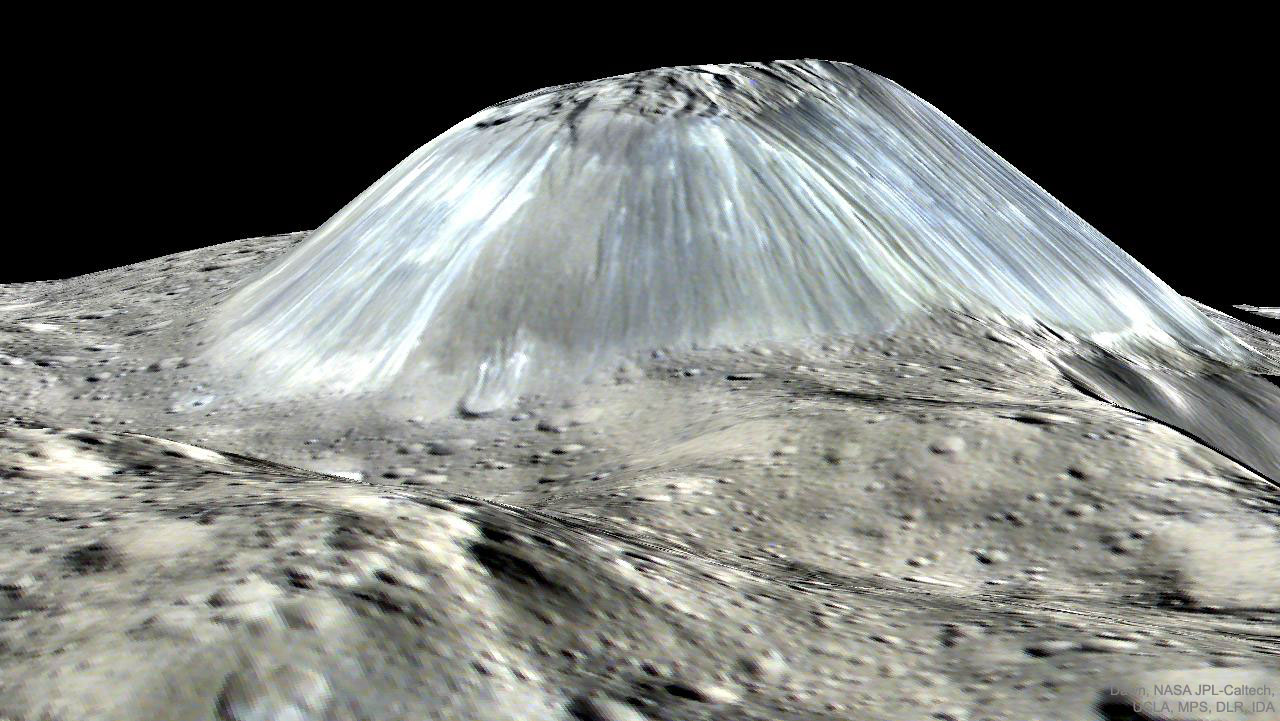
What created this unusual mountain? There is a new theory. Ahuna Mons is the largest mountain on the largest known asteroid in our Solar System, Ceres, which orbits our Sun in the main asteroid belt between Mars and Jupiter. Ahuna Mons, though, is like nothing that humanity has ever seen before. For one thing, its slopes are garnished not with old craters but young vertical streaks. The new hypothesis, based on numerous gravity measurements, holds that a bubble of mud rose from deep within the dwarf planet and pushed through the icy surface at a weak point rich in reflective salt -- and then froze. The bright streaks are thought to be similar to other recently surfaced material such as visible in Ceres' famous bright spots. The featured double-height digital image was constructed from surface maps taken of Ceres in 2016 by the robotic Dawn mission. Successfully completing its mission in 2018, Dawn continues to orbit Ceres even though it has exhausted the fuel needed to keep its antennas pointed toward Earth. Anniversary: The first APOD appeared 24 years ago today.
¿Qué creó esta montaña inusual? Hay una nueva teoría. Ahuna Mons es la montaña más grande en el asteroide más grande conocido en nuestro Sistema Solar, Ceres, que orbita nuestro Sol en el cinturón principal de asteroides entre Marte y Júpiter. Sin embargo, Ahuna Mons es algo que la humanidad nunca ha visto antes. Por un lado, sus laderas están decoradas no con cráteres antiguos, sino con rayas verticales jóvenes. La nueva hipótesis, basada en numerosas mediciones de gravedad, sostiene que una burbuja de lodo ascendió desde lo profundo del planeta enano y empujó a través de la superficie helada en un punto débil rico en sal reflectante, y luego se congeló. Se cree que las rayas brillantes son similares a otros materiales recientemente expuestos, como los visibles en los famosos puntos brillantes de Ceres. La imagen digital de doble altura mostrada fue construida a partir de mapas de la superficie de Ceres tomados en 2016 por la misión robótica Dawn. Dawn completó con éxito su misión en 2018 y continúa orbitando Ceres, aunque ha agotado el combustible necesario para mantener sus antenas apuntando hacia la Tierra.