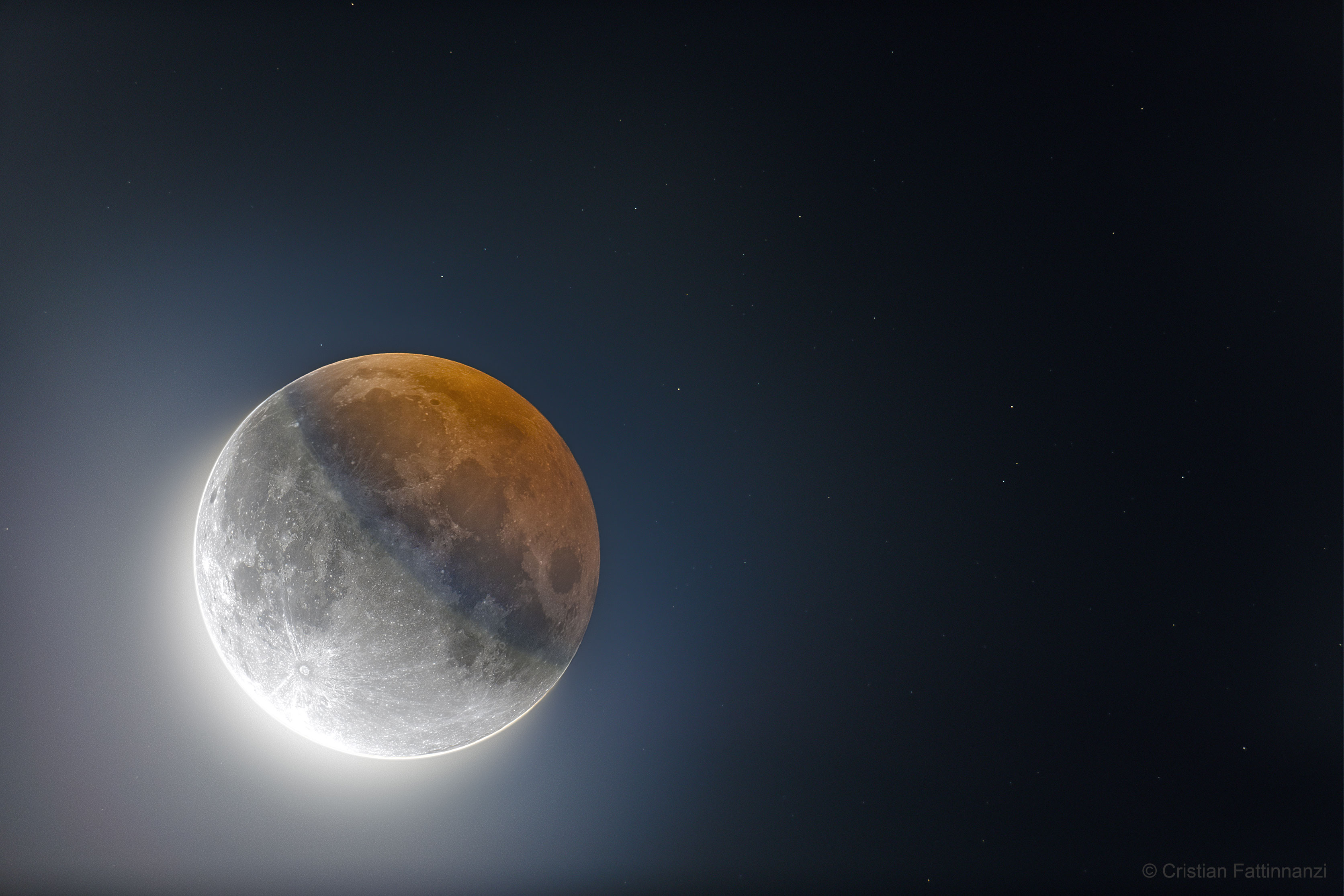
What could create such a large circular shadow on the Moon? The Earth. Last week's full Moon -- the Buck Moon -- was so full that it fell almost exactly in a line with the Sun and the Earth. When that happens the Earth casts its shadow onto the Moon. The circularity of the Earth's shadow on the Moon was commented on by Aristotle and so has been noticed since at least the 4th century BC. What's new is humanity's ability to record this shadow with such high dynamic range (HDR). The featured HDR composite of last week's partial lunar eclipse combines 15 images and include an exposure as short as 1/400th of a second -- so as not to overexpose the brightest part -- and an exposure that lasted five seconds -- to bring up the dimmest part. This dimmest part -- inside Earth's umbra -- is not completely dark because some light is refracted through the Earth's atmosphere onto the Moon. A total lunar eclipse will occur next in 2021 May. Partial Lunar Eclipse in 2019 July: Some memorable images submitted to APOD
¿Qué podría crear una sombra tan circular sobre la Luna? La Tierra. La Luna llena de la semana pasada —la Luna del Ciervo— fue tan llena que quedó casi exactamente alineada con el Sol y la Tierra. Cuando ocurre esto, la Tierra proyecta su sombra sobre la Luna. La circularidad de la sombra terrestre sobre la Luna fue observada por Aristóteles y, por lo tanto, ha sido notada desde al menos el siglo IV a.C. Lo nuevo es la capacidad de la humanidad para registrar esta sombra con un rango dinámico tan alto (DRC). La imagen compuesta DRC de la semana pasada del eclipse lunar parcial combina 15 imágenes y incluye una exposición tan corta como 1/400 de segundo —para no sobreexponer la parte más brillante— y una exposición que duró cinco segundos —para resaltar la parte más oscura. Esta parte más oscura —dentro de la umbra terrestre— no está completamente a oscuras porque algo de luz se refracta a través de la atmósfera terrestre hacia la Luna. Un eclipse lunar total ocurrirá nuevamente en mayo de 2021. Eclipse lunar parcial de julio de 2019: Algunas imágenes memorables enviadas a APOD