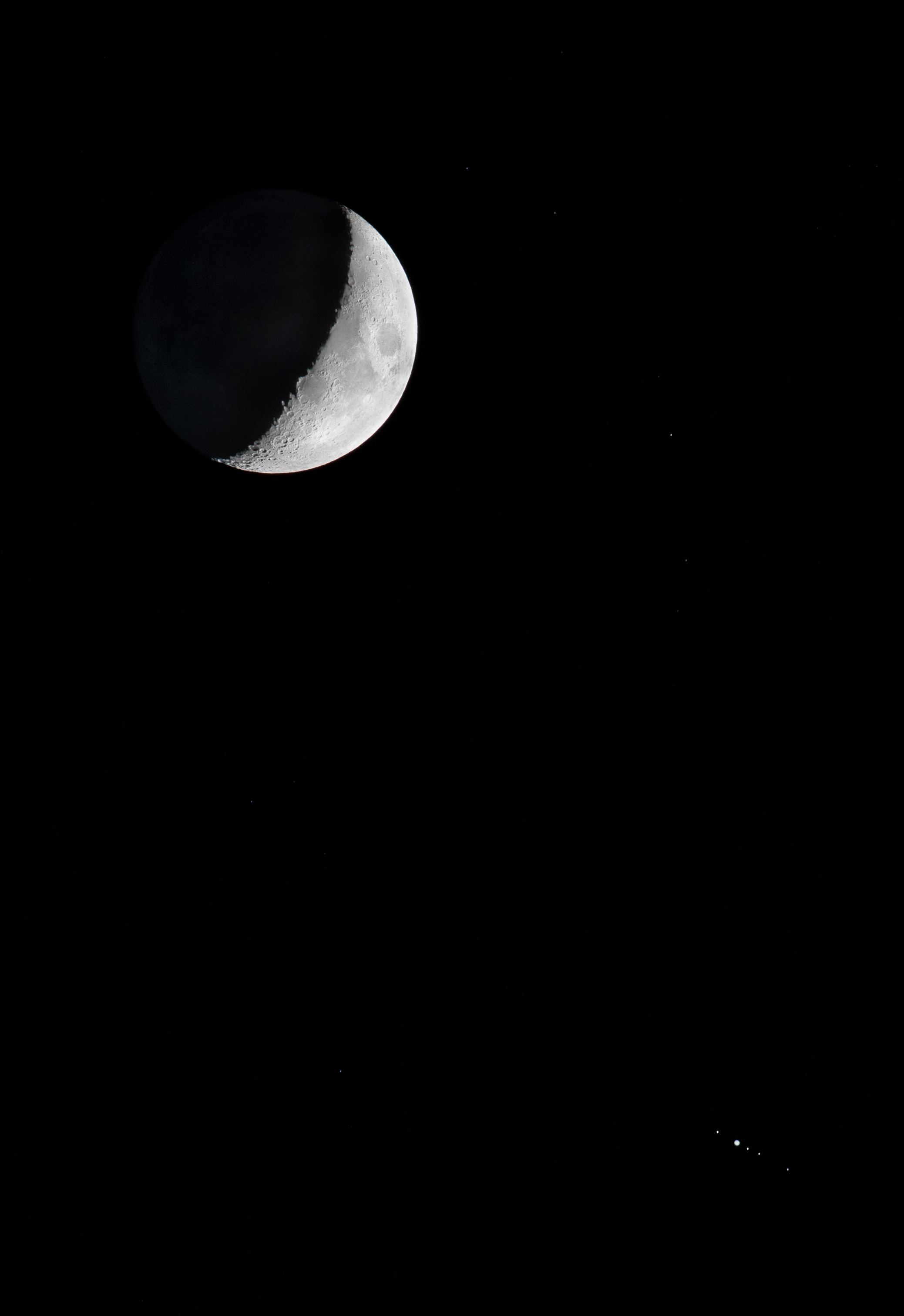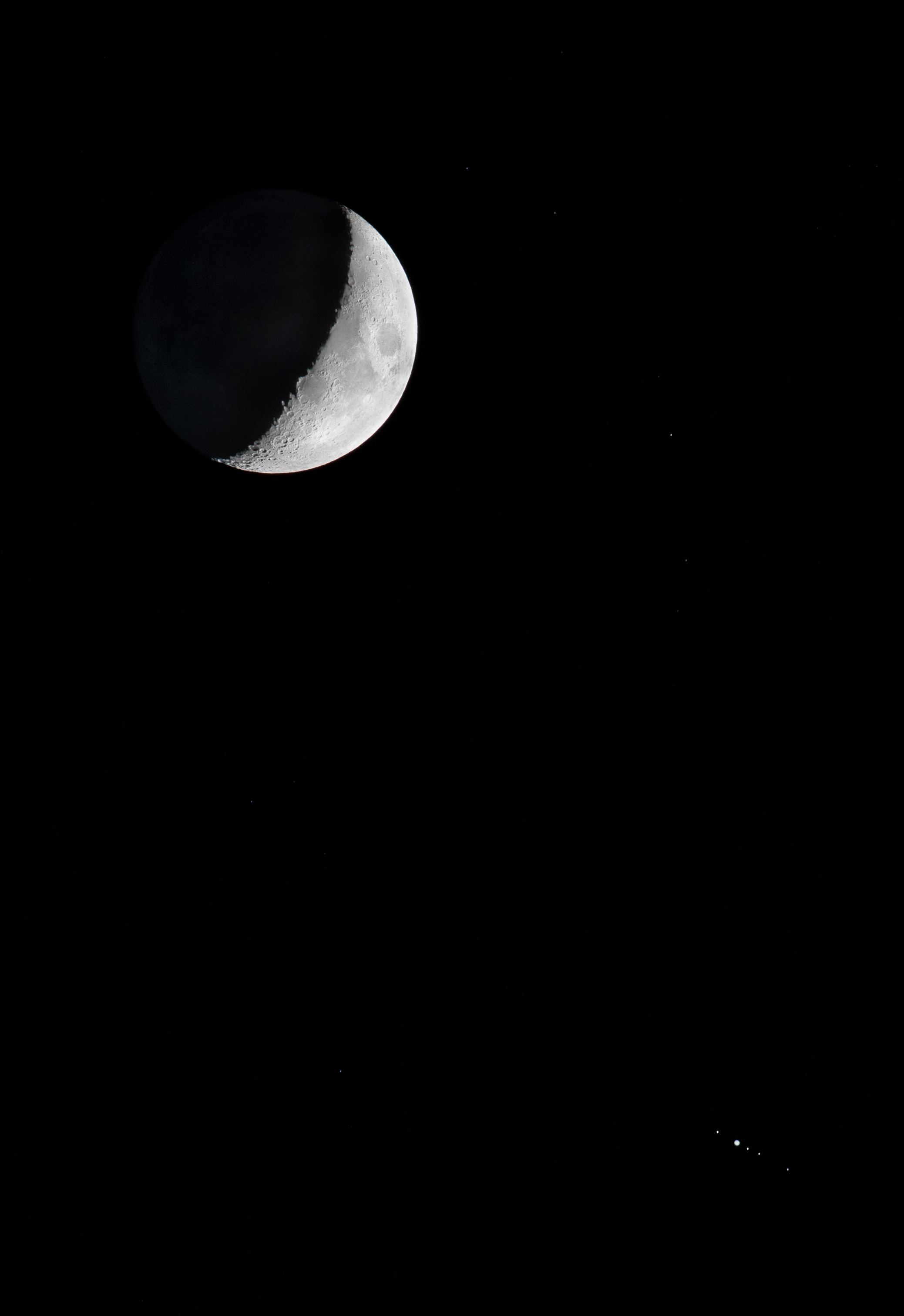
After sunset on October 3, some of the Solar System's largest moons stood low along the western horizon with the largest planet. Just after nightfall, a pairing of the Moon approaching first quarter phase and Jupiter was captured in this telephoto field of view. A blend of short and long exposures, it reveals the familiar face of our fair planet's own large natural satellite in stark sunlight and faint earthshine. At lower right are the ruling gas giant and its four Galilean moons. Left to right, the tiny pinpricks of light are Ganymede, [Jupiter], Io, Europa, and Callisto. Our own natural satellite appears to loom large because it's close, but Ganymede, Io, and Callisto are actually larger than Earth's Moon. Water world Europa is only slightly smaller. Of the Solar System's six largest planetary satellites, only Saturn's moon Titan, is missing from this scene. But be sure to check for large moons in your sky tonight. Tonight: International Observe the Moon Night Submitted to APOD: The Moon and Jupiter with its Satellites
Crédito: NASA, CGRO SSC Después de la puesta de Sol el 3 de octubre, algunas de las lunas más grandes del Sistema Solar aparecieron cerca del horizonte occidental junto con el planeta más grande. Justo después de la puesta de la noche, una alineación de la Luna en fase de cuarto creciente y Júpiter fue capturada en este campo de visión con teleobjetivo. Una combinación de exposiciones cortas y largas revela el rostro familiar de nuestro satélite natural en la luz solar nítida y en la tenue luz terrestre. En la parte inferior derecha se encuentran el gigante gaseoso y sus cuatro lunas galileanas. De izquierda a derecha, los diminutos puntos de luz son Ganímedes, [Júpiter], Io, Europa y Calisto. Nuestro satélite natural parece grande porque está cerca, pero Ganímedes, Io y Calisto son en realidad más grandes que la Luna de la Tierra. El mundo acuático Europa es solo ligeramente más pequeño. De las seis lunas más grandes del Sistema Solar, solo la luna Titán de Saturno falta en esta escena. Pero asegúrate de buscar lunas grandes en tu cielo esta noche. Esta noche: Noche Internacional de Observación de la Luna