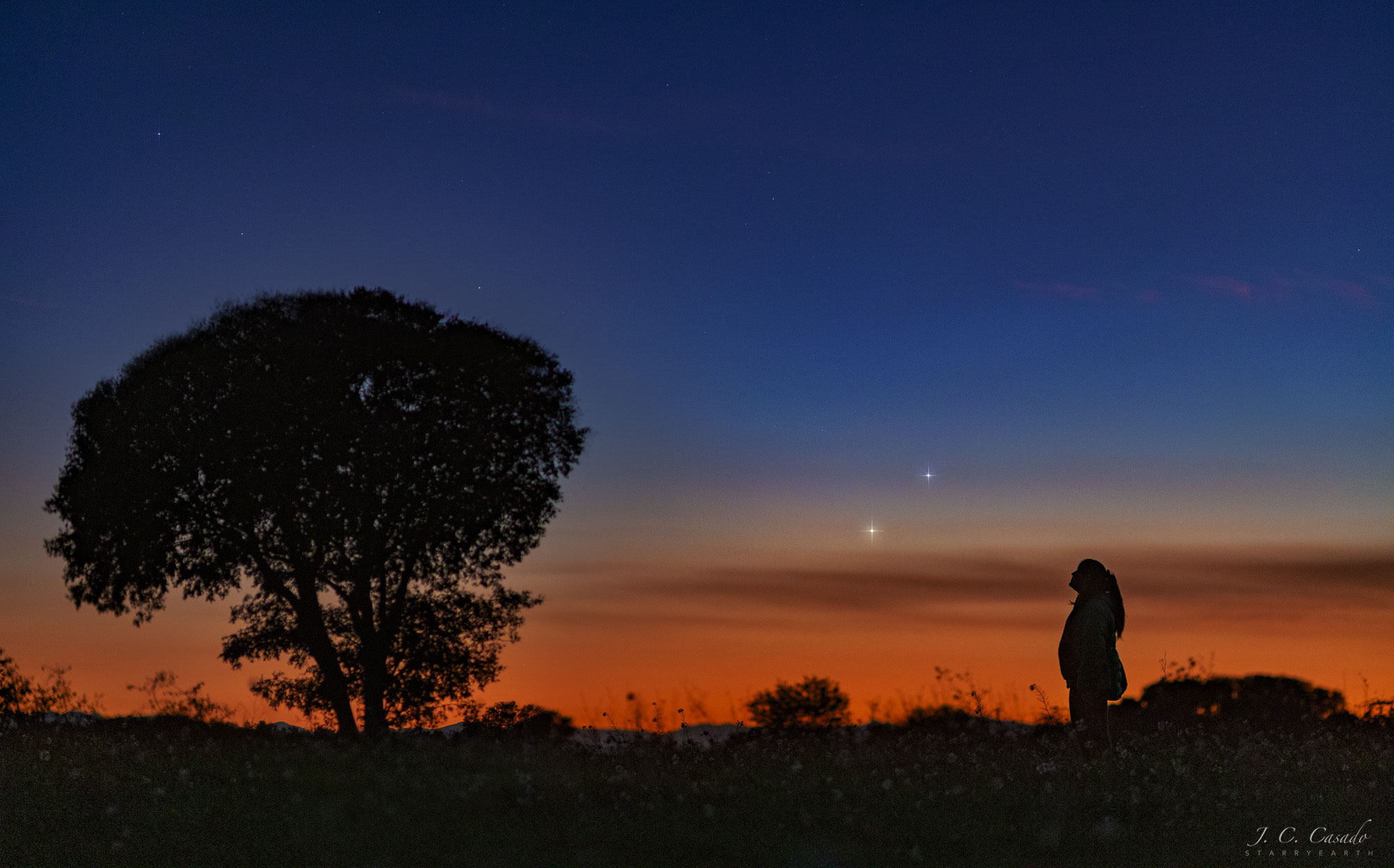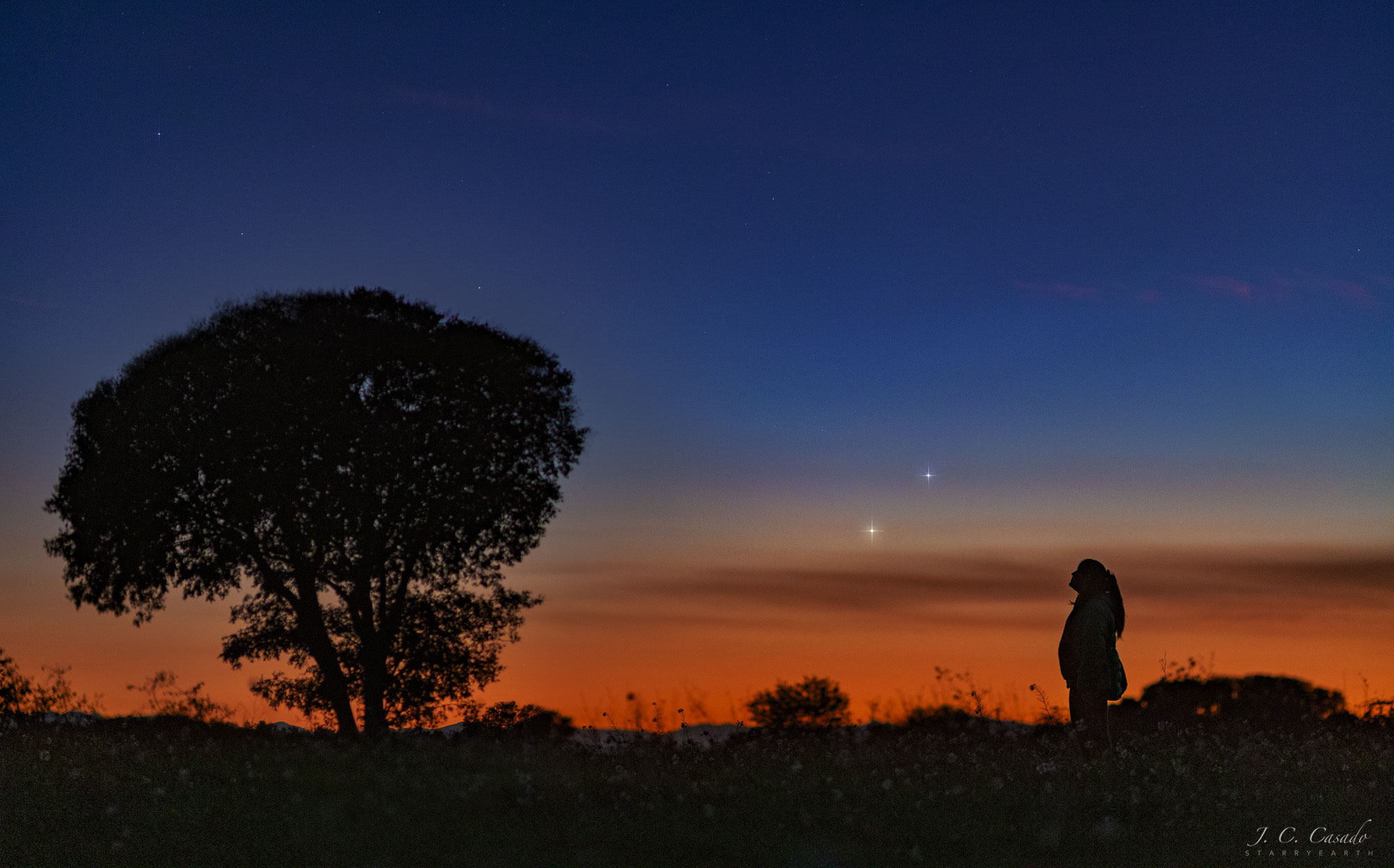
What are those two bright objects on the horizon? Venus and Jupiter. The two brightest planets in the night sky passed very close together -- angularly -- just two days ago. In real space, they were just about as far apart as usual, since Jupiter (on the right) orbits the Sun around seven times farther out than Venus. The planetary duo were captured together two days ago in a picturesque sunset sky from Llers, Catalonia, Spain between a tree and the astrophotographer's daughter. These two planets will continue to stand out in the evening sky, toward the west, for the next few days, with a sliver of a crescent Moon and a fainter Saturn also visible nearby. As November ends, Jupiter will sink lower into the sunset horizon with each subsequent night, while Venus will rise higher. The next Jupiter-Venus conjunction will occur in early 2021.
¿Qué son esos dos objetos brillantes en el horizonte? Venus y Júpiter. Los dos planetas más brillantes del cielo nocturno pasaron muy cerca entre sí —angularmente— hace apenas dos días. En el espacio real, estaban tan separados como de costumbre, ya que Júpiter (a la derecha) orbita alrededor del Sol a unas siete veces la distancia de Venus. El dúo planetario fue capturado juntos hace dos días en un pintoresco cielo de atardecer desde Llers, en Cataluña, España, entre un árbol y la hija del fotógrafo astronómico. Estos dos planetas continuarán destacando en el cielo vespertino, hacia el oeste, durante los próximos días, con un delgado creciente de Luna y un Saturno más tenue también visibles cerca. A medida que termine noviembre, Júpiter se hundirá cada noche más en el horizonte del atardecer, mientras que Venus subirá más alto. La próxima conjunción de Júpiter y Venus ocurrirá a principios de 2021.