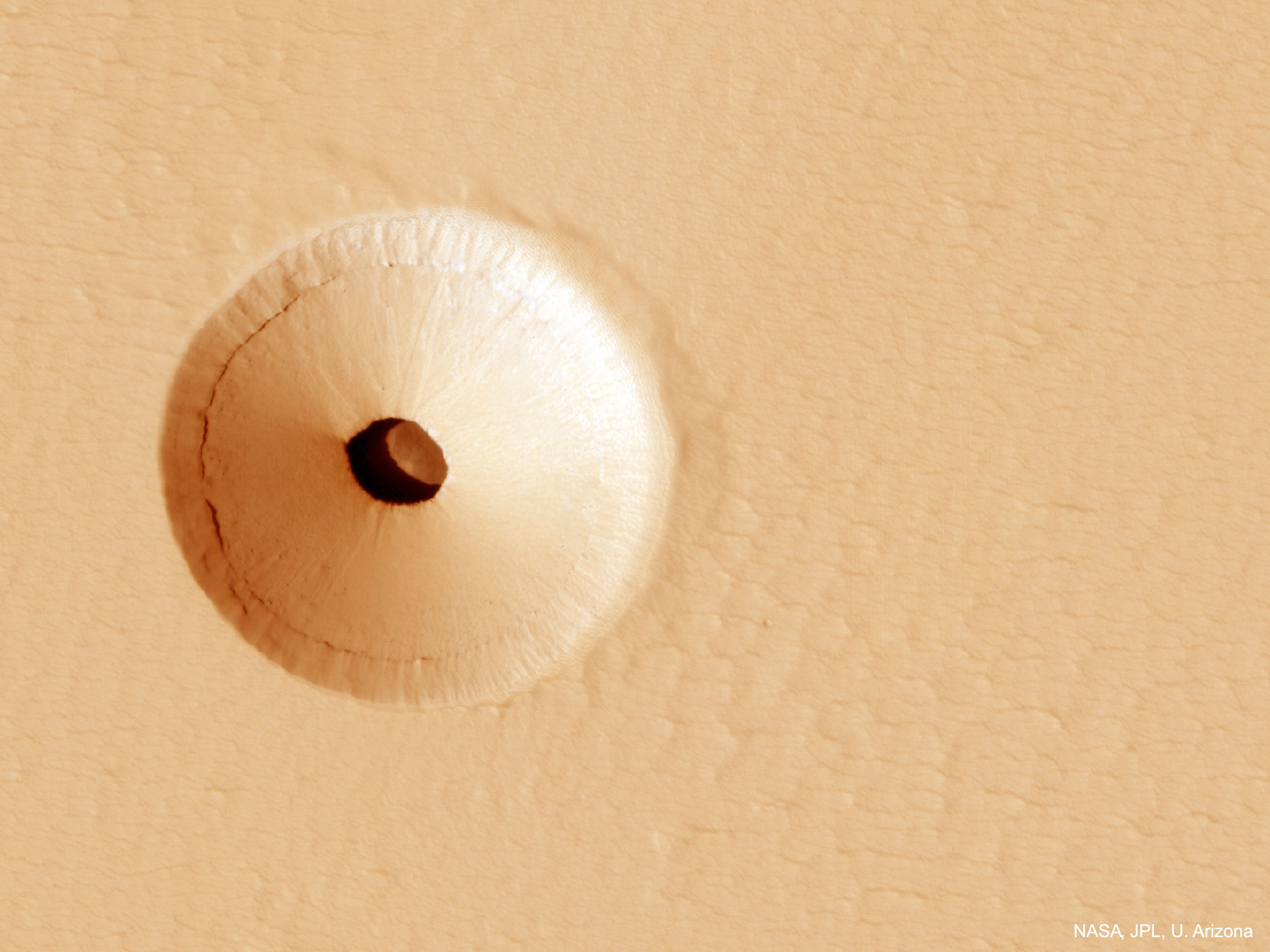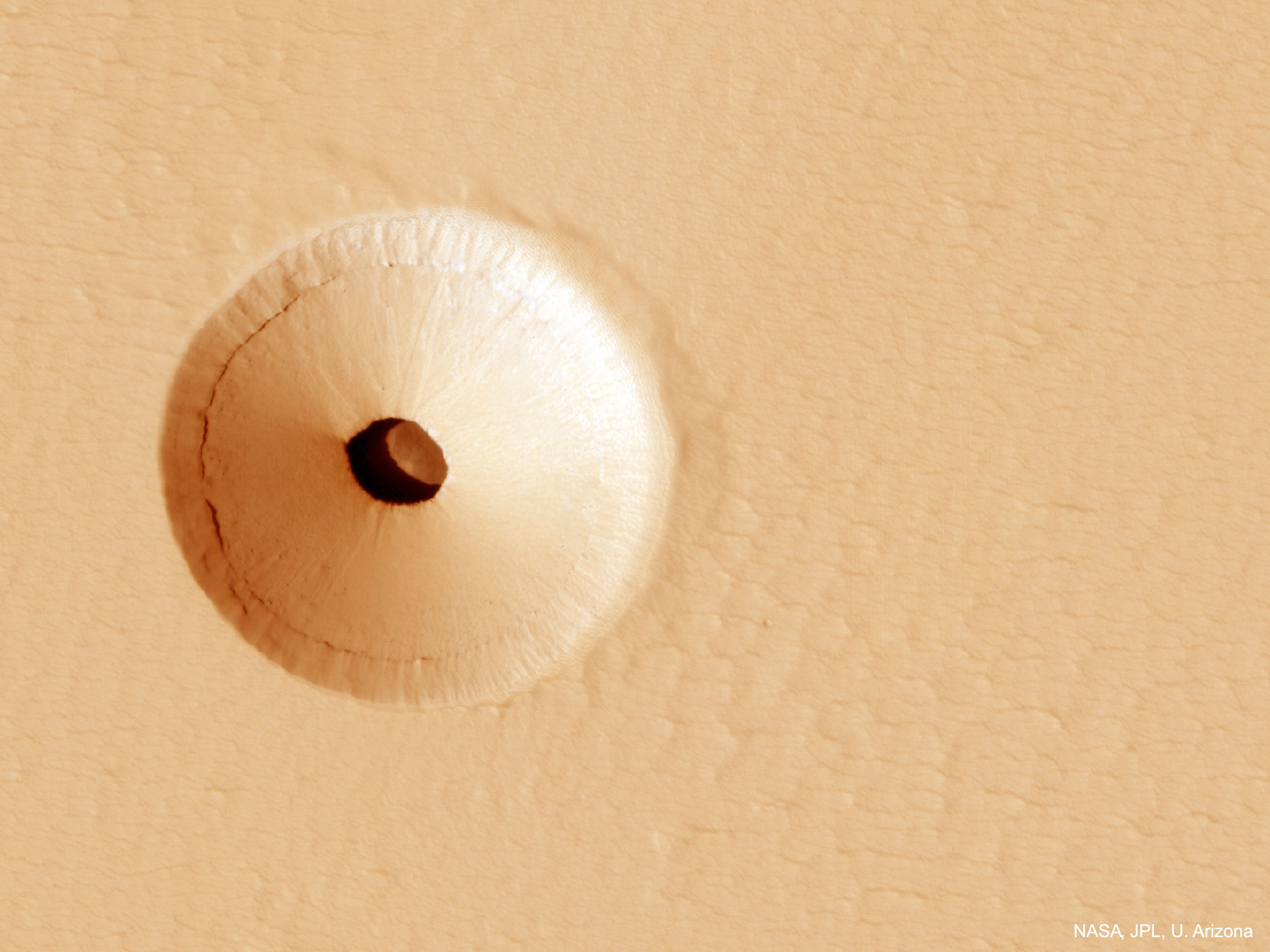
What created this unusual hole in Mars? The hole was discovered by chance in 2011 on images of the dusty slopes of Mars' Pavonis Mons volcano taken by the HiRISE instrument aboard the robotic Mars Reconnaissance Orbiter currently circling Mars. The hole, shown in representative color, appears to be an opening to an underground cavern, partly illuminated on the image right. Analysis of this and follow-up images revealed the opening to be about 35 meters across, while the interior shadow angle indicates that the underlying cavern is roughly 20 meters deep. Why there is a circular crater surrounding this hole remains a topic of speculation, as is the full extent of the underlying cavern. Holes such as this are of particular interest because their interior caves are relatively protected from the harsh surface of Mars, making them relatively good candidates to contain Martian life. These pits are therefore prime targets for possible future spacecraft, robots, and even human interplanetary explorers.
¿Qué creó este agujero inusual en Marte? El agujero fue descubierto por casualidad en 2011 en imágenes de las empinadas laderas del volcán Pavonis Mons en Marte, tomadas por el instrumento HiRISE a bordo de la nave robótica Mars Reconnaissance Orbiter que actualmente orbita Marte. El agujero, mostrado en color representativo, parece ser una entrada a una cueva subterránea, parcialmente iluminada en el lado derecho de la imagen. El análisis de esta y de imágenes posteriores reveló que la apertura tiene aproximadamente 35 metros de diámetro, mientras que el ángulo de la sombra interior indica que la cueva subyacente tiene alrededor de 20 metros de profundidad. Por qué hay un cráter circular rodeando este agujero sigue siendo un tema de especulación, al igual que la extensión completa de la cueva subterránea. Agujeros como este son de particular interés porque sus cuevas interiores están relativamente protegidas de la dura superficie de Marte, lo que las convierte en candidatas relativamente buenas para albergar vida marciana. Estos cráteres son, por tanto, objetivos prioritarios para posibles futuras naves espaciales, robots e incluso exploradores humanos interestelares.