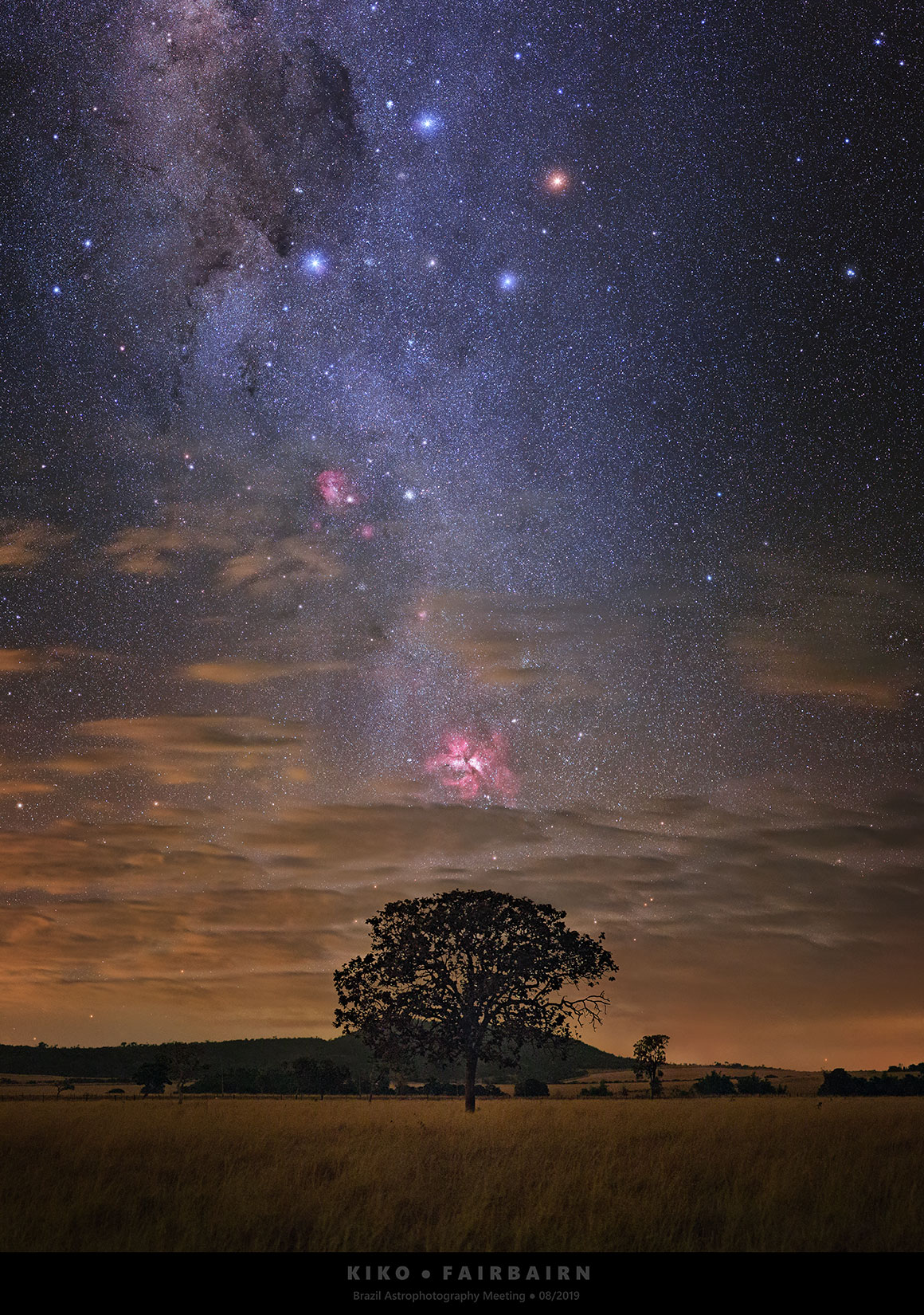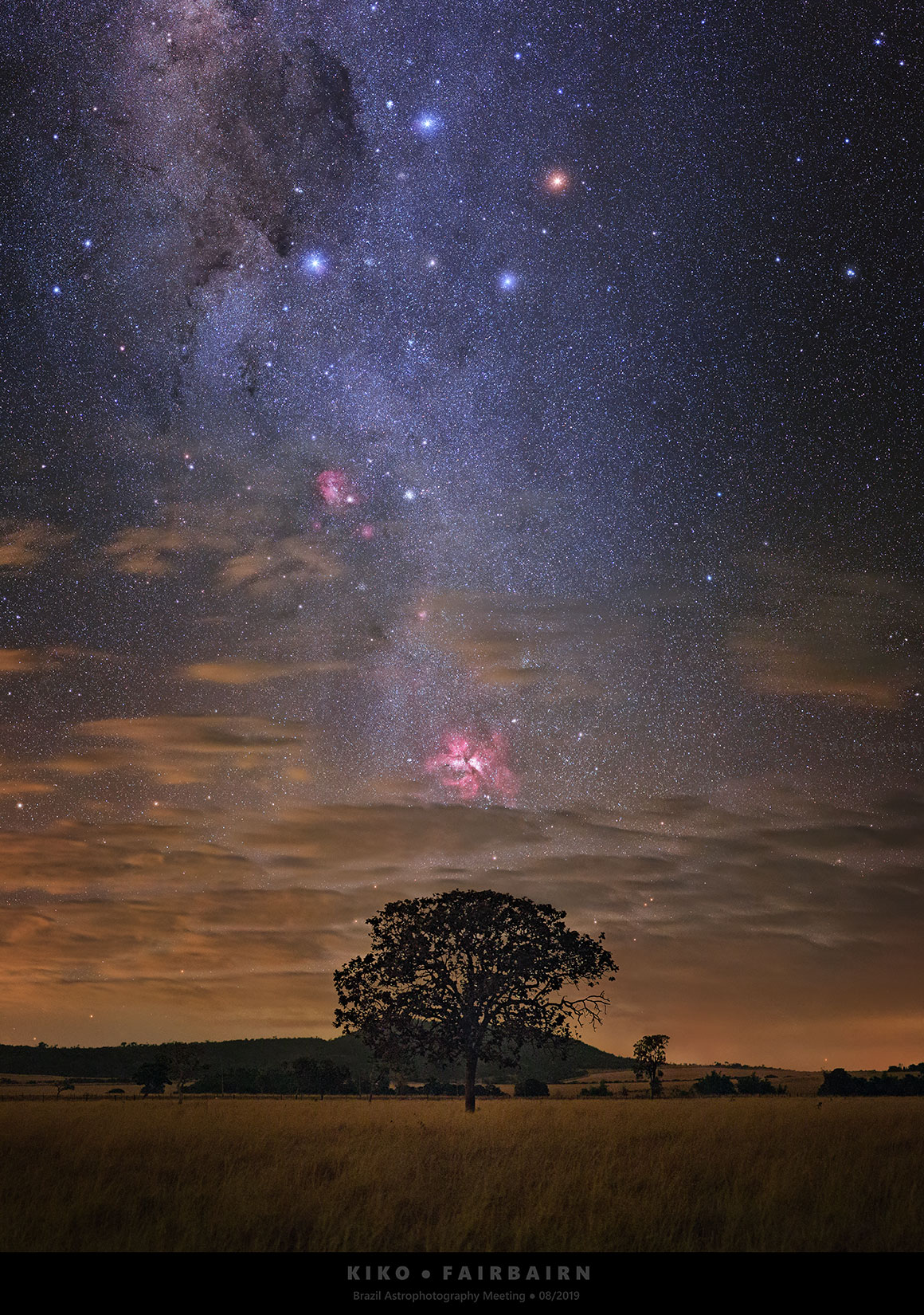
You need to be in the south, looking south, to see such a sky. And only then if you're lucky. Just above the picturesque tree is the impressive Carina Nebula, one of the few nebulas in the sky that is visible to the unaided eye. The featured image had to be taken from a very dark location to capture the Carina Nebula with such perspective and so near the horizon. The Great Nebula in Carina, cataloged as NGC 3372, is home to the wildly variable star Eta Carinae that sometimes flares to become one of the brightest stars in the sky. Above Carina is IC 2944, the Running Chicken Nebula, a nebula that not only looks like a chicken, but contains impressive dark knots of dust. Above these red-glowing emission nebulas are the bright stars of the Southern Cross, while on the upper left of the image is the dark Coalsack Nebula. This image was composed from six consecutive exposures taken last summer from Padre Bernardo, Goiás, Brazil. Even with careful planning, the astrophotographer felt lucky to get this shot because clouds -- some still visible near the horizon -- kept getting in the way. Almost Hyperspace: Random APOD Generator
Necesitas estar en el hemisferio sur, mirando hacia el sur, para ver un cielo así. Y aún así, solo si tienes suerte. Justo encima del pintoresco árbol se encuentra la impresionante nebulosa Carina, una de las pocas nebulosas en el cielo que es visible a simple vista. La imagen destacada tuvo que ser tomada desde un lugar muy oscuro para capturar la nebulosa Carina con tal perspectiva y tan cerca del horizonte. La Gran Nebulosa de Carina, catalogada como NGC 3372, alberga la estrella muy variable Eta Carinae, que a veces se ilumina para convertirse en una de las estrellas más brillantes del cielo. Encima de Carina se encuentra IC 2944, la Nebulosa del Pollo Corredor, una nebulosa que no solo se parece a un pollo, sino que contiene impresionantes nudos oscuros de polvo. Encima de estas nebulosas de emisión que brillan con luz rojiza se encuentran las brillantes estrellas de la Cruz del Sur, mientras que en la parte superior izquierda de la imagen se encuentra la nebulosa oscura Coalsack. Esta imagen fue compuesta a partir de seis exposiciones consecutivas tomadas el verano pasado desde Padre Bernardo, Goiás, Brasil. Incluso con un plan cuidadoso, el fotógrafo astronómico se sintió afortunado de obtener esta imagen porque las nubes —algunas aún visibles cerca del horizonte— continuamente se interponían en el camino.