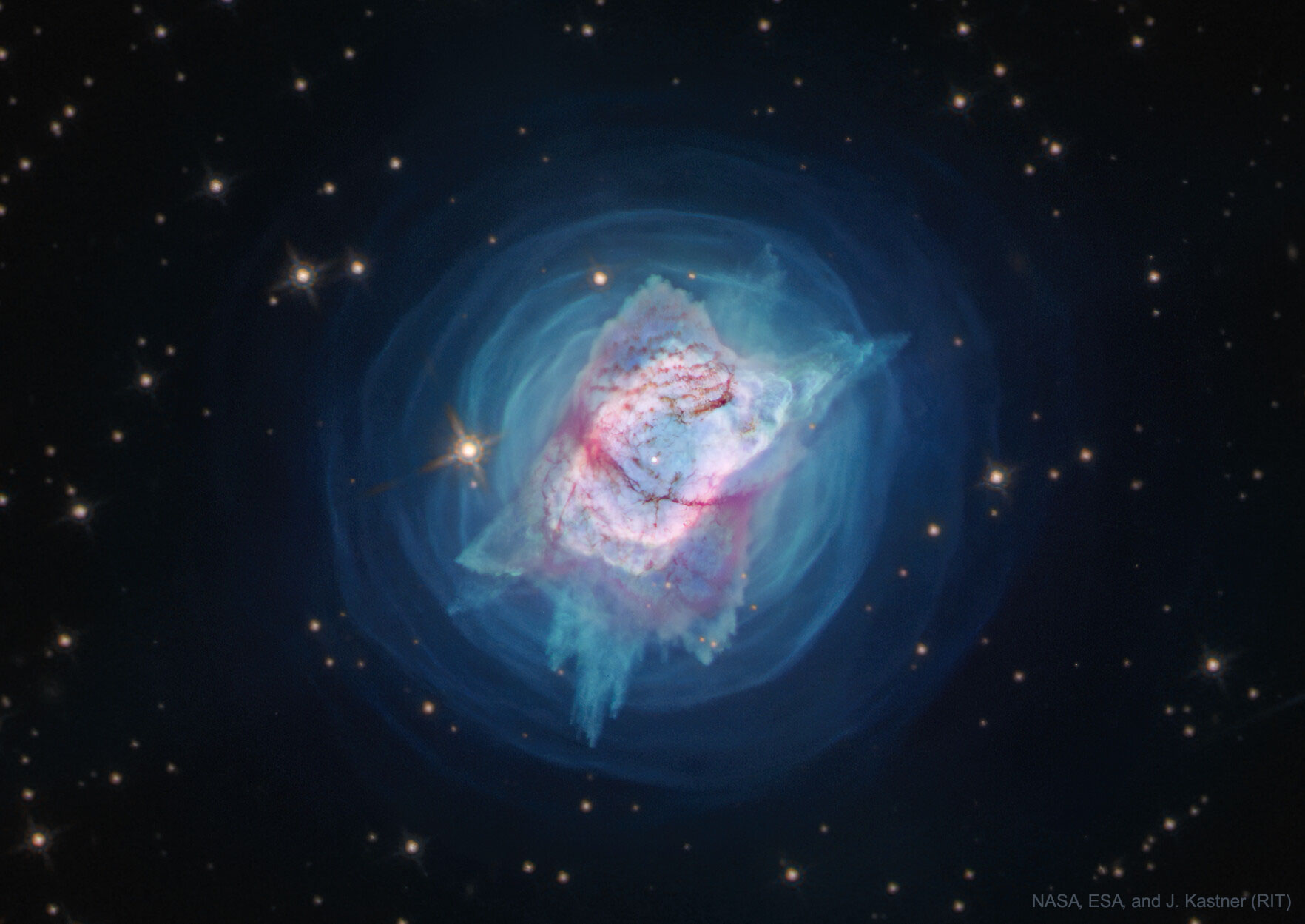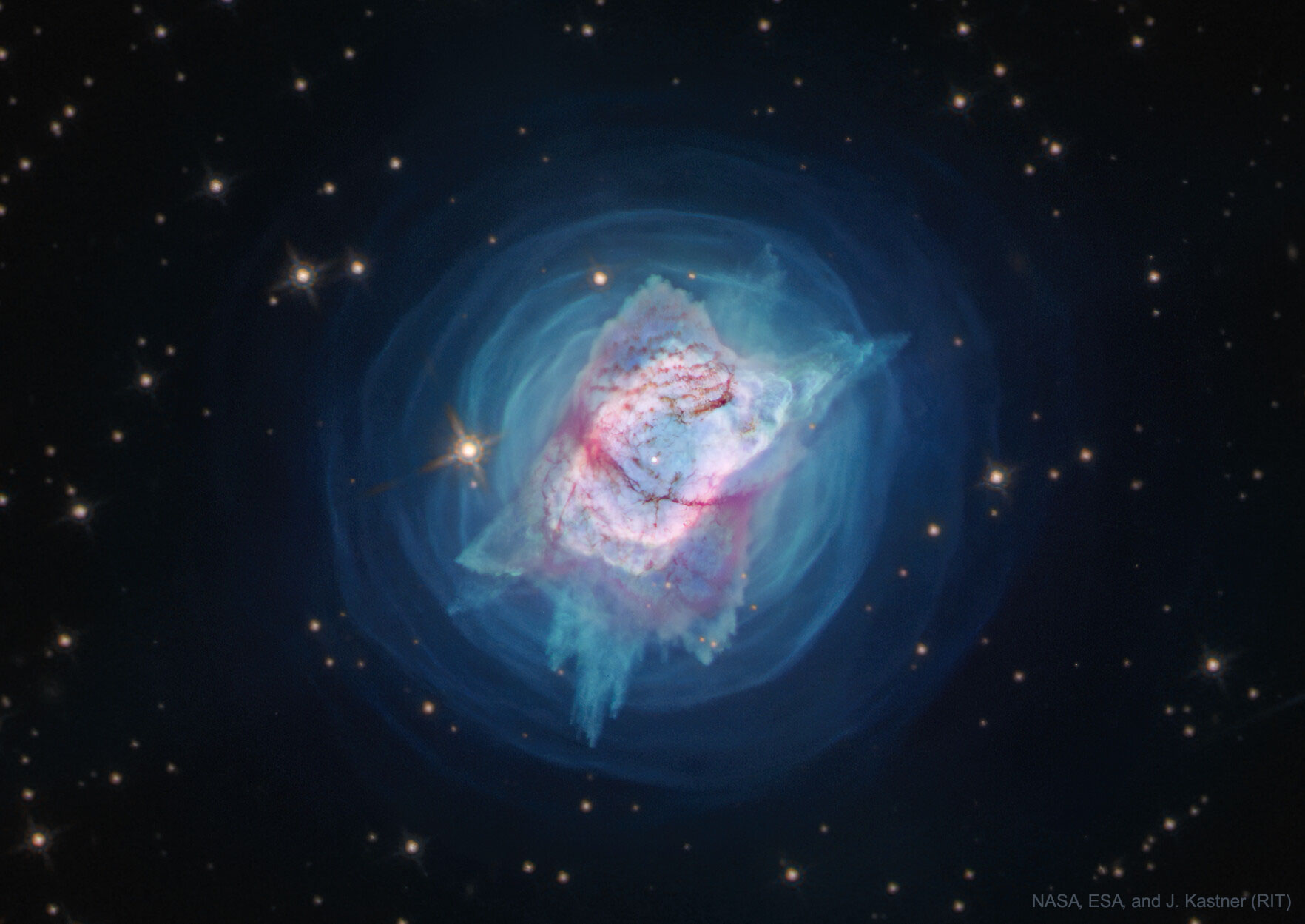
What created this unusual planetary nebula? NGC 7027 is one of the smallest, brightest, and most unusually shaped planetary nebulas known. Given its expansion rate, NGC 7027 first started expanding, as visible from Earth, about 600 years ago. For much of its history, the planetary nebula has been expelling shells, as seen in blue in the featured image. In modern times, though, for reasons unknown, it began ejecting gas and dust (seen in red) in specific directions that created a new pattern that seems to have four corners. These shells and patterns have been mapped in impressive detail by recent images from the Wide Field Camera 3 onboard the Hubble Space Telescope. What lies at the nebula's center is unknown, with one hypothesis holding it to be a close binary star system where one star sheds gas onto an erratic disk orbiting the other star. NGC 7027, about 3,000 light years away, was first discovered in 1878 and can be seen with a standard backyard telescope toward the constellation of the Swan (Cygnus).
¿Qué creó esta nebulosa planetaria inusual? NGC 7027 es una de las nebulosas planetarias más pequeñas, brillantes y de forma más inusual conocidas. Dado su ritmo de expansión, NGC 7027 comenzó a expandirse, visible desde la Tierra, hace aproximadamente 600 años. Durante gran parte de su historia, la nebulosa planetaria ha estado expulsando capas, visibles en azul en la imagen destacada. Sin embargo, en tiempos modernos, por razones desconocidas, comenzó a expulsar gas y polvo (visibles en rojo) en direcciones específicas que crearon un nuevo patrón que parece tener cuatro esquinas. Estas capas y patrones han sido mapeados con un detalle impresionante por imágenes recientes del Cámara de Campo Ancho 3 a bordo del Telescopio Espacial Hubble. Lo que se encuentra en el centro de la nebulosa es desconocido, con una hipótesis sugiriendo que podría ser un sistema binario estelar cercano donde una estrella libera gas sobre un disco errático que orbita la otra estrella. NGC 7027, a unos 3000 años luz de distancia, fue descubierto por primera vez en 1878 y puede ser observado con un telescopio estándar de jardín hacia la constelación del Cisne (Cisne).