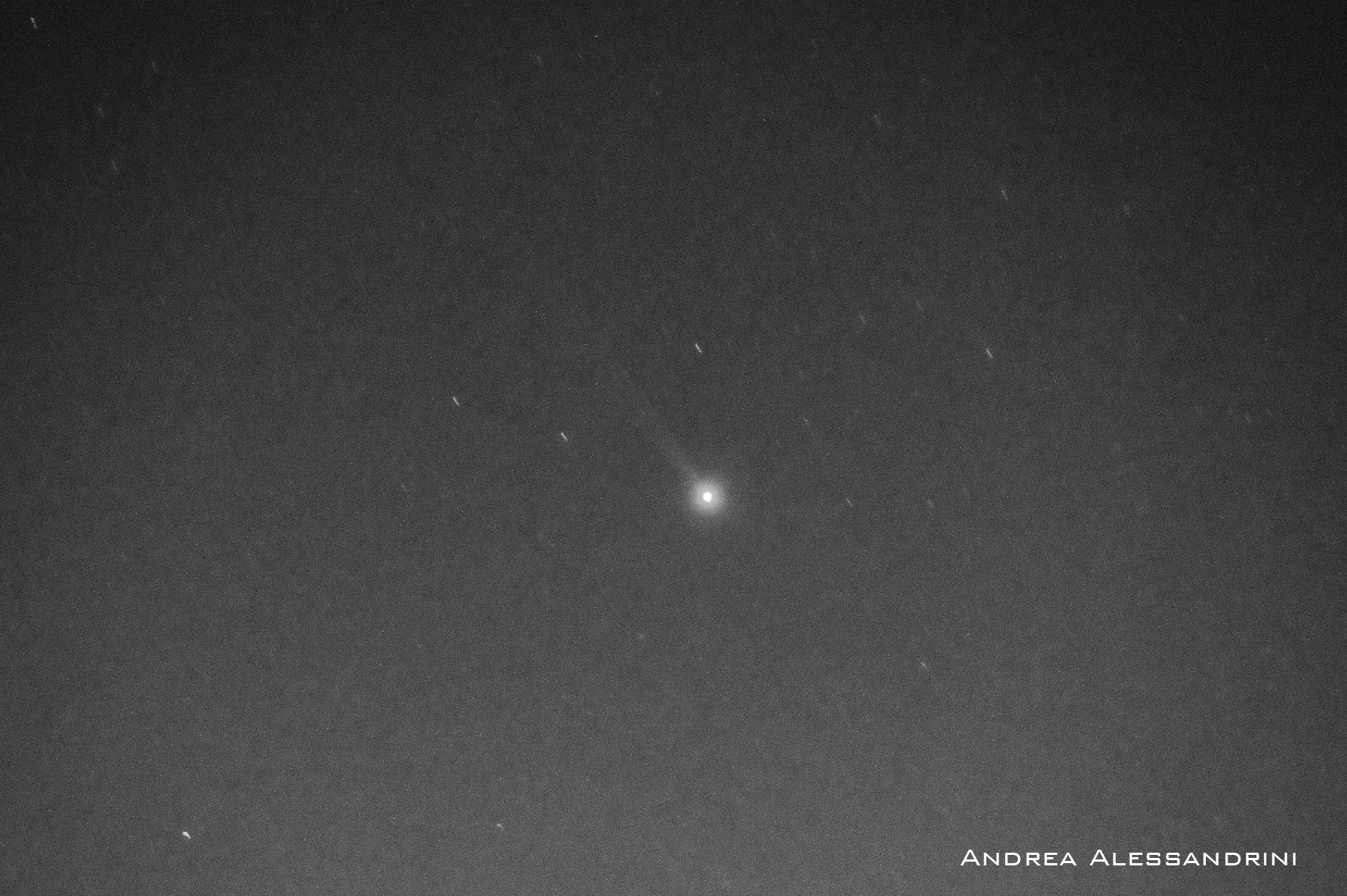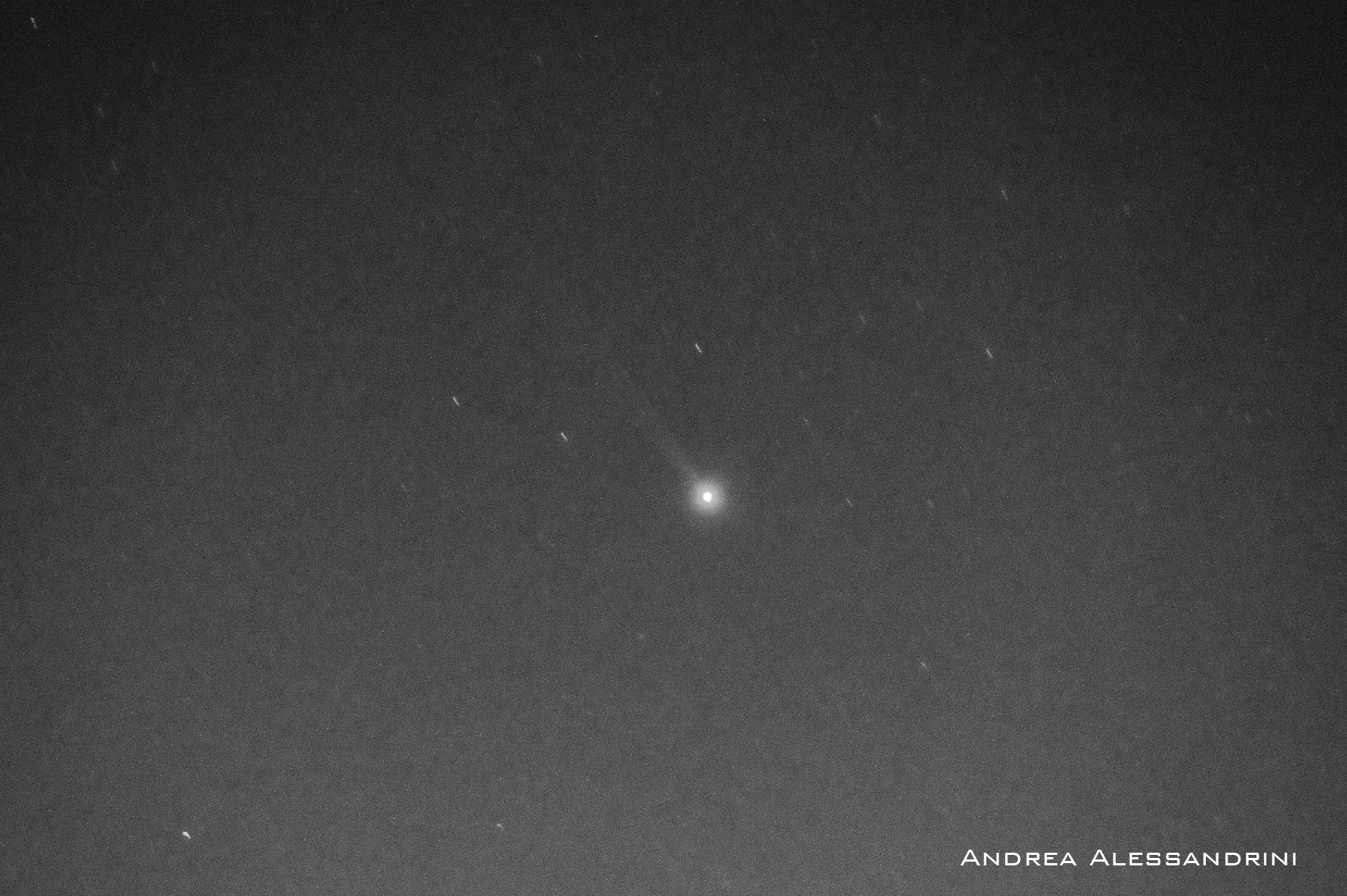
What is that fuzzy streak extending from Mercury? Long exposures of our Solar System's innermost planet may reveal something unexpected: a tail. Mercury's thin atmosphere contains small amounts of sodium that glow when excited by light from the Sun. Sunlight also liberates these molecules from Mercury's surface and pushes them away. The yellow glow from sodium, in particular, is relatively bright. Pictured, Mercury and its sodium tail are visible in a deep image taken in late May from Italy through a filter that primarily transmits yellow light emitted by sodium. First predicted in the 1980s, Mercury's tail was first discovered in 2001. Many tail details were revealed in multiple observations by NASA's robotic MESSENGER spacecraft that orbited Mercury between 2011 and 2015. Tails are usually associated with comets. The tails of Comet NEOWISE are currently visible with the unaided eye in the morning sky. Comet NEOWISE from Around the Globe: Notable Images Submitted to APOD
¿Qué es esa raya borrosa que se extiende desde Mercurio? Exposiciones largas del planeta más interno de nuestro sistema solar pueden revelar algo inesperado: una cola. La delgada atmósfera de Mercurio contiene pequeñas cantidades de sodio que brillan cuando son excitadas por la luz del Sol. La luz solar también libera estas moléculas de la superficie de Mercurio y las empuja hacia afuera. En particular, el brillo amarillo del sodio es relativamente brillante. En la imagen, Mercurio y su cola de sodio son visibles en una imagen profunda tomada a finales de mayo desde Italia a través de un filtro que principalmente transmite luz amarilla emitida por el sodio. La cola de Mercurio fue predicha por primera vez en la década de 1980 y fue descubierta por primera vez en 2001. Muchos detalles de la cola se revelaron en múltiples observaciones realizadas por la nave espacial robótica MESSENGER de la NASA, que orbitó Mercurio entre 2011 y 2015. Las colas suelen estar asociadas con cometas. Actualmente, las colas del cometa NEOWISE son visibles a simple vista en el cielo matutino.