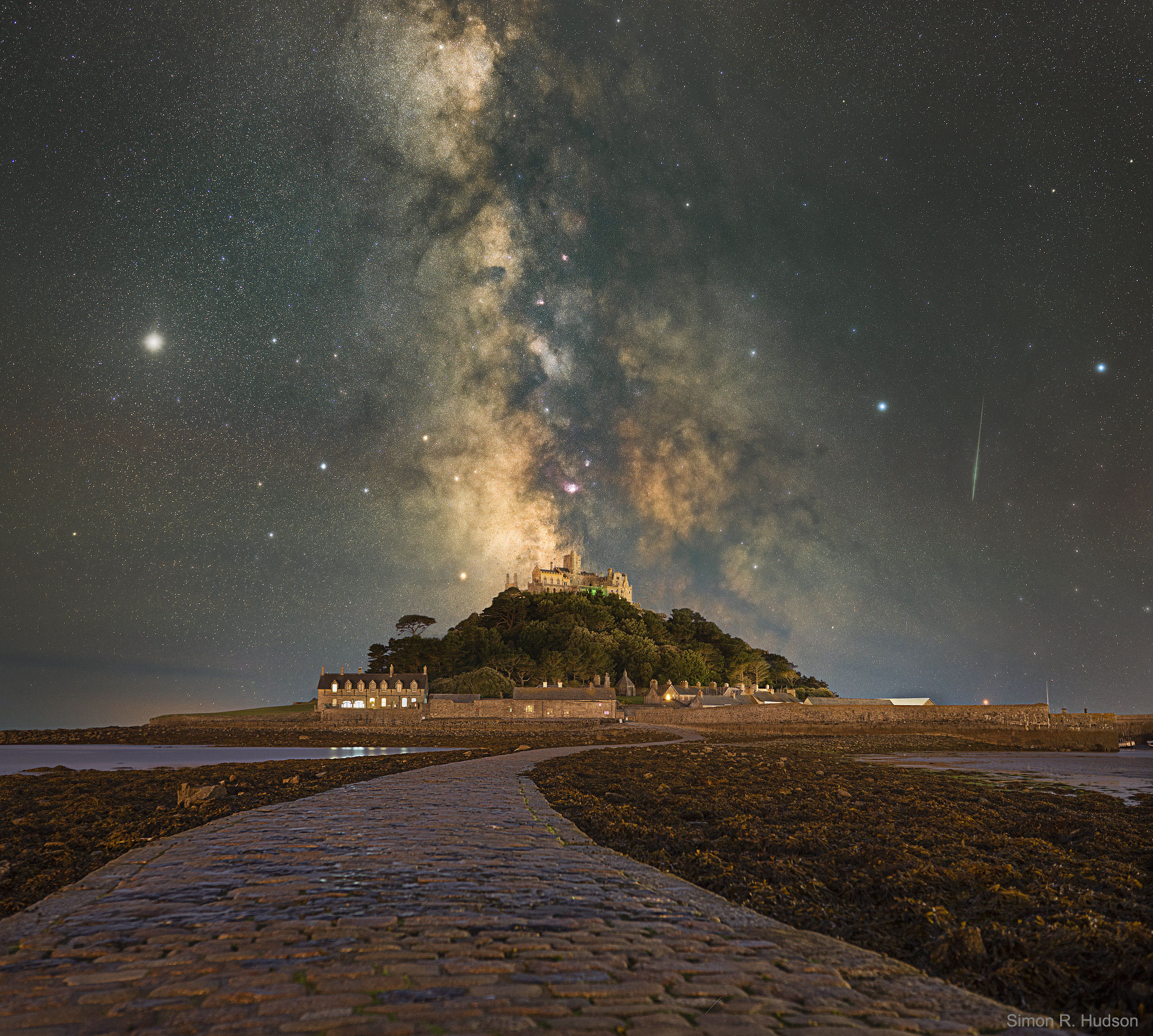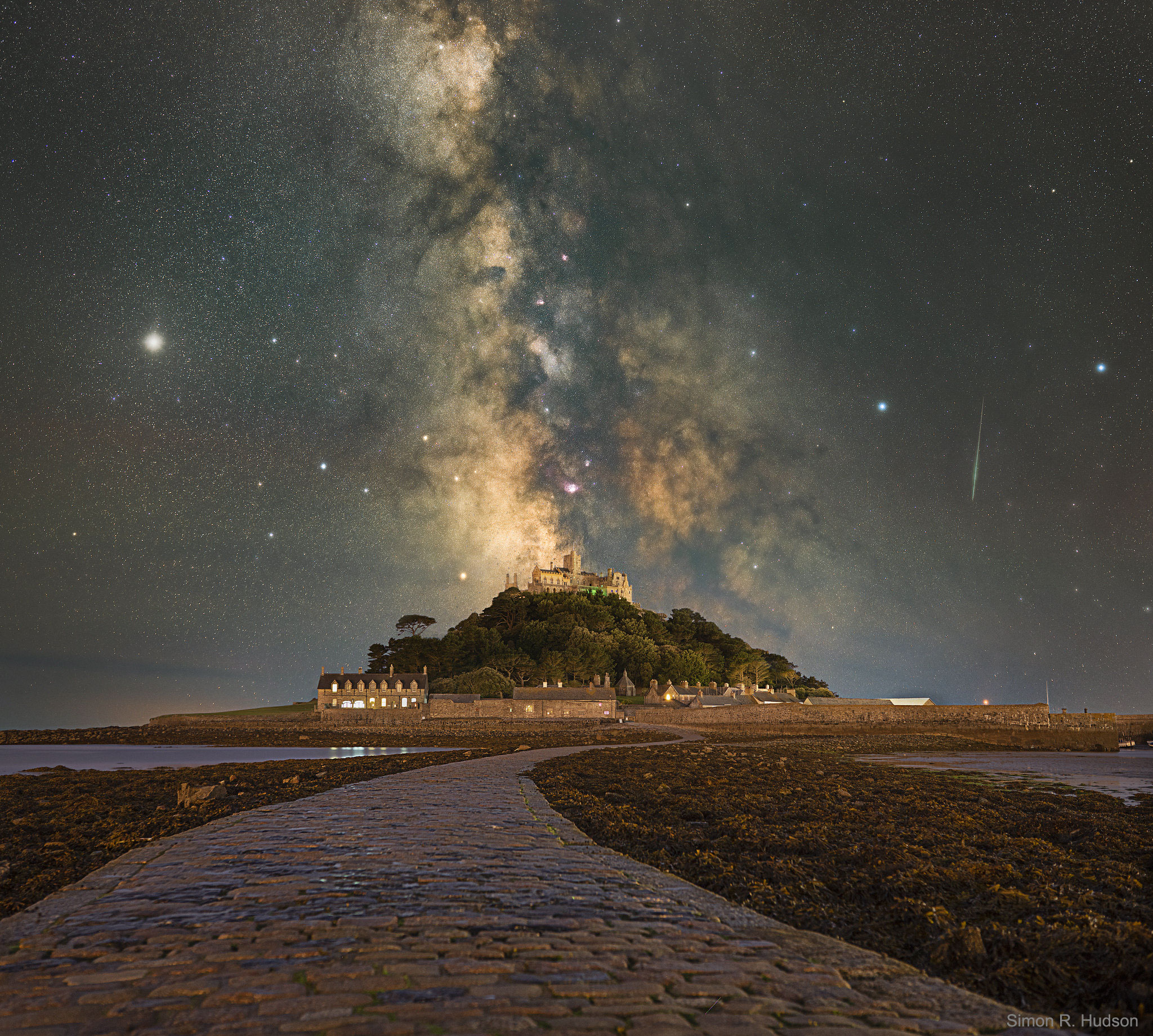
Where do land and sky converge? On every horizon -- but in this case the path on the ground leads to St Michael's Mount (Cornish: Karrek Loos yn Koos), a small historic island in Cornwall, England. The Mount is usually surrounded by shallow water, but at low tide is spanned by a human-constructed causeway. The path on the sky, actually the central band of our Milky Way Galaxy, also appears to lead to St Michael's Mount, but really lies far in the distance. The red nebula in the Milky Way, just above the castle, is the Lagoon Nebula, while bright Jupiter shines to the left, and a luminous meteor flashes to the right. The foreground and background images of this featured composite were taken on the same July night and from the same location. Although meteors are fleeting and the Milky Way disk shifts in the night as the Earth turns, Jupiter will remain prominent in the sunset sky into December. Moon Occults Mars: Notable images submitted to APOD
Crédito: NASA, APOD ¿Dónde convergen la tierra y el cielo? En cada horizonte — pero en este caso, el camino en tierra conduce al Monte San Miguel (en cornés: Karrek Loos yn Koos), una pequeña isla histórica en Cornualles, Inglaterra. El Monte suele estar rodeado por aguas poco profundas, pero durante la marea baja se accede a través de un camino construido por el hombre. El camino en el cielo, en realidad la banda central de nuestra Galaxia, la Vía Láctea, también parece conducir al Monte San Miguel, pero en realidad se encuentra muy lejos. La nebulosa rojiza en la Vía Láctea, justo encima del castillo, es la Nebulosa del Lago, mientras que Júpiter brilla a la izquierda, y un meteoro luminoso cruza a la derecha. Las imágenes de primer plano y de fondo de esta composición destacada fueron tomadas la misma noche de julio y desde el mismo lugar. Aunque los meteoros son efímeros y el disco de la Vía Láctea cambia durante la noche a medida que gira la Tierra, Júpiter permanecerá destacado en el cielo al atardecer hasta diciembre. Luna oculta Marte: Imágenes notables enviadas a APOD