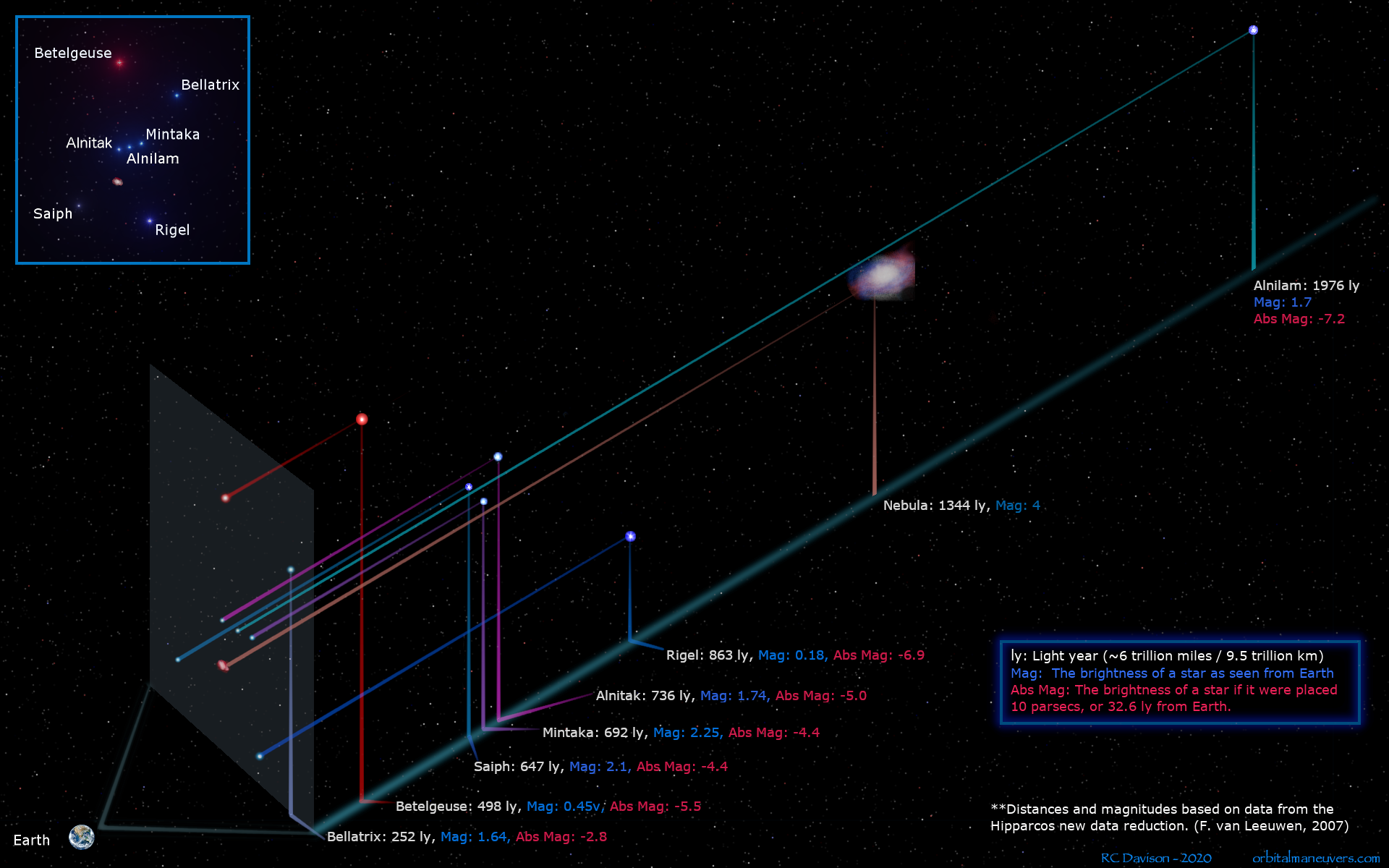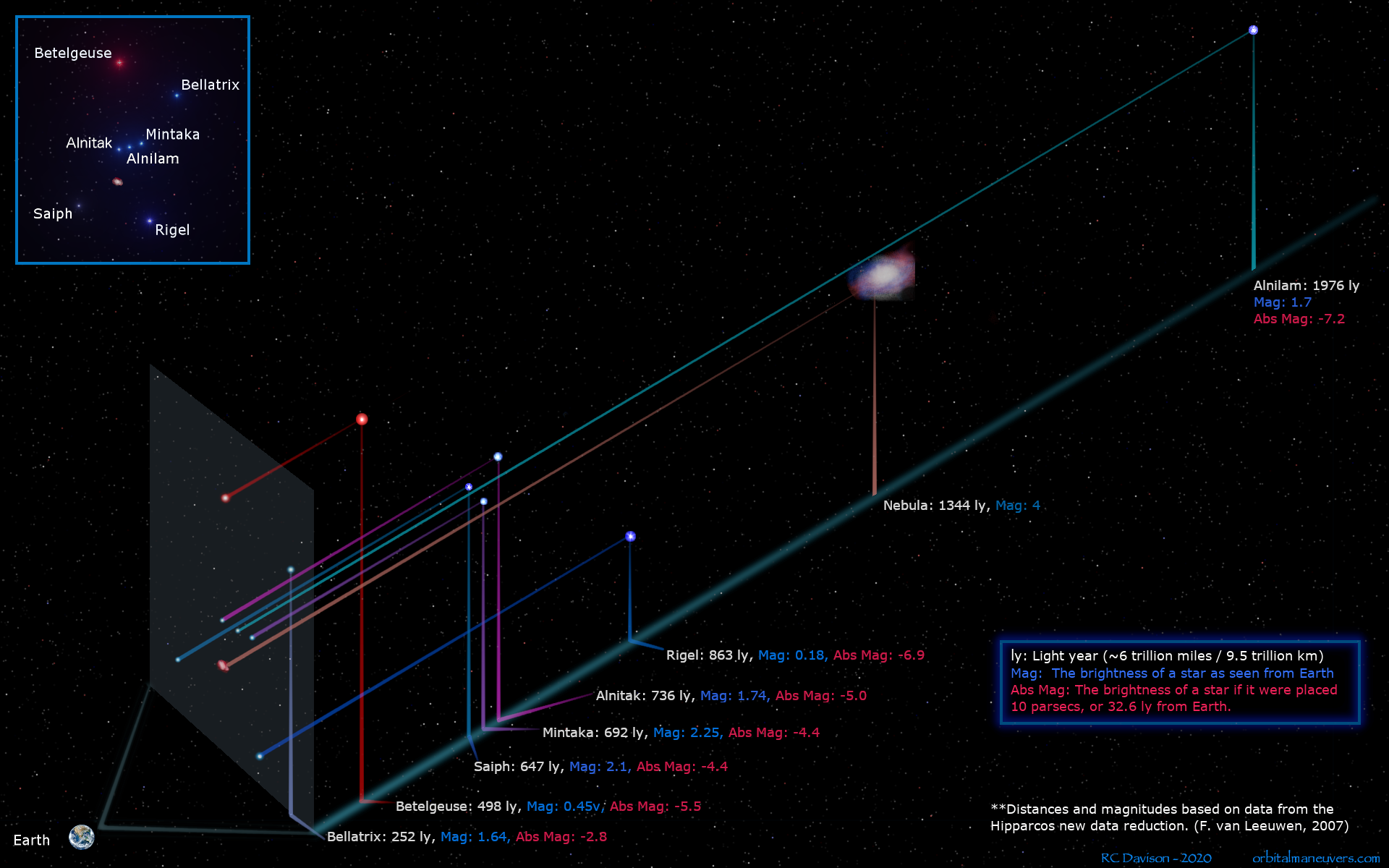
Orion is a familiar constellation. The apparent positions of its stars in two dimensions create a well-known pattern on the bowl of planet Earth's night sky. Orion may not look quite so familiar in this 3D view though. The illustration reconstructs the relative positions of Orion's bright stars, including data from the Hipparcus catalog of parallax distances. The most distant star shown is Alnilam. The middle one in the projected line of three that make up Orion's belt when viewed from planet Earth, Alnilam is nearly 2,000 light-years away, almost 3 times as far as fellow belt stars Alnitak and Mintaka. Though Rigel and Betelgeuse apparently shine brighter in planet Earth's sky, that makes more distant Alnilam intrinsically (in absolute magnitude) the brightest of the familiar stars in Orion. In the Hipparcus catalog, errors in measured parallaxes for Orion's stars can translate in to distance errors of a 100 light-years or so.
Crédito: NASA, Hipparcus Orion es una constelación familiar. Las posiciones aparentes de sus estrellas en dos dimensiones crean un patrón bien conocido en la bóveda de la noche terrestre. Orion podría no parecer tan familiar en esta vista en 3D, sin embargo. La ilustración reconstruye las posiciones relativas de las estrellas brillantes de Orion, incluyendo datos del catálogo Hipparcus de distancias por paralaje. La estrella más distante mostrada es Alnilam. La del medio en la línea proyectada de tres que forman la cintura de Orion cuando se ven desde la Tierra, Alnilam está a casi 2000 años luz de distancia, casi tres veces más lejos que las estrellas de la cintura Alnitak y Mintaka. Aunque Rigel y Betelgeuse parecen brillar más en el cielo terrestre, eso hace que Alnilam, más distante, sea intrínsecamente (en magnitud absoluta) la más brillante de las estrellas familiares en Orion. En el catálogo Hipparcus, los errores en las paralajes medidas para las estrellas de Orion pueden traducirse en errores de distancia de unos 100 años luz.