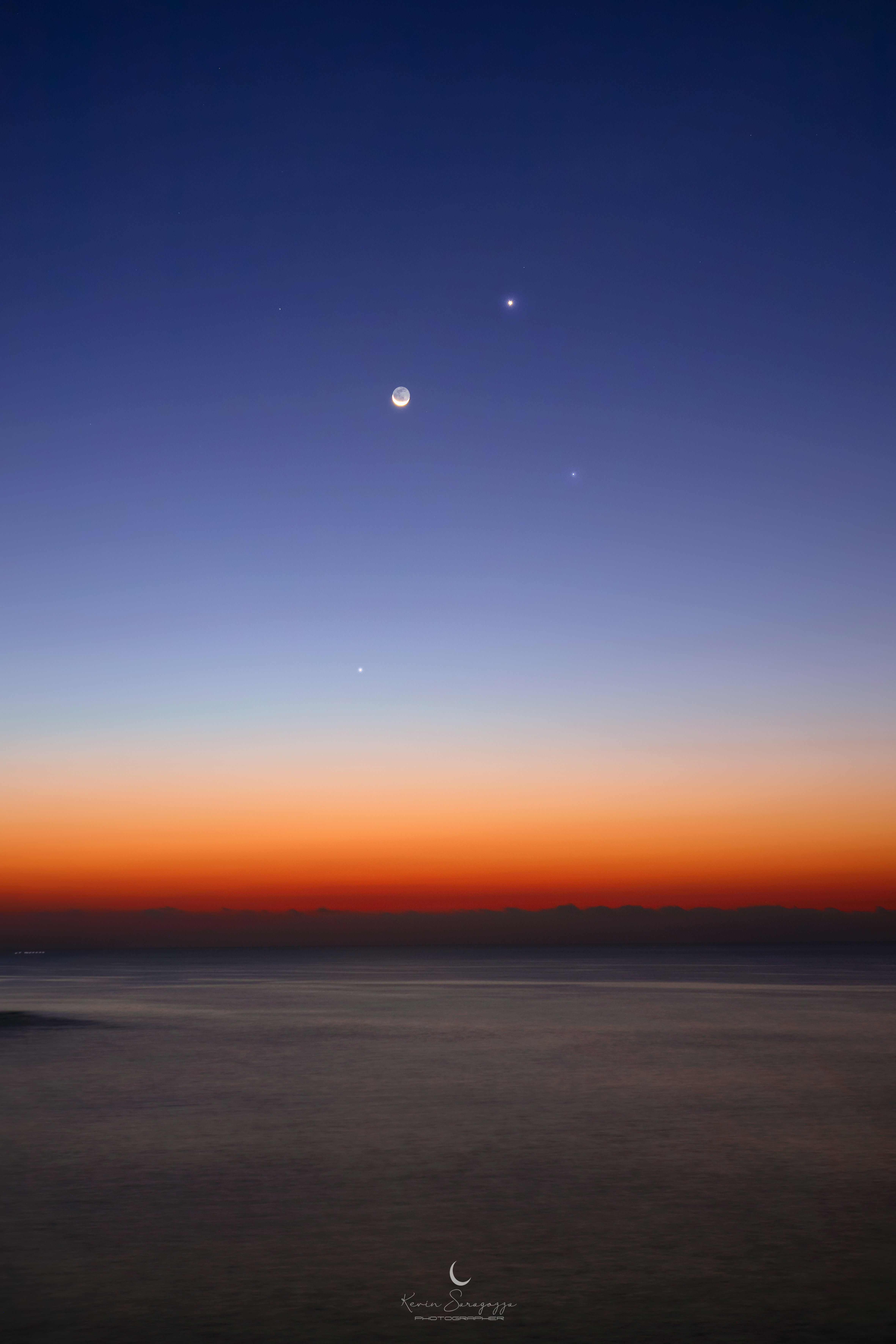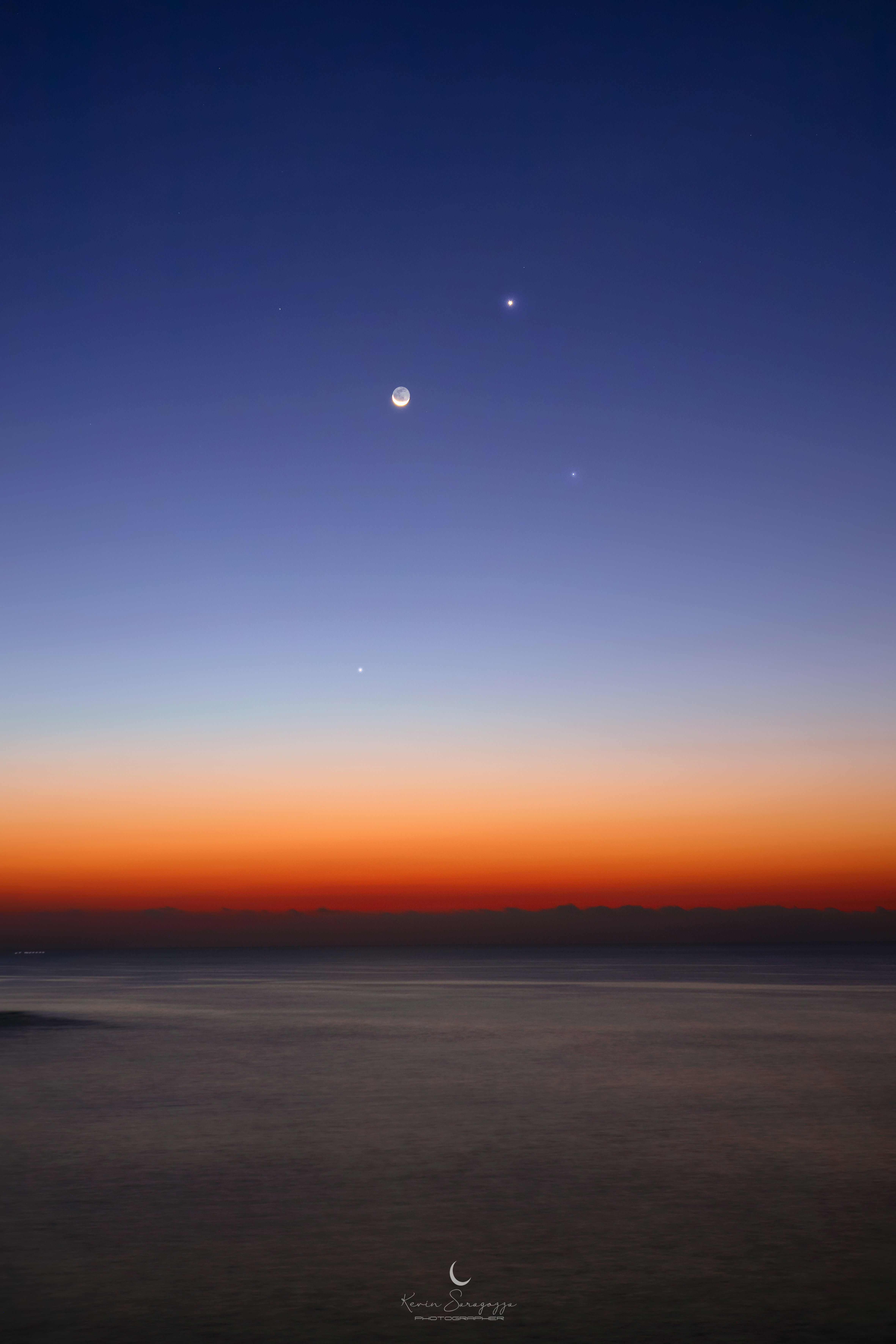
Yesterday, early morning risers around planet Earth were treated to a waning Moon low in the east as the sky grew bright before dawn. From the Island of Ortigia, Syracuse, Sicily, Italy this simple snapshot found the slender sunlit crescent just before sunrise. Never wandering far from the Sun in Earth's sky, inner planets Venus and Mercury shared the calm seaside view. Also in the frame, right of the line-up of Luna and planets, is bright star Spica, alpha star of the constellation Virgo and one of the 20 brightest stars in Earth's night. Tomorrow the Moon will be New. The dark lunar disk means mostly dark nights for planet Earth in the coming week and a good chance to watch the annual Leonid Meteor Shower.
Ayer, los observadores tempraneros en la Tierra fueron recompensados con una Luna menguante baja en el este a medida que el cielo se aclaraba antes del amanecer. Desde la Isla de Ortigia, en Siracusa, Sicilia, Italia, este sencillo disparo captó el delgado creciente iluminado por el sol justo antes del amanecer. Nunca se alejan mucho del Sol en el cielo terrestre, los planetas interiores Venus y Mercurio compartieron esta tranquila vista marítima. También en el marco, a la derecha de la alineación de la Luna y los planetas, se encuentra la brillante estrella Spica, estrella alfa de la constelación de Virgo y una de las 20 estrellas más brillantes en la noche terrestre. Mañana la Luna será Nueva. El disco lunar oscuro significa noches principalmente oscuras para la Tierra en la próxima semana y una buena oportunidad para observar la lluvia anual de meteoros de las Leónidas.