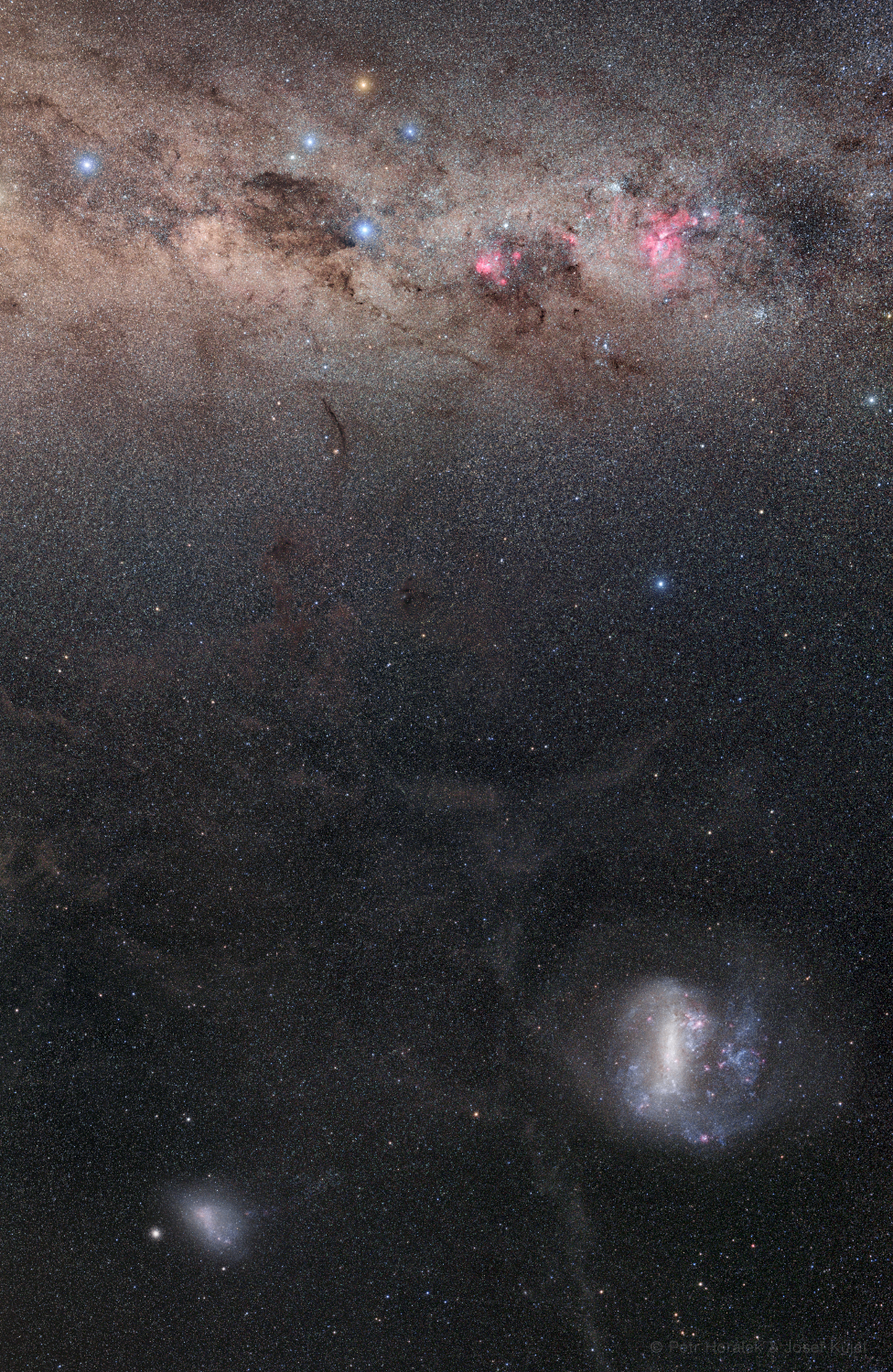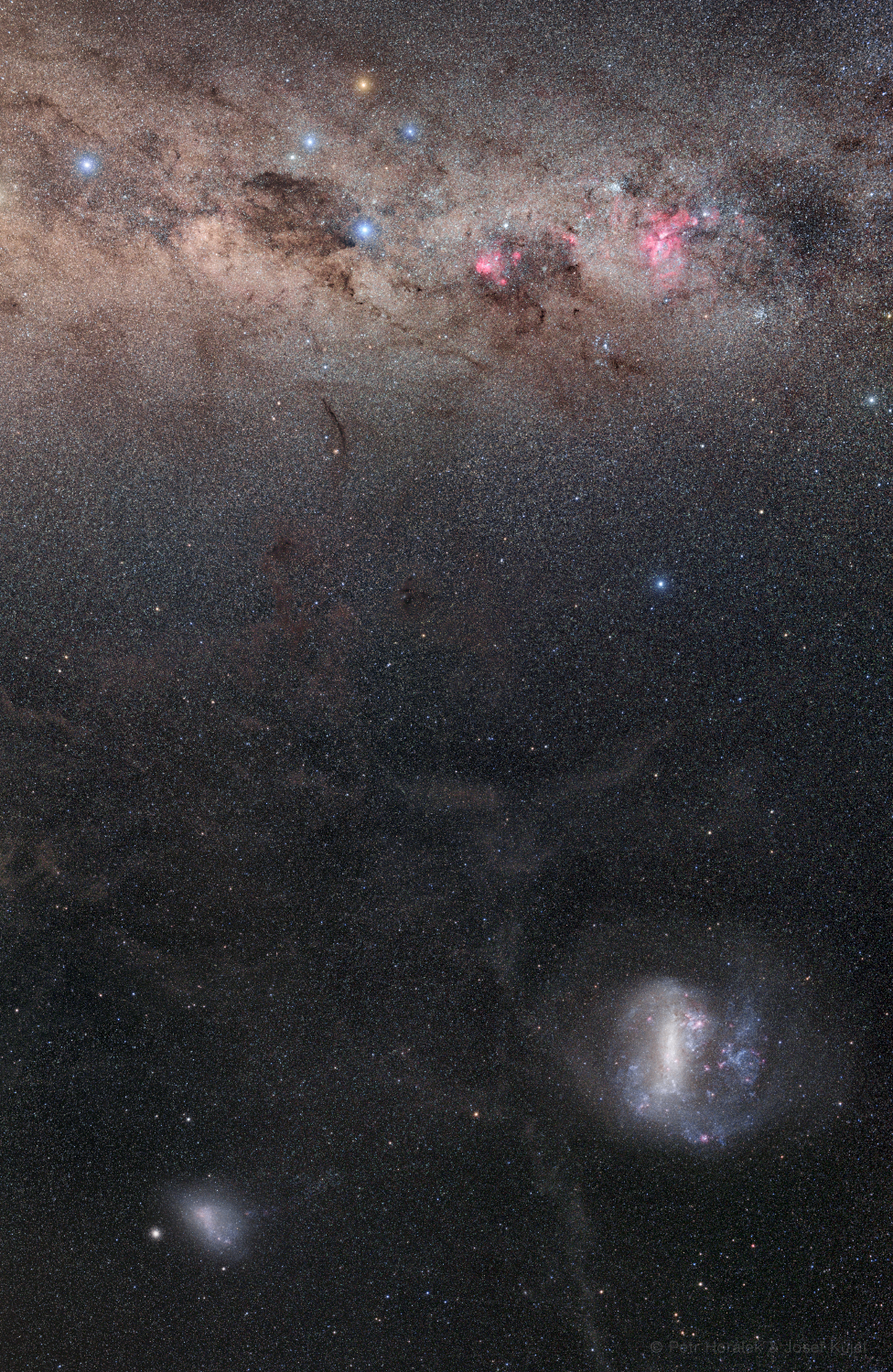
The South Celestial Pole is easy to spot in star trail images of the southern sky. The extension of Earth's axis of rotation to the south, it's at the center of all the southern star trail arcs. In this starry panorama streching about 60 degrees across deep southern skies the South Celestial Pole is somewhere near the middle though, flanked by bright galaxies and southern celestial gems. Across the top of the frame are the stars and nebulae along the plane of our own Milky Way Galaxy. Gamma Crucis, a yellowish giant star heads the Southern Cross near top center, with the dark expanse of the Coalsack nebula tucked under the cross arm on the left. Eta Carinae and the reddish glow of the Great Carina Nebula shine along the galactic plane near the right edge. At the bottom are the Large and Small Magellanic clouds, external galaxies in their own right and satellites of the mighty Milky Way. A line from Gamma Crucis through the blue star at the bottom of the southern cross, Alpha Crucis, points toward the South Celestial Pole, but where exactly is it? Just look for south pole star Sigma Octantis. Analog to Polaris the north pole star, Sigma Octantis is little over one degree fom the the South Celestial pole.
El Polo Celeste Sur es fácil de identificar en imágenes de rastros estelares del cielo sur. Extensión del eje de rotación de la Tierra hacia el sur, se encuentra en el centro de todos los arcos de rastros estelares del hemisferio sur. En esta panorámica estrellada que abarca unos 60 grados del profundo cielo sur, el Polo Celeste Sur se encuentra cerca del centro, flanqueado por galaxias brillantes y joyas celestes del hemisferio sur. A lo largo de la parte superior del marco se encuentran las estrellas y nebulosas a lo largo del plano de nuestra propia galaxia, la Vía Láctea. Gamma Crucis, una estrella gigante de color amarillento, encabeza la Cruz del Sur cerca del centro superior, con la extensa oscuridad de la nebulosa Coalsack escondida bajo el brazo de la cruz a la izquierda. Eta Carinae y el resplandor rojizo de la Gran Nebulosa de Carina brillan a lo largo del plano galáctico cerca del borde derecho. En la parte inferior se encuentran las Nubes de Magallanes, grandes y pequeñas, galaxias externas en sí mismas y satélites de la poderosa Vía Láctea. Una línea desde Gamma Crucis hasta la estrella azul en la parte inferior de la Cruz del Sur, Alpha Crucis, apunta hacia el Polo Celeste Sur, pero ¿dónde exactamente se encuentra? Simplemente busque la estrella polar Sigma Octantis. Análoga a Polaris, la estrella polar del norte, Sigma Octantis se encuentra a poco más de un grado del Polo Celeste Sur.