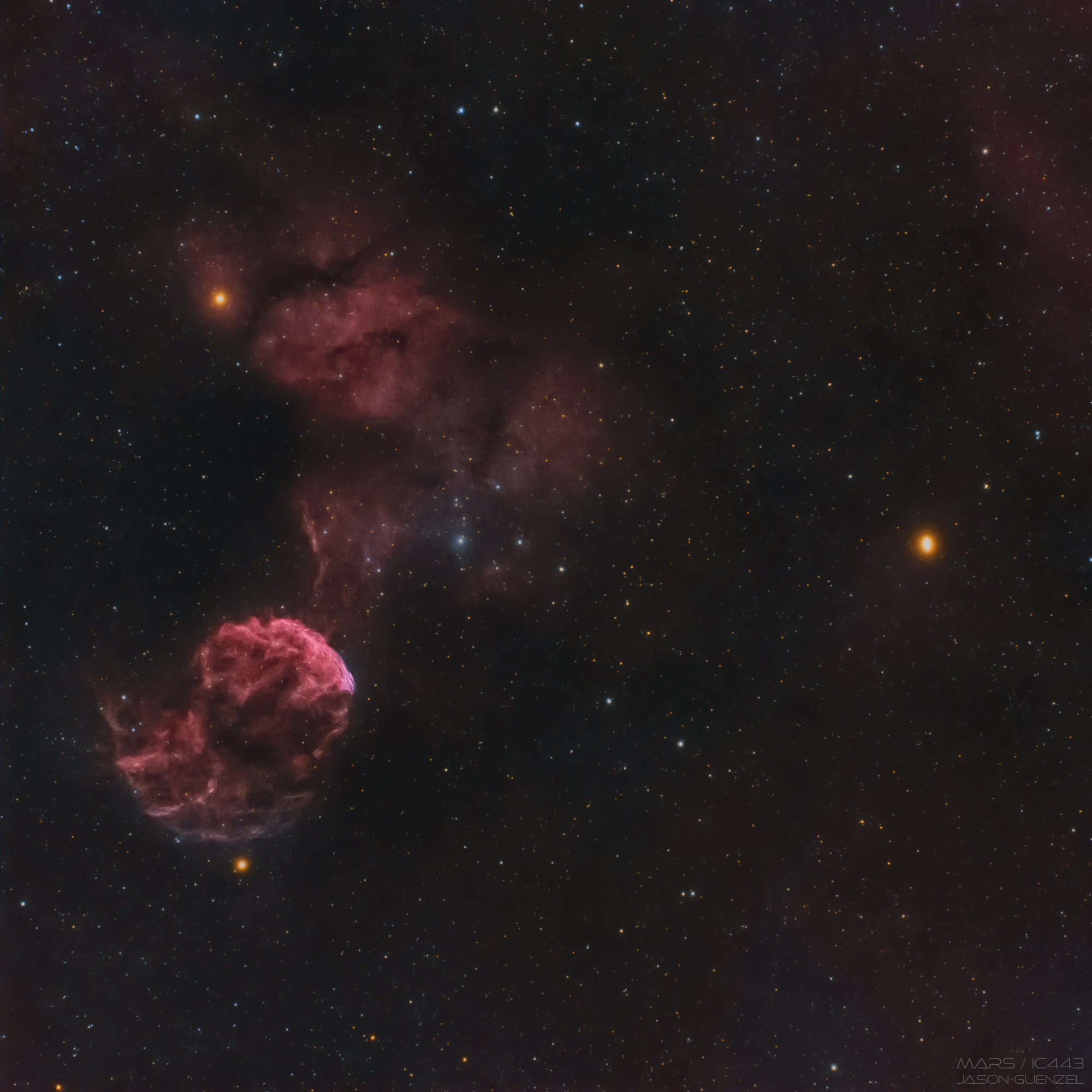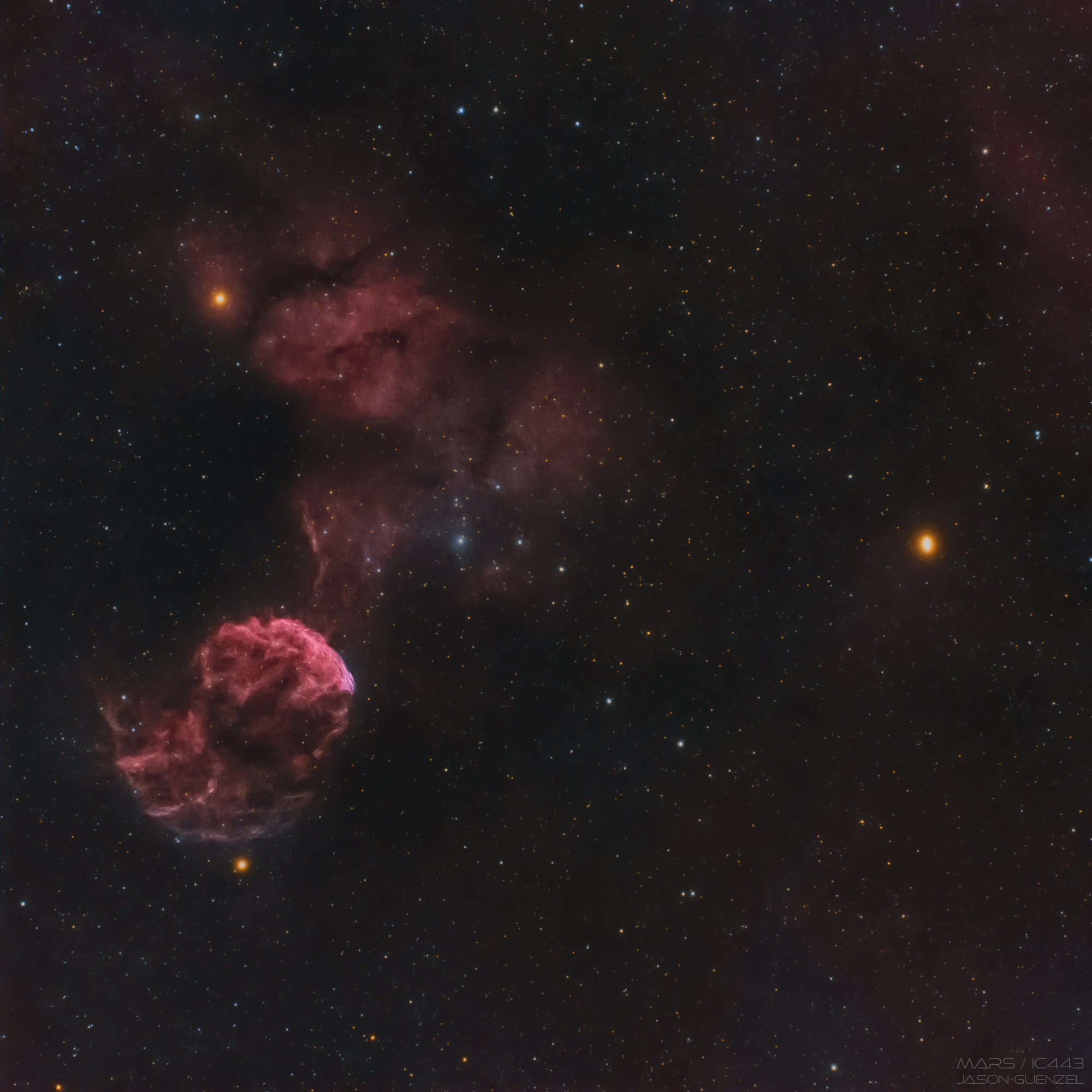
Normally faint and elusive, the Jellyfish Nebula is caught in this alluring scene. In the telescopic field of view two bright yellowish stars, Mu and Eta Geminorum, stand just below and above the Jellyfish Nebula at the left. Cool red giants, they lie at the foot of the celestial twin. The Jellyfish Nebula itself floats below and left of center, a bright arcing ridge of emission with dangling tentacles. In fact, the cosmic jellyfish is part of bubble-shaped supernova remnant IC 443, the expanding debris cloud from a massive star that exploded. Light from that explosion first reached planet Earth over 30,000 years ago. Like its cousin in astrophysical waters the Crab Nebula supernova remnant, the Jellyfish Nebula is known to harbor a neutron star, the remnant of the collapsed stellar core. Composed on April 30, this telescopic snapshot also captures Mars. Now wandering through early evening skies, the Red Planet also shines with a yellowish glow on the right hand side of the field of view. Of course, the Jellyfish Nebula is about 5,000 light-years away, while Mars is currently almost 18 light-minutes from Earth.
Normalmente tenue y difícil de observar, la Nebulosa Medusa aparece en esta sugerente escena. En el campo de visión telescópico, dos estrellas brillantes de color amarillento, Mu y Eta Geminorum, se sitúan justo debajo y encima de la Nebulosa Medusa a la izquierda. Son gigantes rojas frías y se encuentran en la base del gemelo celestial. La Nebulosa Medusa misma flota debajo y a la izquierda del centro, una brillante cresta arqueada de emisión con tentáculos colgantes. De hecho, la medusa cósmica forma parte del remanente de supernova de forma de burbuja IC 443, la nube de escombros en expansión de una estrella masiva que explotó. La luz de esa explosión llegó por primera vez a la Tierra hace más de 30 000 años. Al igual que su pariente en las aguas astrofísicas, el remanente de supernova Nebulosa del Cangrejo, la Nebulosa Medusa es conocida por albergar una estrella de neutrones, el remanente del núcleo estelar colapsado. Esta imagen telescópica, compuesta el 30 de abril, también captura a Marte. Ahora errante por los cielos de la tarde temprana, el Planeta Rojo también brilla con un resplandor amarillento en el lado derecho del campo de visión. Por supuesto, la Nebulosa Medusa se encuentra a unos 5 000 años luz de distancia, mientras que Marte actualmente se encuentra a casi 18 minutos luz de la Tierra.