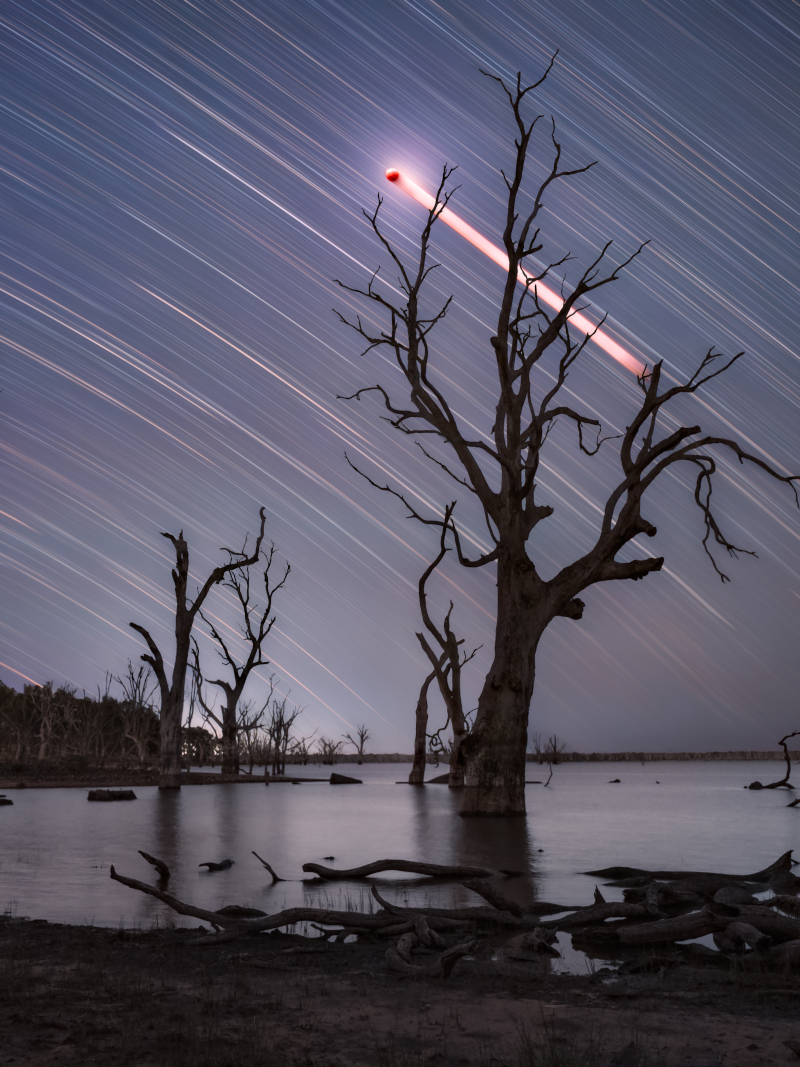
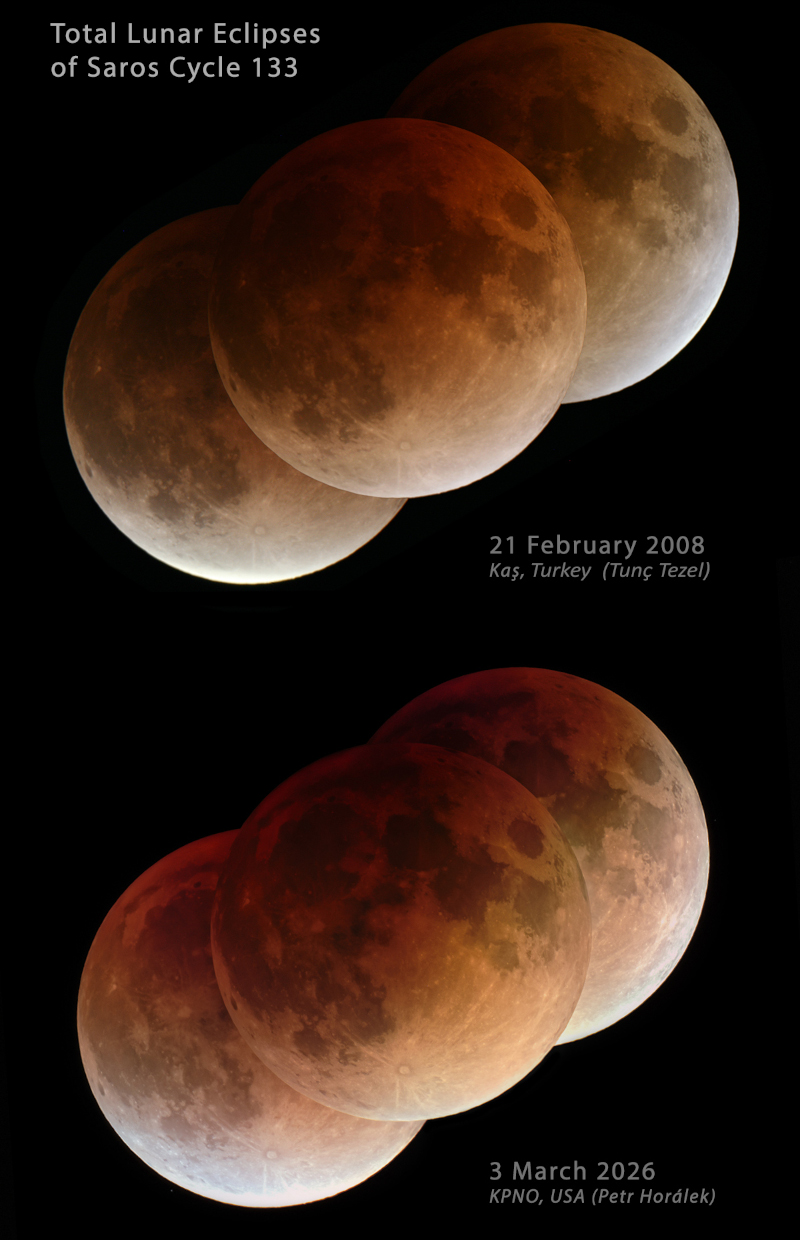
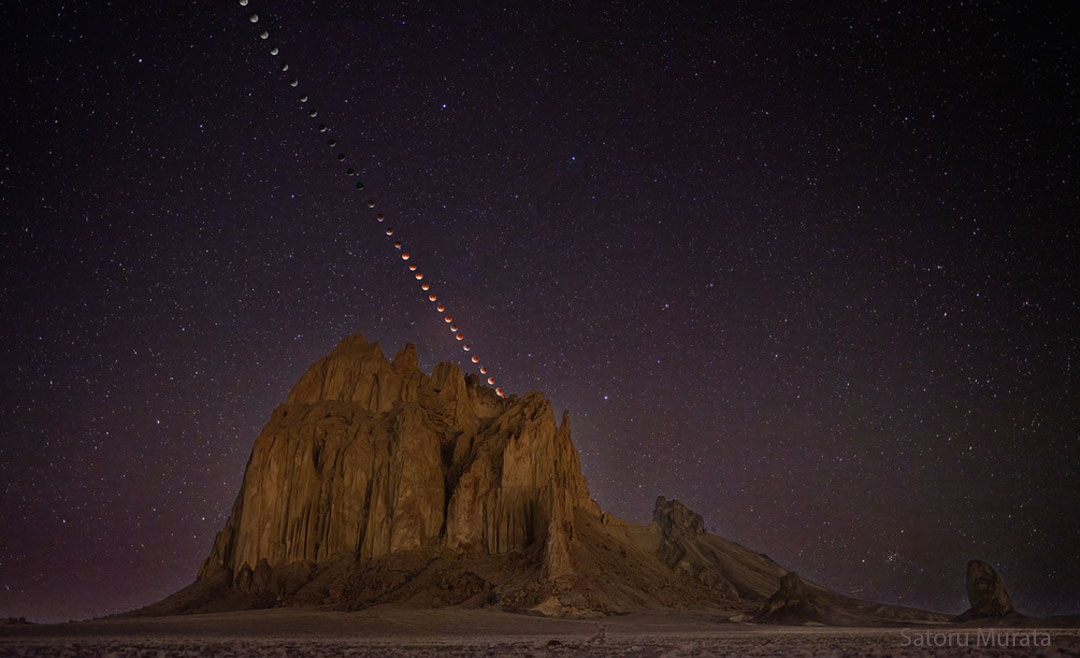
How does the Moon's appearance change during a total lunar eclipse? The featured time-lapse video was digitally processed to keep the Moon bright and centered during the 5-hour eclipse of 2018 January 31. At first the full moon is visible because only a full moon can undergo a lunar eclipse. Stars move by in the background because the Moon orbits the Earth during the eclipse. The circular shadow of the Earth is then seen moving across the Moon. The light blue hue of the shadow's edge is related to why Earth's sky is blue, while the deep red hue of the shadow's center is related to why the Sun appears red when near the horizon. Tomorrow, people living from southeast Asia, across the Pacific, to the southwest Americas may get to see a Blood Supermoon Total Lunar Eclipse. Here the term blood refers to the (likely) red color of the fully eclipsed Moon, while the term supermoon indicates the Moon's slightly high angular size -- due to being relatively close to the Earth in its slightly elliptical orbit. Details: Total Lunar Eclipse on 2021 May 26
¿Cómo cambia la apariencia de la Luna durante un eclipse lunar total? El video de avance acelerado mostrado aquí fue procesado digitalmente para mantener la Luna brillante y centrada durante el eclipse de 5 horas del 31 de enero de 2018. Al principio se ve la Luna llena, ya que solo una Luna llena puede sufrir un eclipse lunar. Las estrellas se mueven en el fondo porque la Luna orbita la Tierra durante el eclipse. Luego se ve la sombra circular de la Tierra desplazándose sobre la Luna. El tono azul claro en el borde de la sombra está relacionado con la razón por la cual el cielo terrestre es azul, mientras que el tono rojizo profundo en el centro de la sombra está relacionado con la razón por la cual el Sol aparece rojo cuando está cerca del horizonte. Mañana, las personas que viven desde el sudeste de Asia, a través del Pacífico, hasta las Américas del sudoeste podrían presenciar un eclipse lunar total de Superluna de Sangre. Aquí, el término sangre se refiere al (probable) color rojo de la Luna completamente eclipsada, mientras que el término superluna indica el tamaño angular ligeramente mayor de la Luna, debido a que está relativamente cerca de la Tierra en su órbita ligeramente elíptica. Detalles: Eclipse lunar total del 26 de mayo de 2021.