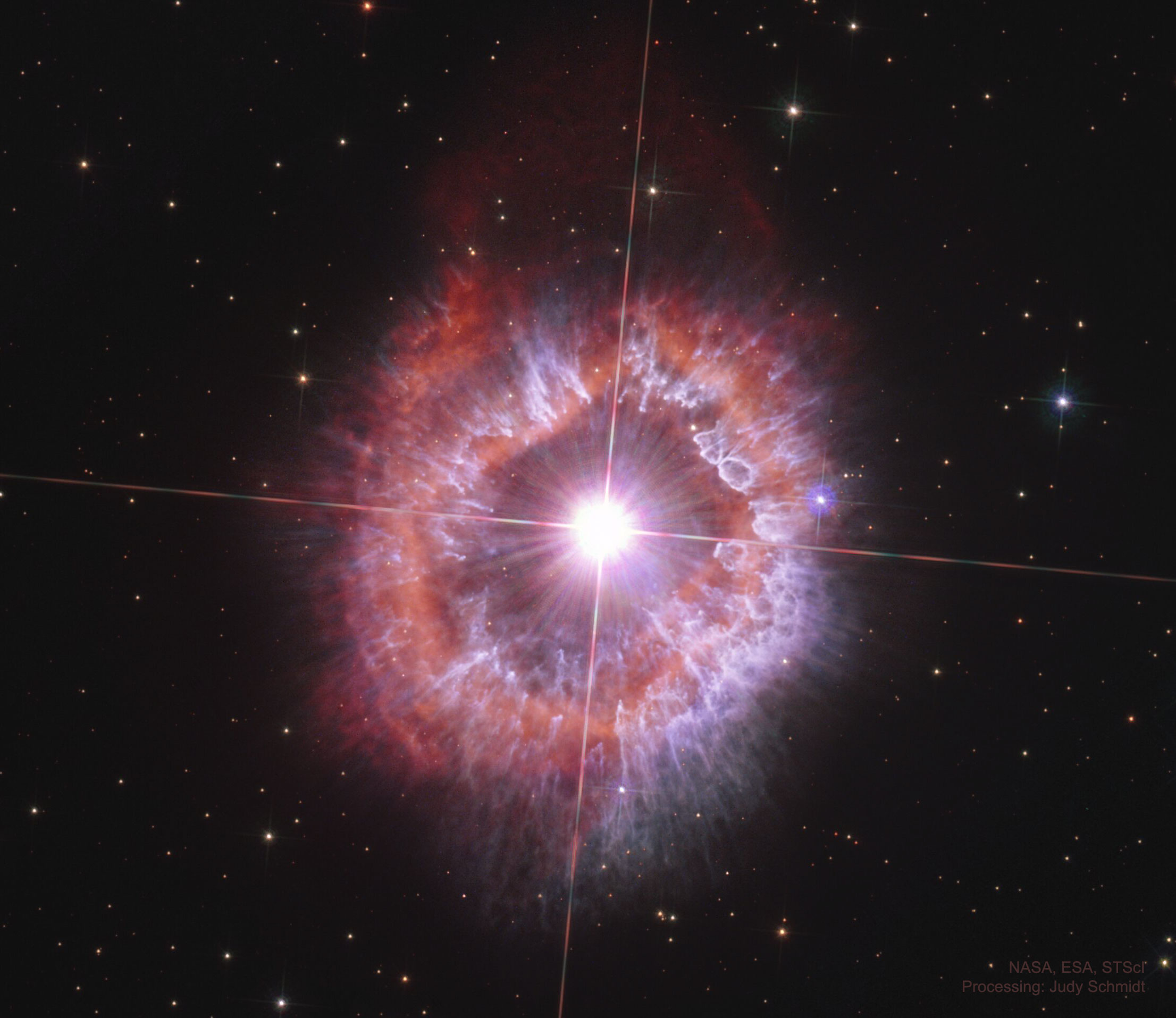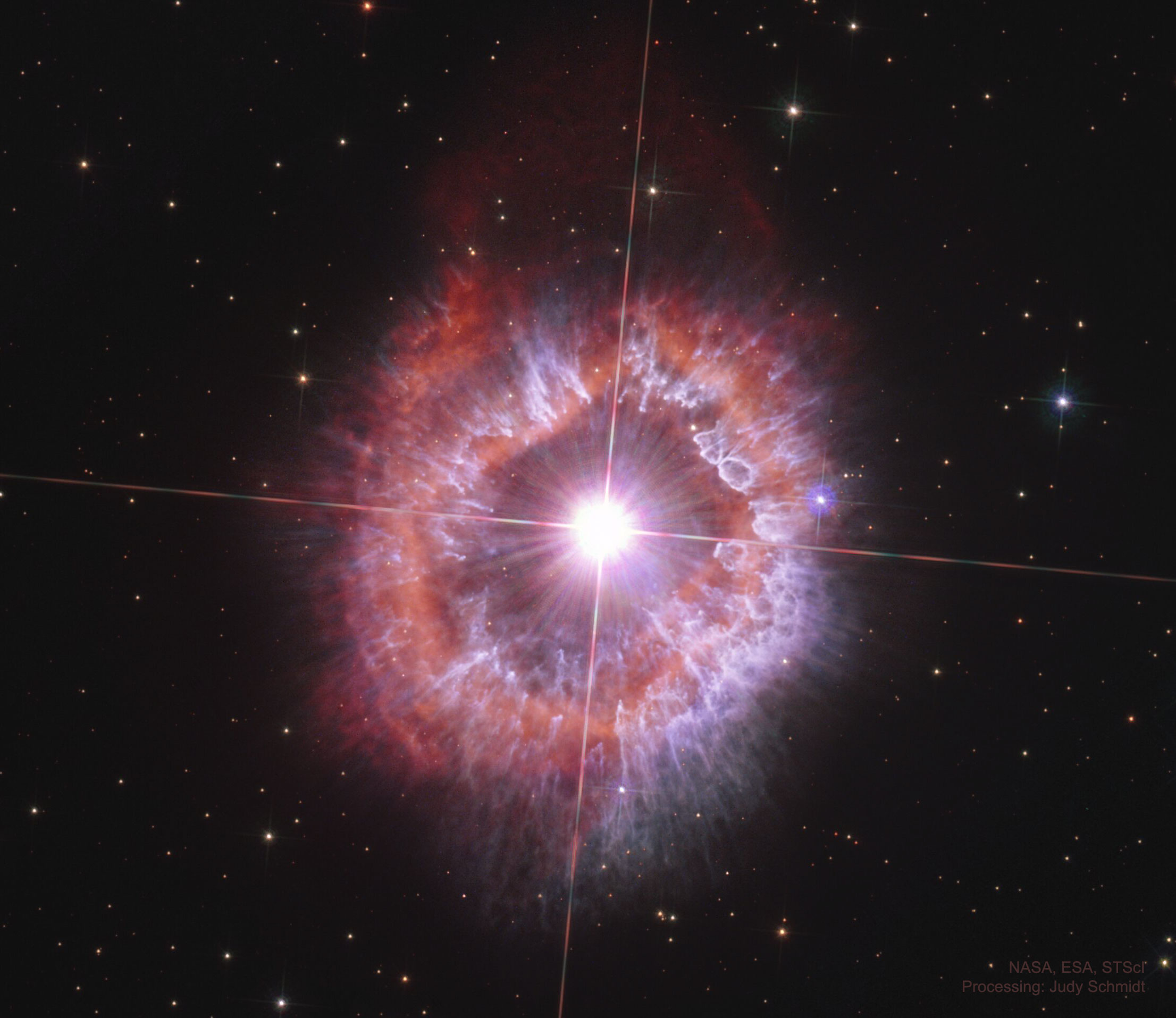
What created these unusual clouds? At the center of this 2021 Hubble image, processed by Judy Schmidt, sits AG Carinae, a supergiant star located about 20,000 light-years away in the southern constellation Carina. The star's emitted power is over a million times that of the Sun, making AG Carinae one of the most luminous stars in our Milky Way galaxy. AG Carinae and its neighbor Eta Carinae belong to the scarce Luminous Blue Variable (LBV) class of stars, known for their rare but violent eruptions. The nebula that surrounds AG Car is interpreted as a remnant of one or more such outbursts. This nebula measures 5 light-years across, is estimated to contain about 10 solar masses of gas, and to be at least 10,000 years old. This Hubble image, taken to commemorate Hubble's 31st launch anniversary, is the first to capture the whole nebula, offering a new perspective on its structure and dust content. The LBVs represent a late and short stage in the lives of some supergiant stars, but explaining their restlessness remains a challenge to humanity's understanding of how massive stars work.
¿Qué creó estas nubes inusuales? En el centro de esta imagen de 2021 procesada por Judy Schmidt, tomada por el telescopio Hubble, se encuentra AG Carinae, una estrella supergigante ubicada a unos 20 000 años luz de distancia en la constelación austral Carina. La potencia emitida por la estrella es más de un millón de veces la del Sol, lo que convierte a AG Carinae en una de las estrellas más luminosas de nuestra galaxia, la Vía Láctea. AG Carinae y su vecina Eta Carinae pertenecen a la escasa clase de estrellas variables azules luminosas (LBV, por sus siglas en inglés), conocidas por sus erupciones raras pero violentas. La nebulosa que rodea a AG Car se interpreta como un resto de una o más de estas erupciones. Esta nebulosa tiene un diámetro de 5 años luz, se estima que contenga alrededor de 10 masas solares de gas y que tenga al menos 10 000 años de antigüedad. Esta imagen de Hubble, tomada para conmemorar el 31º aniversario del lanzamiento del telescopio, es la primera que captura la totalidad de la nebulosa, ofreciendo una nueva perspectiva sobre su estructura y contenido de polvo. Las LBVs representan una etapa tardía y breve en la vida de algunas estrellas supergigantes, pero explicar su inestabilidad sigue siendo un desafío para la comprensión humana de cómo funcionan las estrellas masivas.