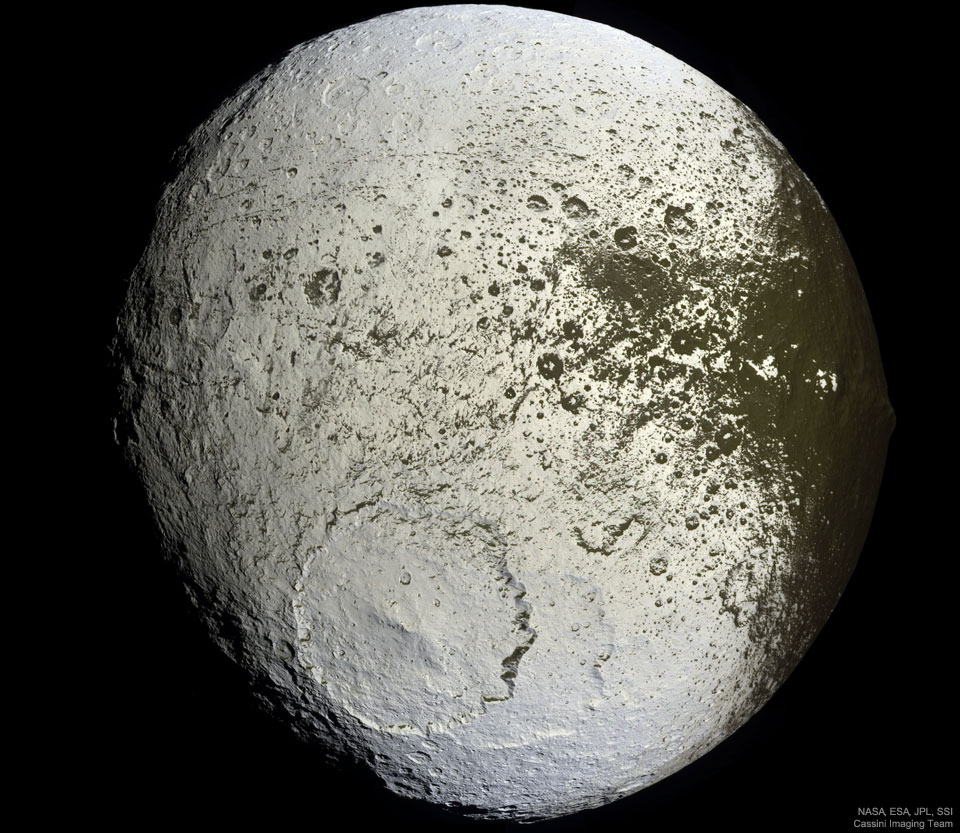
What has happened to Saturn's moon Iapetus? Vast sections of this strange world are dark brown, while others are as bright white. The composition of the dark material is unknown, but infrared spectra indicate that it possibly contains some dark form of carbon. Iapetus also has an unusual equatorial ridge that makes it appear like a walnut. To help better understand this seemingly painted moon, NASA directed the robotic Cassini spacecraft orbiting Saturn to swoop within 2,000 kilometers in 2007. Iapetus is pictured here in 3D. A huge impact crater seen in the south spans a tremendous 450 kilometers and appears superposed on an older crater of similar size. The dark material is seen increasingly coating the easternmost part of Iapetus, darkening craters and highlands alike. Close inspection indicates that the dark coating typically faces the moon's equator and is less than a meter thick. A leading hypothesis is that the dark material is mostly dirt leftover when relatively warm but dirty ice sublimates. An initial coating of dark material may have been effectively painted on by the accretion of meteor-liberated debris from other moons.
¿Qué ha sucedido con la luna de Saturno Iapetus? Grandes secciones de este mundo extraño son de color marrón oscuro, mientras que otras son blancas brillantes. La composición del material oscuro es desconocida, pero los espectros en el infrarrojo indican que podría contener alguna forma oscura de carbono. Iapetus también tiene un inusual cordón ecuatorial que le da la apariencia de una nuez. Para ayudar a comprender mejor esta luna aparentemente pintada, la NASA dirigió la nave espacial robótica Cassini, que orbita Saturno, a acercarse a menos de 2000 kilómetros en 2007. Iapetus se muestra aquí en 3D. Un gran cráter de impacto visible en el sur abarca un impresionante 450 kilómetros y parece superpuesto sobre un cráter más antiguo de tamaño similar. El material oscuro se ve cada vez más cubriendo la parte más oriental de Iapetus, oscureciendo tanto los cráteres como las zonas altas. Una inspección más cercana indica que el revestimiento oscuro típicamente enfrenta hacia el ecuador de la luna y tiene menos de un metro de espesor. Una hipótesis principal es que el material oscuro es principalmente suciedad restante cuando el hielo sucio pero relativamente cálido sublima. Un recubrimiento inicial de material oscuro podría haberse pintado eficazmente por la acreción de escombros liberados por meteoritos de otras lunas.