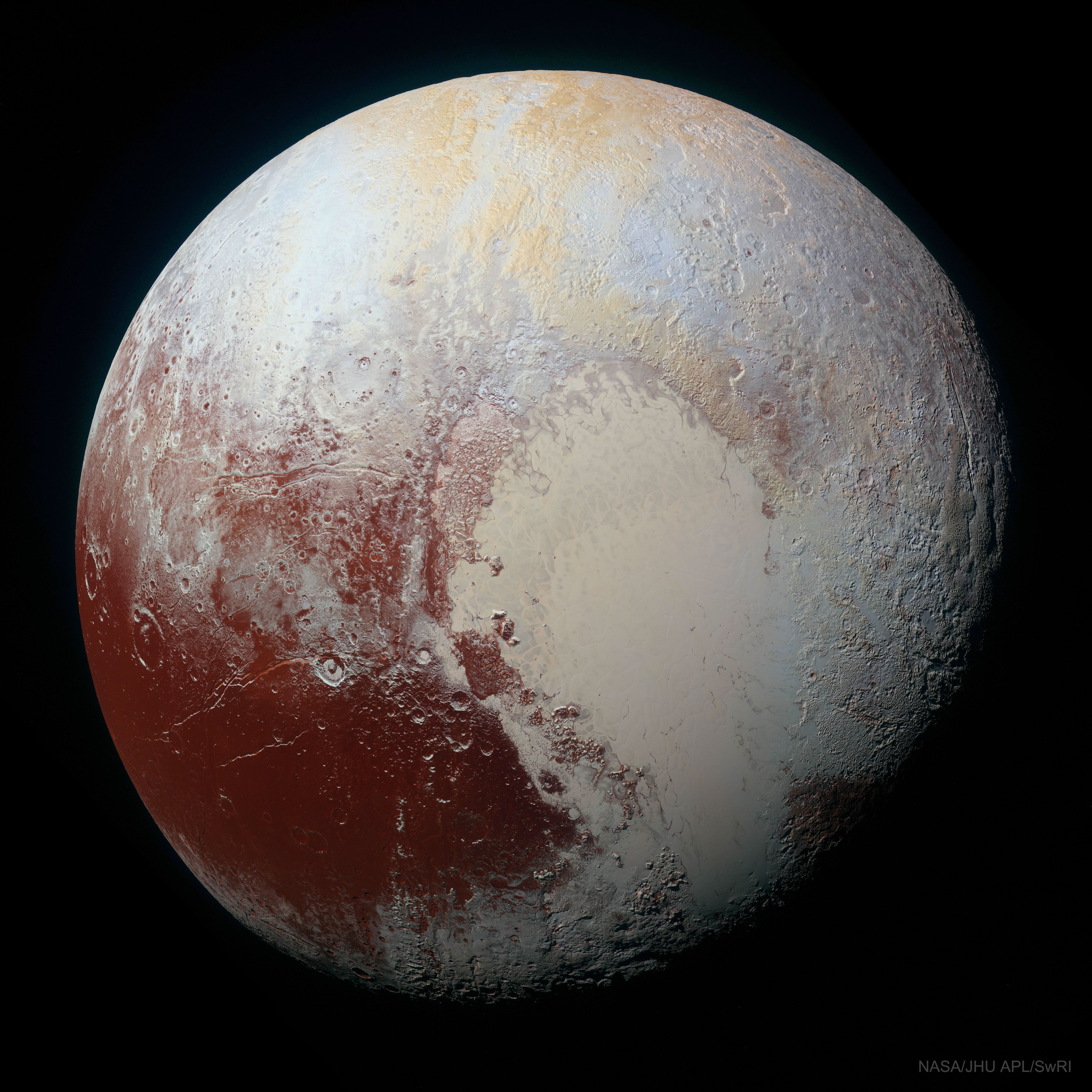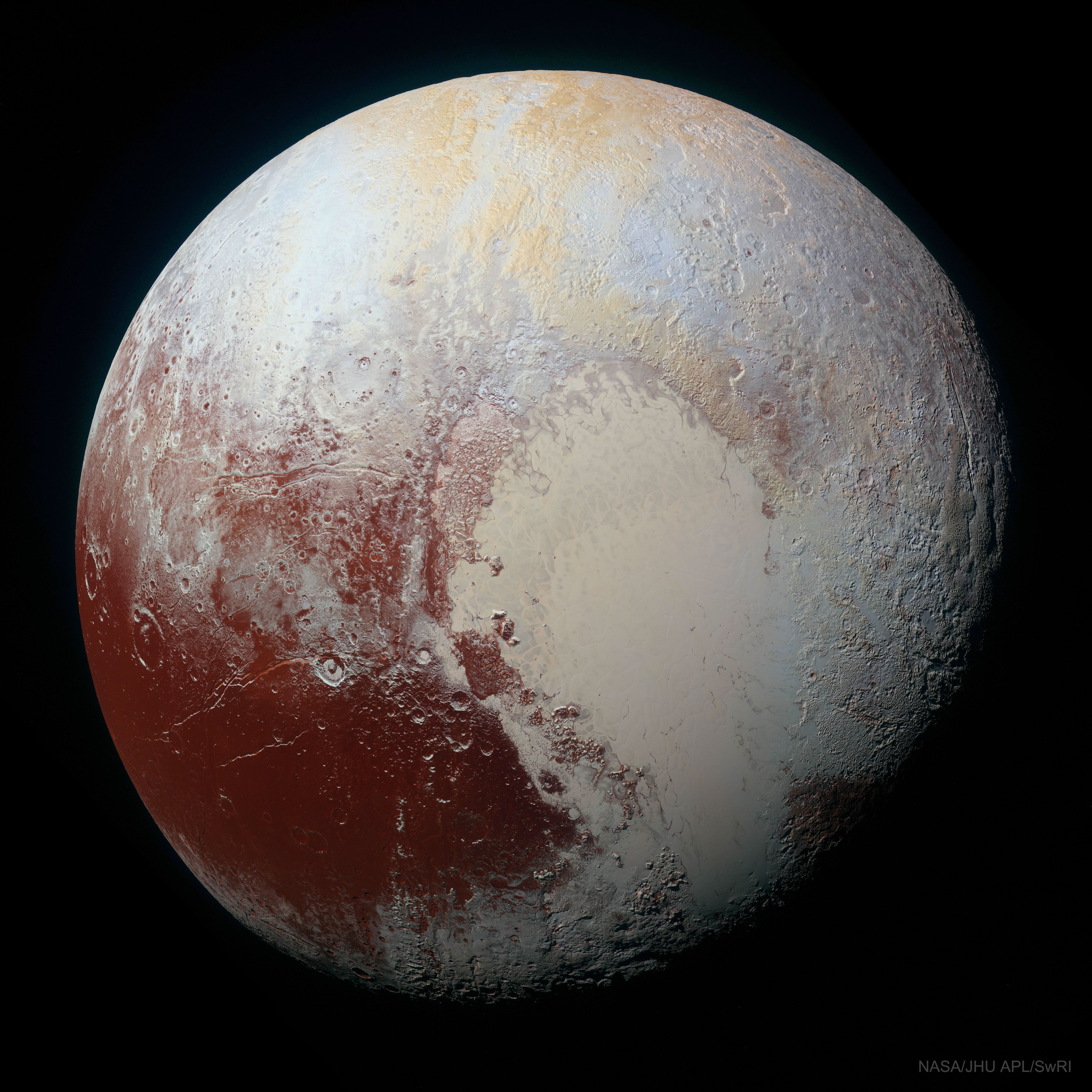
Pluto is more colorful than we can see. Color data and high-resolution images of our Solar System's most famous dwarf planet, taken by the robotic New Horizons spacecraft during its flyby in 2015 July, have been digitally combined to give an enhanced-color view of this ancient world sporting an unexpectedly young surface. The featured enhanced color image is not only esthetically pretty but scientifically useful, making surface regions of differing chemical composition visually distinct. For example, the light-colored heart-shaped Tombaugh Regio on the lower right is clearly shown here to be divisible into two regions that are geologically different, with the leftmost lobe Sputnik Planitia also appearing unusually smooth. After Pluto, New Horizons continued on, shooting past asteroid Arrokoth in 2019 and has enough speed to escape our Solar System completely. Pluto-Related Images with Brief Explanations: APOD Pluto Search
Plutón es más colorido de lo que podemos ver. Los datos de color y las imágenes de alta resolución de nuestro planeta enano más famoso del Sistema Solar, tomadas por la nave espacial robótica New Horizons durante su sobrevuelo en julio de 2015, han sido combinadas digitalmente para ofrecer una vista en color mejorado de este mundo antiguo que muestra una superficie inesperadamente joven. La imagen en color mejorado no solo es estéticamente atractiva, sino también científicamente útil, ya que hace visiblemente distintas las regiones de la superficie con composiciones químicas diferentes. Por ejemplo, la región en forma de corazón de color claro Tombaugh Regio en la parte inferior derecha se muestra claramente aquí dividida en dos regiones geológicamente diferentes, con la lóbulo izquierdo Sputnik Planitia que también aparece notablemente liso. Después de Plutón, New Horizons continuó su viaje, pasando por el asteroide Arrokoth en 2019 y tiene suficiente velocidad para escapar completamente de nuestro Sistema Solar.